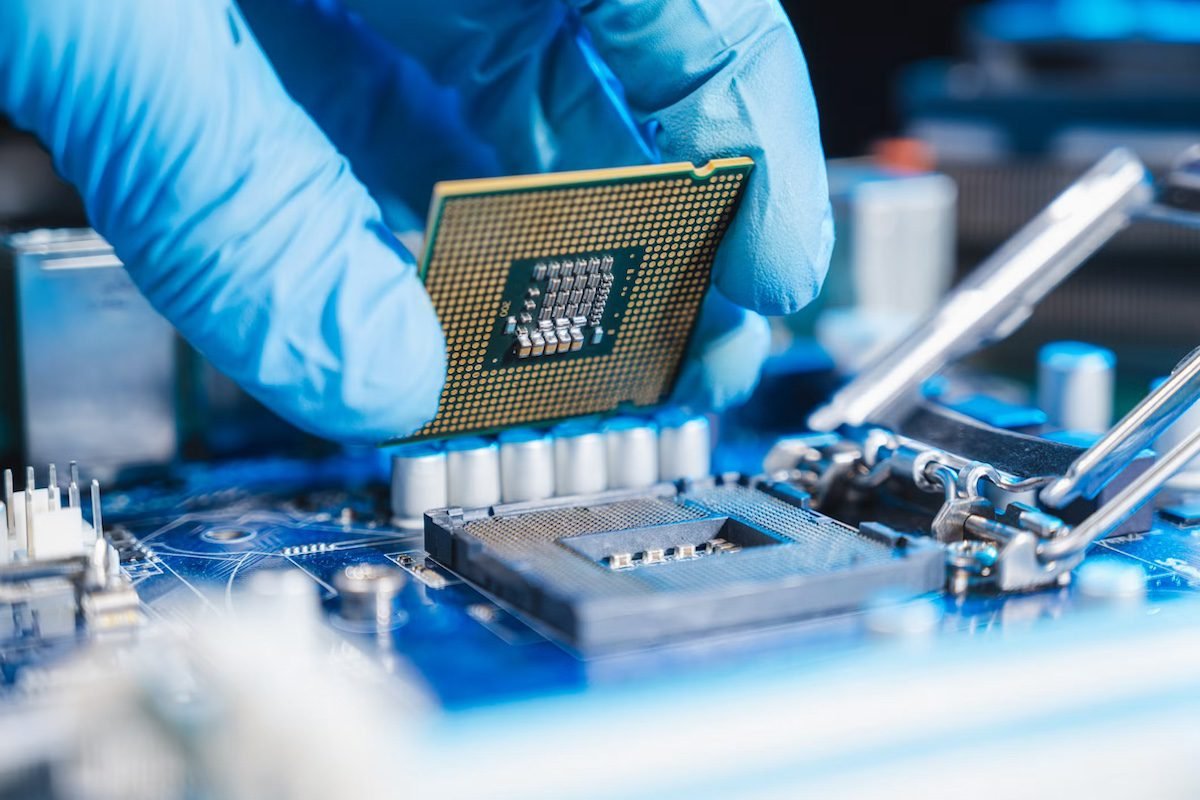
Silicon Valley built its reputation by making transistors smaller and smaller. For decades, each shrink delivered a predictable payoff: faster computers, cheaper computing power, new products and new industries.
Moore’s Law became a self-reinforcing cycle. Lower costs expanded demand, rising demand funded the next generation of innovation and the result was an economy where a US$200 laptop now surpasses the computing power of many 1990s supercomputers.
But the economic logic that powered the last 50 years is beginning to change. The race to smaller nodes continues. TSMC and Samsung are producing chips at 3nm and targeting 2nm. Intel is pushing its 18A process.
Building the factories required to stay at the leading edge has become a national priority. A modern semiconductor fab now costs more than $20 billion. The United States committed $52 billion through the CHIPS Act. The European Union launched its own €43 billion initiative, while China has invested more than $150 billion in domestic semiconductor development since 2014.
California sits at the center of this competition. Nvidia, Google, OpenAI and countless startups are buying advanced chips as fast as manufacturers can supply them. Yet a critical assumption often goes unchallenged: that ever-smaller chips will automatically translate into higher productivity and broader prosperity.
Three shifts have weakened the historical link between transistor scaling and economic gains. First, the cost curve has reversed. For years, shrinking transistors reduced the cost of computing. That relationship largely broke down after 7nm.
Advanced nodes now require extraordinary capital expenditures, and leading-edge wafers can cost dramatically more than their predecessors. The result is that only a handful of companies, including Apple, Nvidia, Microsoft, Google and Amazon, can afford to design at the most advanced nodes, concentrating the benefits among a small group of firms.
Second, engineering returns are diminishing. Moving from 180nm to 28nm produced dramatic gains in performance and energy efficiency. The jump from 5nm to 2nm is far more incremental.
Increasingly, the real breakthroughs come not from the transistor itself but from the surrounding ecosystem: chiplets, 3D stacking, advanced packaging technologies such as CoWoS, high-bandwidth memory, and software optimized for AI workloads. A well-designed system built on mature silicon can often outperform a poorly optimized design on the latest node.
Third, and most important, productivity is created through adoption, not fabrication. Most sectors of California’s economy do not depend on leading-edge chips. The trucks produced in the Central Valley, medical equipment in hospitals, cranes operating at the Port of Oakland and irrigation systems across agricultural regions typically run on mature-node semiconductors.
These industries do not need 2nm processors. They need affordable computing, practical software and workers trained to use both effectively.
California has seen this movie before. The state spent years celebrating broadband expansion while overlooking whether businesses, schools and local communities were equipped to use the new infrastructure productively. Connectivity mattered, but adoption determined the outcome.
Semiconductors present the same challenge. Building another $20 billion fab may generate headlines. Helping manufacturers in Fremont, logistics operators in Oakland and farms in Salinas deploy AI tools at scale would generate productivity.
That distinction matters because productivity growth, not technological prestige, is what ultimately raises living standards. California should focus on three priorities.
First, support domestic capacity at mature and mid-range nodes, where automotive, medical and industrial supply chains remain most vulnerable.
Second, lead in advanced packaging, where much of the performance gains from modern computing are now captured at lower cost and energy consumption.
Third, treat technology adoption as an economic policy objective by expanding tax incentives, workforce training and implementation support for small and mid-sized businesses deploying AI.
Robert Solow’s famous observation still applies. In 1987, the Nobel Prize-winning economist noted that the computer age could be seen “everywhere but in the productivity statistics.” New technologies create measurable economic gains only when firms reorganize work around them. Hardware alone does not transform an economy; adoption does.
The semiconductor race remains vital for national security and technological leadership. California should absolutely compete to host the world’s most advanced chip production.
But policymakers should ask a harder question: if the state succeeds in reaching 1.4nm, who becomes more productive as a result? If the answer is only a handful of technology companies, California will have won the chip race while losing the productivity race.
Bruno S. Sergi is an instructor at Harvard University’s Sustainability and Global Development Practice Graduate Programs. He is also affiliated with the Harvard Center for International Development, the Davis Center for Russian and Eurasian Studies and the Harvard University Asia Center. He has led the launch of multiple scholarly journals and book series, including the Cambridge Elements series at Cambridge University Press and Entrepreneurship and Global Economic Growth at Emerald Publishing.
Kevin Chen is the chief economist and CIO of Horizon Financial and partner and CIO of CoinBridge, specializing in global macroeconomics, asset allocation and digital assets (stablecoins, RWA tokenization). He is also an adjunct associate professor at NYU, and he serves on multiple Nasdaq and international corporate boards. He has held senior roles at Morgan Stanley and Amundi Asset Management. Dr. Chen holds a PhD in finance from the University of Lausanne and is a life member of the Council on Foreign Relations. He is working on a new book about the US-China AI competition.