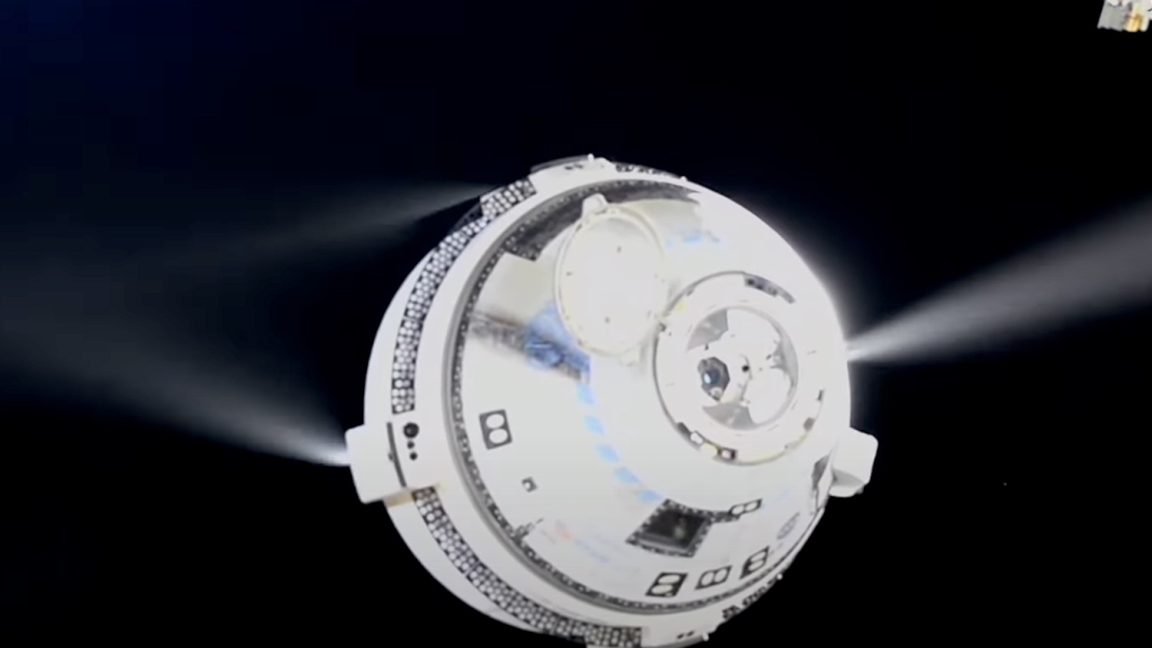
NASA announced on Monday that it will exercise options to purchase two additional flights on Boeing’s Starliner spacecraft, as well as financially support the company in its efforts to return the crewed vehicle to flight and find a new rocket after the Atlas V vehicle retires.
The space agency’s announcement confirms reporting by Ars Technica earlier this month on NASA’s plans to maintain access to low-Earth orbit after the impending retirement of SpaceX’s Crew Dragon vehicle.
“I do not think it’s a secret that SpaceX intends to sunset older platforms like Falcon and Dragon as they concentrate on their next-generation capability, Starship,” NASA Administrator Jared Isaacman said during a news conference on Monday afternoon.
Starliner struggles to get going
Dragon has successfully been flying NASA astronauts into orbit for more than six years. Boeing, by contrast, has struggled mightily to bring the Starliner vehicle into service for NASA. Starliner experienced numerous issues on uncrewed test flights in 2019 and 2022; most seriously, thruster issues nearly led to the catastrophic loss of two astronauts during the spacecraft’s first crew test flight in June 2024.
There had been some discussion that Boeing would walk away from the Starliner program, which has incurred more than $2 billion in losses for the company. The fact that NASA—which has already provided $5.1 billion as part of the “fixed price” Commercial Crew program to Boeing—felt obliged to spend additional funding underscores that this was a possibility.
During the news conference, Dana Weigel, manager of NASA’s Low Earth Orbit Program, said the space agency would pay $359 million to Boeing to help the company complete a rebuild of the reaction control system thrusters that have overheated in flight, as well as certify United Launch Alliance’s Vulcan rocket for human missions.
NASA also said it would exercise options to order two additional crewed missions on Starliner, bringing its total spaceflights on the vehicle to six.
Presently, NASA has manifested an uncrewed demonstration flight on the spacecraft, Starliner-1, which could launch in December 2026 or January 2027. It also has three crewed missions already on contract, the first of which, Starliner-2, could fly in mid-2028. NASA said Monday that veteran astronaut Woody Hoburg would command that mission.
Facing a difficult decision
With the retirement of Dragon likely by or before 2030, NASA faced a difficult decision. As it contemplates a future in low-Earth orbit, the space agency is considering extending the International Space Station’s lifetime to 2032. It is also supporting the development of private space stations, known as CLDs (commercial LEO destinations). The space agency needed some way to get its astronauts there.
Starliner, for all of its flaws to date, was evidently the best option. Some critics have suggested that NASA should fund a second crew competition that would include Boeing, Blue Origin with its under-development “space vehicle” and potentially others such as The Exploration Company.
But Isaacman seemed reluctant to make such an investment, which likely would cost billions. During the news conference, he noted that NASA’s future demand for astronaut flights to low-Earth orbit will be two seats every six to nine months. The nation has already invested heavily in Boeing’s effort, and with Starliner close to being ready, it would be foolish to throw the nation’s considerable investment away, NASA officials said.
Boeing, for its part, appears to be energized by the opportunity to claim the mantle of the nation’s provider of access to low-Earth orbit for US astronauts.
“We’re incredibly excited about the partnership with NASA,” said John Mulholland, vice president and program manager of Commercial Crew at Boeing. “To continue to fly to the International Space Station, and then obviously, with the Vulcan certification, missions beyond the current six that we have. Certainly, we have talked to all of the CLD providers about becoming their preferred transportation supplier in the future.”
Boeing will compete against … Boeing?
All of this requires Boeing to execute, of course, which it has yet to do. Another major concern for NASA and the private space station operators is the cost. Boeing, for a time at least, is likely to have a monopoly on crew transportation after Dragon exits the market.
For the Starliner-2 through Starliner-6 missions, NASA and Boeing have agreed to a price point of approximately $90 million per seat. However, this summer, as Boeing was negotiating with CLD providers, the company would not commit to seat prices in the 2030s.
“We couldn’t provide detailed pricing to the CLD suppliers as the Vulcan rocket has not been certified, and the spacecraft has not been certified, and we don’t have detailed pricing on the Vulcan,” Mulholland said. “That will come in the future, and obviously we want to be as competitive as possible.”