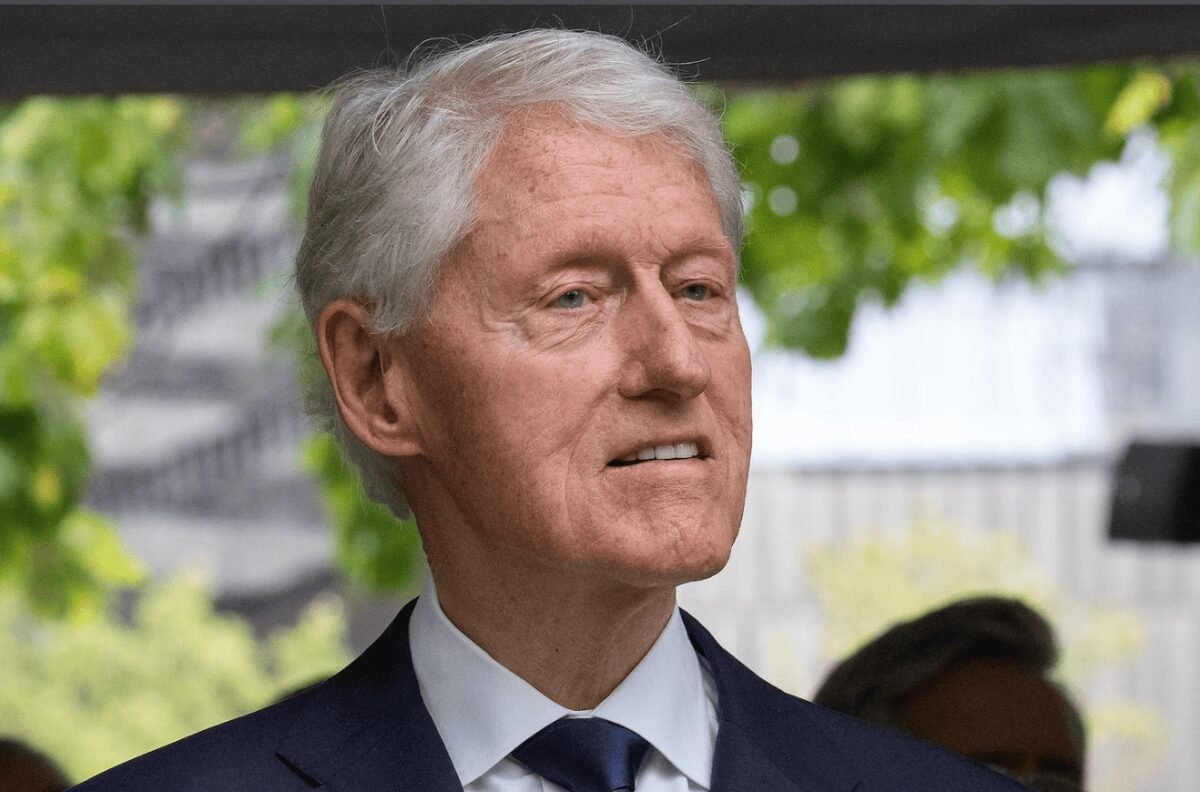
Former President Bill Clinton unloaded on the direction of the country Tuesday, taking a series of thinly veiled shots at President Donald Trump while stopping just short of mentioning him by name.
Speaking at the opening of the Clinton Global Initiative’s 2026 annual meeting in New York on Sept. 22, Clinton mocked Trump’s proposed massive triumphal arch near Arlington National Cemetery and questioned what he described as a growing “politics of brute force.”
“I suppose I could take my entire allotted time to discuss the self-evident wisdom of building an Arc de Triomphe in Washington to hold all our drones,” Clinton told the audience. “Some of this stuff — it’s hard to make up.”
The remark was clearly aimed at Trump’s controversial plan for a roughly 250-foot triumphal arch near Arlington Memorial Bridge.
Trump announced Sunday that the planned structure would also function as what he called a “top grade Military Complex,” capable of storing drones and ammunition and accommodating snipers.
That part was not simply political rhetoric from Clinton. Trump publicly described those proposed military uses himself. The project has drawn legal and preservation challenges, and the Federal Aviation Administration’s earlier review of the arch did not evaluate drone operations associated with the structure.
Clinton then broadened his criticism.
“I believe that on the 250th anniversary of this country, we can’t have a politics driven by zero-sum thinking: in order for me to win, you have to lose,” he said.
The former president went significantly further moments later, accusing unnamed people “in charge” of applying different standards to themselves, using government against opponents and benefiting themselves financially.
Those were Clinton’s political allegations, not findings established by a court.
He also invoked the Constitution’s emoluments clauses, which restrict certain benefits or payments received by federal officeholders. Clinton claimed current conduct had violated both the “spirit and letter” of those provisions, but he did not lay out a specific legal case during that portion of his speech.
The former Democratic president also turned his attention toward the ideological left.
“So here we are at the 250th anniversary of our country, where there seems to be, at the right and left, dueling visions of socialism,” Clinton said. “Should it be socialism for everybody, or should it just be for the wealthy and well-connected?”
The comment allowed Clinton to criticize political movements on both sides rather than delivering a speech focused exclusively on Trump.
His broader argument was that American politics has increasingly become a winner-take-all contest in which opposing groups view one another’s gains as their own losses.
Clinton also pointed to the recent battle over mail-in voting as one development that made him more optimistic.
On Sept. 14, the Supreme Court refused to let the Trump administration immediately enforce new U.S. Postal Service requirements for mail ballots ahead of the November midterm elections.
The regulations would have required states using the mail for federal ballots to comply with new envelope specifications, specialized barcodes and voter-information reporting requirements. Mailings that failed to meet the standards could have been returned to election officials.
A federal judge had blocked the rules before the Supreme Court declined the administration’s request to put them into effect.
The decision leaves the existing mail-voting system largely intact for the 2026 elections, although litigation over the administration’s broader election policies could continue.
Clinton also addressed another controversy surrounding Trump — the battle over the name and future of Washington’s John F. Kennedy Center for the Performing Arts.
“I personally think that the way we’ve argued about what’s going on at Kennedy Center and all that kind of stuff, I think we’ve been majoring in the minors,” Clinton said.
He questioned whether Americans a century from now would care whose name appeared on a building, arguing that what happens inside major institutions matters more.
The dispute is more than symbolic.
Trump and his allies have pushed to have his name added to the Kennedy Center, but federal courts have ruled that the center’s legal name cannot simply be changed by its board and that congressional authorization would be required.
The Trump-aligned board subsequently voted to close the main building for as long as two years for a planned $257 million renovation. The Justice Department has been fighting the court rulings surrounding the naming dispute.
Trump said last week that he wanted recognition for his role in the center and declined to definitively rule out tearing the existing structure down. A federal judge has required advance notice before any demolition or major changes take place.
The speech represented one of Clinton’s more direct public critiques of Trump’s second administration in recent months.
But rather than repeatedly using Trump’s name, the 42nd president relied on unmistakable references to controversies currently surrounding the White House — from the triumphal arch and Kennedy Center to mail voting and federal power.
And Clinton’s message ultimately went beyond one president.
His central warning was that the United States risks becoming increasingly governed by a political culture in which every issue is treated as a battle with only winners and losers.
Whether Americans agree with Clinton’s diagnosis or not, several of the controversies he highlighted are far from settled.
The triumphal arch is still facing regulatory and legal questions, litigation over federal election rules continues, and the Kennedy Center remains entangled in a court battle over its name, renovation and future.