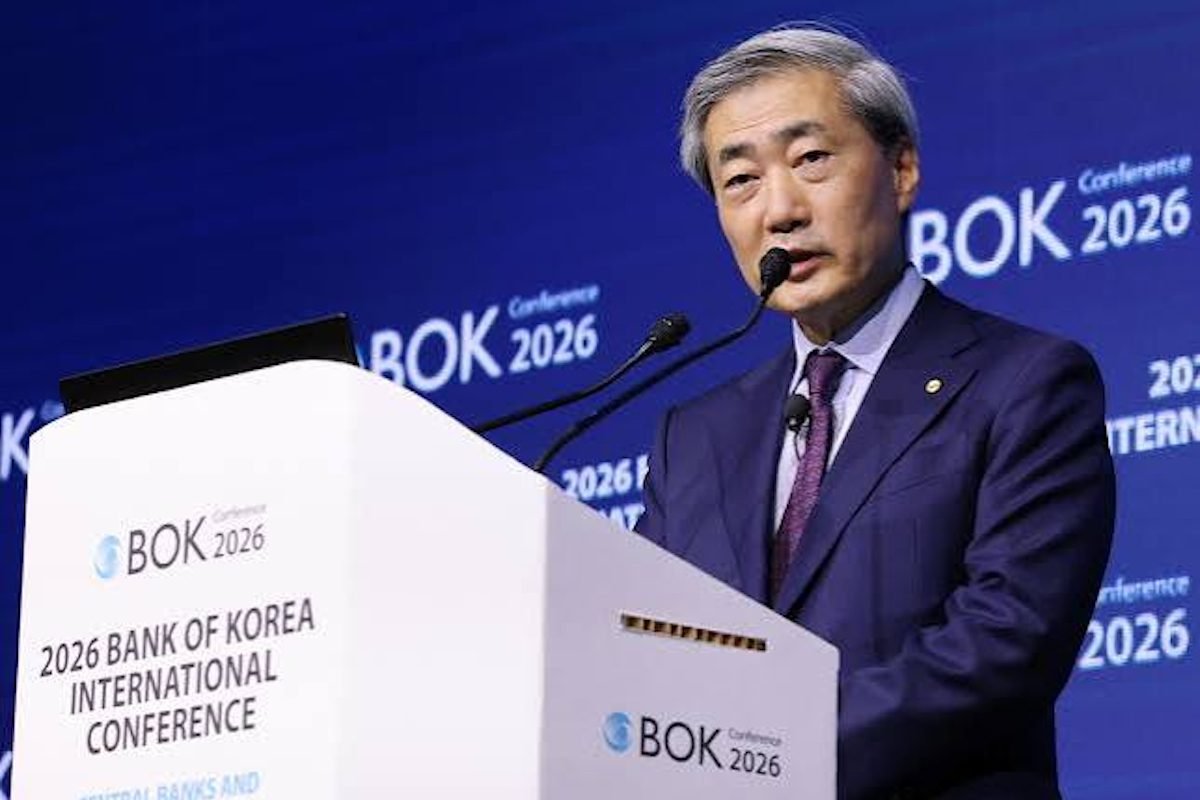
TOKYO — Bank of Korea Governor Shin Hyun-song ended a three-and-a-half-year rate freeze on Thursday, lifting the policy rate 25 basis points to 2.75% — the BOK’s first tightening move since January 2023.
The timing makes this more than a routine adjustment. Shin appears to be picking a direct fight with the Federal Reserve’s view that AI investment isn’t fueling inflation.
No economy is better placed to arbitrate that debate than Korea’s. Its open, $1.9 trillion economy has long served as an early-warning system for global inflection points, sitting squarely on the fault lines of demand shifts between the US, China and the high-tech export sectors AI now dominates.
Korea’s economy is fast becoming an AI trade proxy in the fullest sense. Chip demand for SK Hynix and Samsung Electronics drove exports up 70.9% year-on-year in June — the biggest jump since 1978 — following a 53.4% surge in May.
Those are “Asian tiger”-era numbers, not the kind a mature, developed economy is supposed to post. Especially when a US-Iran war is raging in the Middle East.
That hasn’t slowed President Lee Jae Myung’s government from doubling down. Late last month, Lee unveiled plans for Seoul to oversee Korea Inc.‘s AI buildout, including at least $880 billion in planned investment from SK Hynix and Samsung to expand chipmaking and AI capacity. “We must secure the core elements of AI faster than any other country,” Lee said.
Lee added that “semiconductors, physical AI, and AI data centers are the triple axis for a great leap forward.” He framed the push as a matter of “survival,” pointing to rural decline driven by Seoul’s industrial concentration and an aging workforce.
Whether Lee’s AI bet is prescient — or a reckless wager on unproven technology at the core of the economic model — will take years to answer. For now, it’s Shin’s job to keep today’s economic structure intact through as audacious a transition as Korea has attempted.
The BOK’s statement Thursday said Korean growth is expected to “considerably exceed” its May forecast of 2.6%, while inflation stays elevated for “a considerable time.” AI wasn’t named as the driver. It didn’t need to be — it’s the engine behind nearly every line of that forecast.
AI is turbocharging exports and pushing the Kospi to record highs — up 61% this year — but it’s also fueling the froth around it. At least six of the Kospi’s 12 all-time circuit-breaker halts have come this year alone.
Finance Minister Koo Yun-cheol is watching volatility risks closely, including in newly launched single-stock leveraged ETFs tied to chipmakers.
Lee Chan-jin, governor of the Financial Supervisory Service, has conceded that approvals for those leveraged products “had been prepared hastily” — an admission that bubble fears are reaching the regulator’s own doorstep. Korea is now halting things.
Shin’s rationale leaned on all three legs of the BOK’s mandate. “Developments across all three areas — growth, inflation, and financial stability — supporting the need for an interest rate hike, it was judged appropriate to raise rates at this meeting,” he said, adding that “unlike major countries with weak economic recoveries, demand-side inflationary pressures are expected to gradually increase as the impact of the semiconductor boom spills over into domestic demand.”
That seems the mirror opposite of new Fed Chair Kevin Warsh’s argument. Hours before the BOK’s hike, Warsh told lawmakers in Washington that the AI investment boom needn’t translate into persistent price pressure.
Supply crunches in energy, labor, chips and software are real, he acknowledged, but unlikely to leave a lasting mark on Fed policy.
“This is one of the good family fights,” Warsh said. “I don’t view a one-time change in prices as necessarily being inflationary because I think there’s a supply response. In that way, this is different from a foreign conflict and what it might do, which tends to reduce the supply side of the economy.”
Korea sees it differently, in both economics and philosophy. Thursday’s BOK statement flagged “the AI investment outlook” as the key swing factor for growth and inflation six months out.
Read one way, the hike signals confidence — a central bank comfortable tightening into an AI boom rather than fearing it. Read another way, it’s a reassurance to global investors that Korea’s financial system can absorb the punch.
That history is exactly why markets are inclined to trust it. Korea was the first economy to claw back from the 1997-98 Asian financial crisis. It navigated the Lehman shock a decade later.
Bets among hedge funds that Asia’s No. 4 economy would become the “next Iceland” never panned out. The 2013 taper tantrum barely dented it. Trump’s first-term trade war didn’t move it. Covid didn’t either — Korea was a model of low infection rates, and by August 2021, the BOK was the first major central bank in the world to tighten policy.
Since taking office in June 2025, Lee’s government has tried to prove Korea can do more than play defense — that it can go on offense and raise its competitive standing, if the AI wager pays off.
But even as Seoul stocks ride a genuine gold rush, MSCI rejected Korea’s bid for “developed market” status last month, declining even to add Seoul to its upgrade watchlist. That verdict undercuts a long-running Lee administration goal of decoupling Korea’s market status from China’s and India’s.
The rejection underscores the gap between Korea’s reform promises and the operational realities foreign funds still face — trading, hedging, settlement and asset transfer remain more cumbersome than index compilers would like. Pledges to smooth those frictions aren’t enough anymore; MSCI wants action.
The trouble for Lee is that talking down the “Korea discount” is far easier than dismantling it. Thirteen months into his term, his government has passed few reforms to loosen the grip of the chaebols — the family-run conglomerates that concentrate economic power and, critics argue, starve startups of capital and oxygen in Asia’s innovation race. In such top-down systems, disruption tends to arrive only once a challenger has already grown large enough to compete on the incumbents’ terms.
In April, Lee pressed Korea Inc. to move upmarket faster. “With free trade weakening and geopolitical risks rising, the global trade order is at a turning point,” he said. “A manufacturing-dependent country like ours must pursue bold, transformative innovation—our future depends on it.”
Even before taking office, Lee promised to double the Kospi from roughly 2,500 to 5,000 and kill the Korea discount for good. The first promise is kept — the Kospi is above 6,800. The second is still waiting, making the BOK’s job harder in the fast-developing AI era.
Follow William Pesek on X at @WilliamPesek