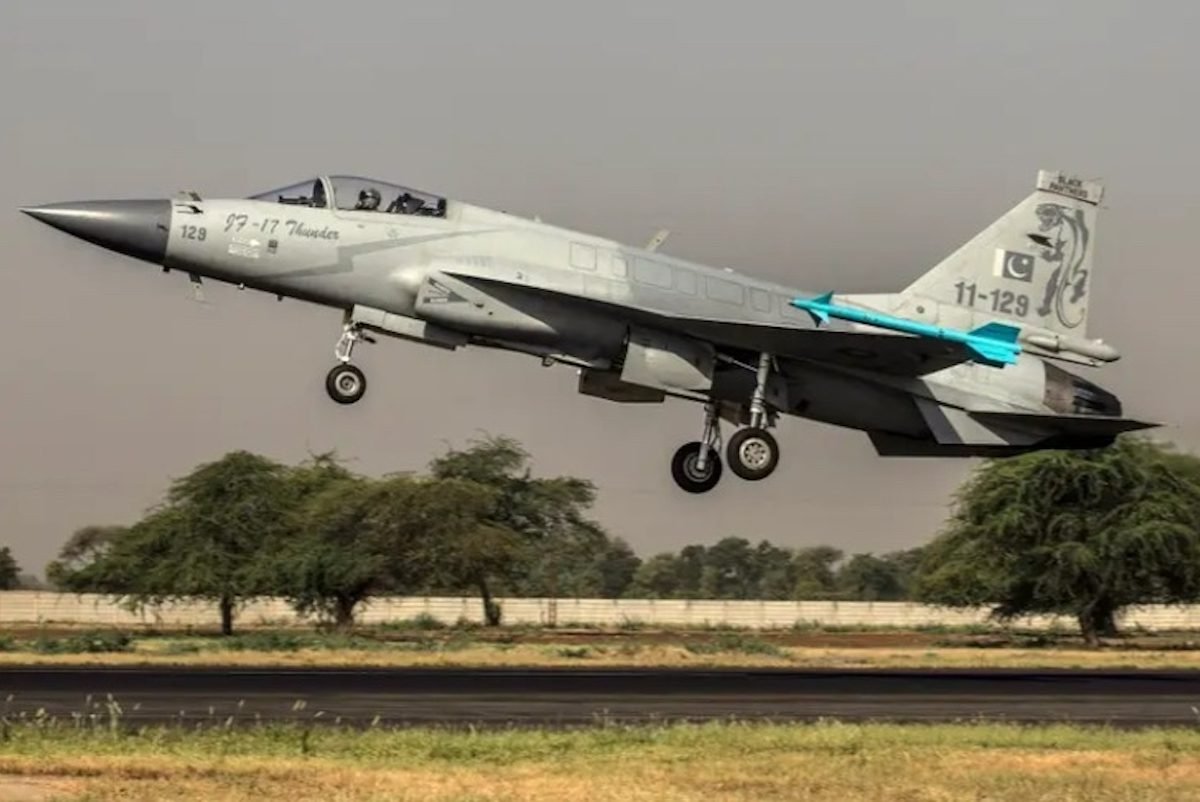
Bangladesh’s possible purchase of the JF-17 is turning a routine fighter jet buy into a dangerous new flashpoint in the escalating India-China-Pakistan power struggle.
This month, the South China Morning Post (SCMP) reported that Bangladesh could heighten security tensions with India by acquiring the China-Pakistan jointly developed JF-17 Thunder Block III fighter.
Those concerns were sparked after Pakistani media reported that the country has transferred a fully operational JF-17 flight simulator to Bangladesh, a move experts described as a strong indication that Bangladesh is preparing to procure the aircraft.
Developed by Pakistan Aeronautical Complex and China’s Chengdu Aircraft Corporation, the JF-17 is viewed as a cost-effective multirole fighter equipped with beyond-visual-range missile capability and modern avionics, potentially allowing Bangladesh to replace its aging MiG-29 and F-7 fleets and significantly improve its air combat capacity.
The acquisition would not overcome India’s regional air superiority but could narrow the capability gap and complicate Indian military planning, particularly around the strategically vital Siliguri Corridor, which links India to its northeastern states.
The development comes amid strained India-Bangladesh ties following Bangladesh’s demand for the extradition of former Prime Minister Sheikh Hasina, who fled to India after her 2024 ouster.
Deeper Bangladesh-Pakistan defense ties could intensify Indian suspicions, trigger stronger military deployments and heighten risks of strategic miscalculation, even if outright conflict remains unlikely.
As of May 2026, the Bangladesh Air Force has only 44 fighter aircraft, 36 of which are aging F-7s, with the remaining 8 being MiG-29s. That small force pales in comparison to the Indian Air Force, which, as of February 2026, operates 29 fighter squadrons.
Assuming each squadron has 18 fighters, India may have an estimated frontline fleet of 522 combat aircraft, including Dassault Mirages, Dassault Rafales, Su-30 MKIs and HAL Tejas fighters, among other types.
Although India overwhelmingly outmatches Bangladesh’s airpower, the latter’s possible acquisition of JF-17s could enable it to patrol its airspace and maintain its aerial warfare capabilities – routine tasks that may become increasingly difficult as its fighter fleet ages.
The deal would further cement Bangladesh’s status as one of China’s biggest arms customers. Aside from F-7 fighters, the country operates two Type 035 Ming-class submarines, two Type 053H3 and two Type 053H2 frigates, four Type 056 corvettes and substantial numbers of Chinese-origin armored fighting vehicles, artillery and air defense systems.
Bangladesh’s extensive reliance on Chinese weaponry could give China significant long-term influence over its defense posture and procurement decisions. Its high-end Chinese-origin systems are likely to depend on Chinese spare parts, maintenance, training and software updates, potentially deepening that reliance over time.
Furthermore, Bangladesh’s location near the Siliguri Corridor, a 60-kilometer-long, 20-kilometer-wide strip of land connecting India’s northeastern states to the rest of the country, poses a significant strategic vulnerability for India.
A Chinese advance from the nearby disputed territories of Arunachal Pradesh could cut off India from its northeastern states and access to the Bay of Bengal.
Ashish Kumar Gupta notes in a February 2025 report for the Center for Joint Warfare Studies (CENJOWS) that Bangladesh’s potential acquisition of Chinese fighter jets could alienate India while giving China strategic leverage to counter India’s regional influence.
Gupta notes that Bangladesh’s possible acquisition of JF-17 fighters could deepen relations with Pakistan, strengthen China’s efforts to bring Bangladesh into its sphere of influence and compel India to secure its border with Bangladesh with greater urgency, thereby requiring the reallocation of military resources. He also adds that Bangladesh could be used to tie down scarce military resources during hostilities with India.
Hasina’s 2024 ouster also reshaped the geopolitical backdrop to Bangladesh’s possible JF-17 acquisition. Byron Chong, in an August 2024 article for the Lee Kuan Yew School of Public Policy, notes that her foreign policy rested on close cooperation with India while balancing ties with China.
Chong notes that under her tenure, India-Bangladesh relations entered a proclaimed “golden era,” with Bangladesh aligning with India on key issues, dismantling camps used by Indian separatists, combating radical Islamic groups and disrupting Pakistan’s Inter-Services Intelligence (ISI) network in Bangladesh.
He also notes that Hasina balanced relations with China while accommodating Indian sensitivities by scrapping the China-backed Sonadia port project and selecting India for the Teesta River project.
However, he says that Hasina’s ouster resulted from increasingly authoritarian tendencies, crackdowns on opposition and civil society groups, and the resulting mass protests.
As noted by P.K. Vijayakumar in a December 2025 article in the peer-reviewed IOSR Journal of Humanities and Social Science, Hasina’s ouster created strong anti-India and anti-Hindu sentiments in Muslim-majority Bangladesh, producing violence against the Hindu minority and constituting a major setback for Indian diplomacy.
Vijayakumar mentions that after Hasina’s ouster, Bangladesh showed a clear trend of de-Indianization, terminated agreements signed during Hasina’s administration, delayed India-led regional initiatives and reduced dependence on India.
He adds that Bangladesh strengthened ties with Pakistan and China to safeguard its strategic autonomy, while India’s support for Hasina and refusal to extradite her intensified tensions.
Mohosina Mostofa notes in a July 2024 report for the Bangladesh Institute of Peace and Security Studies (BIPSS) that post-Hasina Bangladesh faces the challenge of preserving strategic autonomy amid growing external pressures from competing powers seeking to draw Bangladesh into their orbit. She also notes that Bangladesh risks achieving short-term economic development at the expense of long-term strategic constraints.
However, Nihar Nayak notes in a March 2026 commentary for the Manohar Parrikar Institute for Defense Studies and Analyses (MP-IDSA) that India views changes in Bangladesh with concern because of its shift toward a more neutral foreign policy, while China is expected to double down on its economic statecraft through Belt and Road projects and infrastructure investments.
China frequently blends military cooperation with economic assistance, including support linked to Pakistan’s transfer of a JF-17 simulator to Bangladesh. He also notes that India is concerned about increasing Pakistani involvement in post-Hasina Bangladesh, which could threaten India’s strategic interests in the Bay of Bengal and along its often volatile northeastern border.
If Bangladesh ultimately acquires the JF-17, the deal may matter less for the aircraft themselves than for what they symbolize: a post-Hasina strategic realignment pulling Bangladesh deeper into the intensifying India-China-Pakistan rivalry.
For India, the greater danger may not be waning air superiority but the loss of political influence over a neighbor once central to its regional security architecture.