The third India-Australia Annual Summit in Melbourne on July 9 produced outcomes across defense, energy, critical minerals, technology and education — 18 in all. But by far the most significant deliverable centered on Australian uranium exports to India.
After nearly 12 years of a civil nuclear agreement on paper, Australia and India finalized the administrative arrangements needed to begin commercial uranium exports. A renewed defense and security declaration replaced the 2009 version, and new commitments on shipbuilding, maritime security and cyber cooperation followed.
However, what the summit did not produce was a trade deal. The Comprehensive Economic Cooperation Agreement (CECA) — launched in May 2011, suspended in 2016, relaunched in 2021 and promised at successive summits since 2023 — was again promised early conclusion yet remains unsigned.
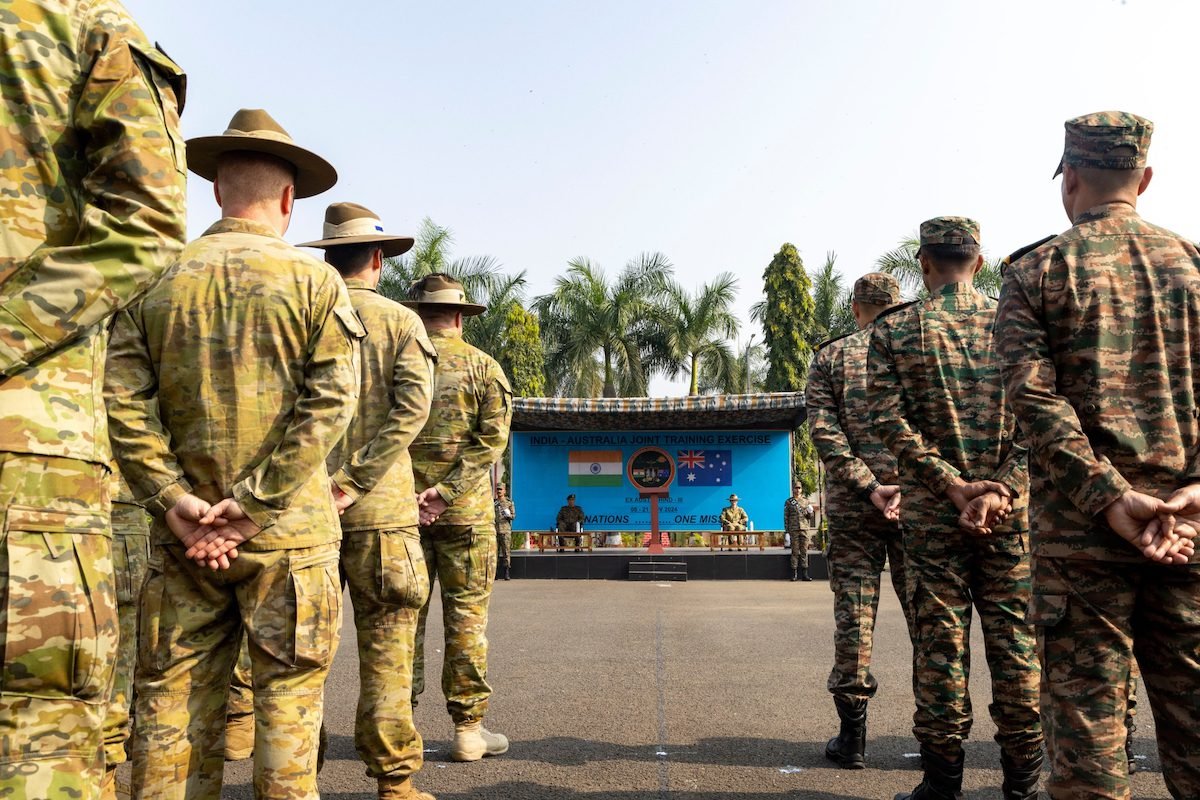
The pattern is now sustained enough to read as structural. Since the Comprehensive Strategic Partnership was established in 2020, with the Mutual Logistics Support Agreement signed at the same summit, the security dimension of the relationship has yielded concrete outcomes at every major meeting.
Those include Australia’s first hosting of Exercise Malabar in 2023 and the defense declaration and uranium operationalization in 2026. The Critical Minerals Corridor, also launched at the Melbourne summit to secure supply chains for lithium, cobalt and rare earths, was framed as a strategic security measure rather than a standard trade mechanism, though it remains at the framework stage.
The economic side has produced one interim deal, the Economic Cooperation and Trade Agreement (ECTA), signed in April 2022. It covered goods tariffs and included limited services and mobility commitments, but left the hardest issues for the CECA, including investment, government procurement and broader labor mobility.
The trade numbers make the gap harder to ignore. Two-way trade has more than doubled since 2020, reaching approximately US$33 billion in 2025, making India Australia’s fifth-largest trading partner.
But the figures remain modest relative to the four partners above it, and Australia has managed to conclude comprehensive trade agreements with all of them. The deal with South Korea took five years from launch to signature, Japan’s seven, China’s 10, Indonesia’s nine and the EU agreement eight. India, at 15 years and counting, is the outlier.
The ECTA has driven much of that growth, with agricultural exports more than doubling since the agreement came into force. But the gains have come from goods liberalization. The services, investment and mobility provisions that would give the relationship economic depth remain unresolved.
The uranium deal reflects a strategic shift. Australia exports uranium to more than 40 countries under established frameworks, but India, as a nuclear-armed state outside the Non-Proliferation Treaty, required more complex safeguards arrangements.
The civil nuclear agreement sat unused for nearly 12 years because the two sides could not agree on how to track and report uranium transfers. India’s foreign secretary said resolving the impasse required “very intense discussions” over two years. Only a single test shipment in 2017 had moved between the two countries before 2026.
Much like the Critical Minerals Corridor, the uranium deal eventually cleared because both governments treated it as a security priority. India wants to expand its nuclear capacity from roughly 8 gigawatts (GW) to 100 GW by 2047, and Australia wants to demonstrate its value as a reliable Indo-Pacific partner while diversifying its export relationships. When the strategic logic on both sides pointed in the same direction, the procedural obstacles gave way.
The trade deal faces a different kind of obstacle. India is the world’s largest milk producer, and the dairy lobby is powerful enough to have helped push India out of the Regional Comprehensive Economic Partnership in 2019.
The Gujarat Milk Marketing Federation, headquartered in Prime Minister Modi’s home state, was among the first to welcome that withdrawal. The same dynamics are now blocking the CECA. As of 2025, dairy and wine tariffs were the main sticking points, with a senior Indian official ruling out further concessions on either.
On the Australian side, the services and mobility provisions India most wants, particularly easier access for IT workers and recognition of professional qualifications, run into politically sensitive workforce and migration debates.
The interim deal was designed as a stepping stone, but by deferring the hardest issues, it left the core obstacles unresolved. CECA negotiations have continued, with more than 10 formal rounds completed, but neither side has signaled a timeline for conclusion.
The underlying problem is that neither government pays a real political price for leaving the CECA unresolved. The trade relationship matters but is not large enough to force action. By comparison, Australia and China’s approximately $212 billion in two-way trade created pressure to manage the relationship even at its most strained.
India’s broader trade posture has been one of “sustained disengagement,” where domestic protectionist interests consistently override outward-looking economic ambitions.
When the politics do align, India can move fast: the trade deal with the UAE was concluded in 88 days. India signed a comprehensive deal with the UK in July 2025, three and a half years after launching negotiations, covering services, mobility and government procurement.
It concluded negotiations with the EU in January 2026, the largest trade deal either side had attempted, after more than three years of active talks. Both involved difficult agricultural and services concessions. The CECA’s 15-year timeline stands out against that record.
This matters because a partnership built primarily on a shared reading of regional threats is only as durable as that shared reading. The Quad has not met at the leaders’ level for nearly two years.
India’s relationship with China, while competitive, has stabilized since the 2020 border crisis, with both sides managing tensions rather than escalating them. Even if the strategic rationale endures, its intensity may fluctuate, and a partnership without economic depth is more exposed to those shifts.
The Comprehensive Strategic Partnership label itself does political work in both capitals, signaling to domestic audiences and third parties that the relationship is deeper than it operationally is. That framing may reduce rather than increase the pressure to close the gap between the security architecture and the economic substance it is supposed to rest on.
The Melbourne Summit showed that when both governments frame an outcome as a strategic necessity, procedural obstacles give way. When an outcome sits in the commercial lane, domestic constituencies hold.
The uranium deal cleared because it was treated as a security imperative. The CECA has stalled because the domestic political costs of concession on dairy, wine and migration remain higher than the perceived cost of delay. Until that calculus shifts, the partnership will remain structurally lopsided.
Lam Duc Vu is a risk analyst writing on Indo-Pacific security and regional affairs.