For decades, the South Pacific was largely relegated to the margins of global politics. Today, it has undergone a seismic shift, transforming into the epicenter of great-power competition.
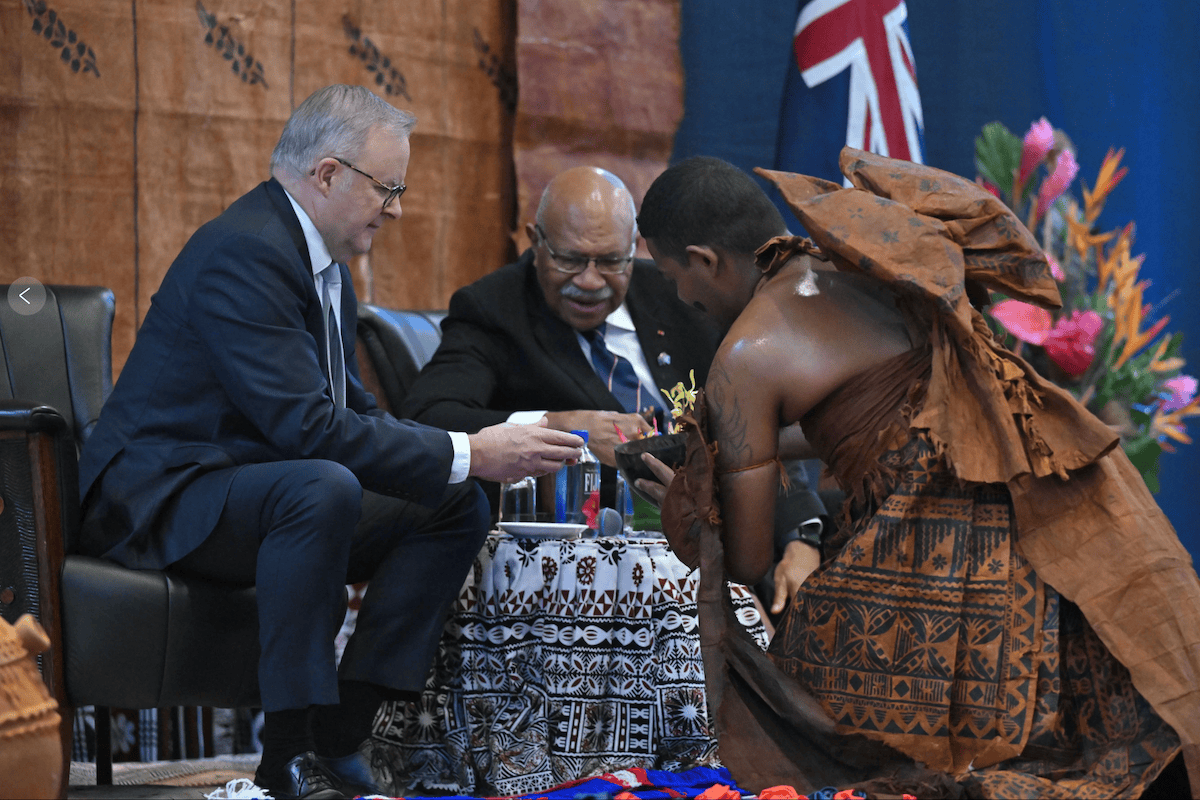
The defense treaty signed by Australian Prime Minister Anthony Albanese and Fijian Prime Minister Sitiveni Rabuka in Suva on July 6, 2026, was not merely a diplomatic routine. It was a calculated strategic maneuver that marks a new era in which Australia has firmly positioned itself as the “security partner of choice” for Pacific island nations, effectively countering the rapid expansion of Chinese influence across the region.
This development is the culmination of intensive defense diplomacy spearheaded by Canberra since October 2025. By binding Fiji through the Ocean of Peace Alliance and the Vuvale Union, Australia has officially solidified Fiji as its fourth formal ally, joining the ranks of the United States, New Zealand and Papua New Guinea.
This deal acts as a systematic response to the regional instability that peaked following the clandestine 2022 security pact between Beijing and the Solomon Islands. For Canberra, the specter of a permanent Chinese military presence in the Pacific is no longer a theoretical scenario; it is an existential threat that must be mitigated by bolstering the region’s security architecture with Australia at its hub.
Australia is no longer merely acting as a tactical adjunct to American interests. The 2026 Australian National Defense Strategy (NDS) underscores Canberra’s ambition to develop a more independent and proactive defense posture.
With defense spending targets reaching 3% of GDP by 2033–2034, Canberra is laser-focused on building resilient military infrastructure in Australia’s north while enhancing independent power-projection capabilities in the Southwest Pacific.
However, beneath this surge of maneuvers lies a structural shift in the region’s geopolitics that demands a more nuanced understanding. The increasingly multipolar nature of great-power competition is compelling island nations, historically seen as passive observers, to assert their own political agency amidst the sometimes crushing pressures of competing global interests.
Anatomy of a treaty
The legal framework of the dual agreement between Australia and Fiji is meticulously designed to integrate conventional defense with comprehensive non-traditional resilience instruments.
The Ocean of Peace Alliance functions as a de facto mutual defense treaty. Its core clause stipulates that any armed attack against either party in the Pacific will be regarded as a direct threat to the other party’s peace and security.
The structure is intentionally “open-ended,” providing a pathway for other regional neighbors such as New Zealand, Papua New Guinea and Tonga to join in the future, thereby coalescing into a broader collective Pacific security architecture.
Within this framework, both parties have committed to acting in concert to address collective threats, in accordance with their respective constitutional procedures.
Furthermore, there is an ironclad obligation to consult immediately whenever security developments emerge that could jeopardize national sovereignty, peace or stability. This not only provides Fiji with a robust security guarantee but also fortifies Australia’s role as the primary anchor of regional defense.
Conversely, the Vuvale Union operates across a much broader spectrum, encompassing domestic security, economic development and robust people-to-people ties. Australia’s involvement extends well beyond the military realm; it is actively bolstering Fiji’s law enforcement capabilities through police training, legislative reform, maritime interdiction, intelligence sharing and the prosecution of transnational crime.
Canberra’s commitments also cover the operational support of Fiji’s Guardian-class patrol vessels, the upgrade of the RFNS Stanley Brown wharf infrastructure and the optimization of the Maritime Essential Services Centre (MESC) in Suva, which has been active since October 2025.
This multifaceted approach demonstrates Canberra’s keen understanding of the necessity of “family diplomacy” (Vuvale) in winning the hearts and minds of Pacific nations. By launching the Vuvale Skills Hub to modernize vocational education and expanding visa access for Fijians through the Pacific Australia Labour Mobility (PALM) program, Australia is seeking to lock in Fiji’s loyalty through mutually beneficial economic interdependence.
This is the antithesis of the physical infrastructure-heavy model often offered by China through the Belt and Road Initiative (BRI), which is frequently encumbered by the involvement of Chinese state-owned enterprises and the looming risk of long-term debt traps.
The narrative paradox
A sharp conceptual tension persists regarding the very definition of “security” in the Pacific. The struggle for influence in the South Pacific is characterized by a clash between the security architecture promoted by Western powers and the local agendas declared by Pacific leaders.
On one side, the Western alliance, through the informal Partners in the Blue Pacific (PBP) mechanism announced in June 2022, is pushing a “hard security” narrative to curb China’s military hegemony through maritime patrols and exclusive treaties.
Conversely, Pacific island leaders, through instruments like the Declaration on the Blue Pacific Ocean of Peace, endorsed at the Honiara Leaders’ meeting in September 2025, consistently assert that their most pressing existential threats are not military aggression, but climate change, rising sea levels, illegal, unreported, and unregulated (IUU) fishing and transnational crime. Through this declaration, the Pacific is defined as a zone of peace that rejects militarization and geopolitical coercion from external powers.
Criticism of Western initiatives often stems from the perception that PBP powers have co-opted the “Blue Pacific” narrative, originally a symbol of self-determination and climate resilience, for the narrow purposes of geopolitical containment.
The PBP initiative is viewed by many as bypassing the consensual decision-making processes of the Pacific Islands Forum (PIF), risking the fragmentation of regional solidarity.
In response, Pacific leaders established the Pacific Resilience Facility (PRF), an independent financial institution designed to mobilize global climate adaptation funding, free from the bureaucratic entanglements of Western donor cycles.
Fiji, with its central position as a hub for air transport, undersea fiber-optic cables, and international shipping lanes, holds unique bargaining power. As the political and institutional leader in Melanesia and the host of the PIF Secretariat, Suva is the ultimate prize in the diplomatic tug-of-war.
Moreover, Fiji is one of the few nations in the South Pacific that maintains a standing military, the Republic of Fiji Military Forces (RFMF), with extensive international experience in UN peacekeeping missions.
Through this alliance, Australia not only secures Fiji’s geography against foreign military penetration but also gains direct military interoperability with the most respected local armed forces in the region.
However, Australia’s success in securing this alliance does not mean that Fiji or other island nations have surrendered their sovereignty. The phenomenon of “pragmatic sovereignty,” as evidenced in the Solomon Islands following Prime Minister Matthew Wale’s election on May 15, 2026, highlights a dynamic diplomatic trajectory.
Wale immediately initiated a review of the 2022 security pact with Beijing, choosing to restore traditional security partnerships with Australia while simultaneously courting Washington for commercial port infrastructure development.
Nevertheless, the fact that Chinese-led infrastructure projects continue to move forward in key areas of the Solomons confirms that balancing Western security partnerships with Chinese economic engagement remains the defining doctrine for most nations in this oceanic region.
Future projections
Australia’s proactive stance in constricting China’s maneuverability is bound to strain bilateral relations between Canberra and Beijing. China consistently opposes the formation of security pacts that it views as instruments of Cold War-era geopolitical maneuvering.
When Australia concluded defense treaties with Papua New Guinea and Vanuatu in mid-2026, Beijing’s Ministry of Foreign Affairs issued stern warnings against targeting third parties or undermining China’s sovereign interests.
Despite this, Prime Minister Sitiveni Rabuka has sought to lower the temperature, asserting that Fiji’s defense alliance with Australia is an exercise of sovereign right, not an act of hostility toward Beijing or a disruption to ongoing Fiji-China economic cooperation.
The challenge for Australia in the years ahead is to sustain this diplomatic momentum amidst the increasingly complex demands of island nations. The ability of smaller states to reject exclusivity clauses or foreign-investment veto powers, as seen in the recent renegotiation of the Nakama’al Agreement in Vanuatu, signals that Canberra can no longer unilaterally dictate policy in the Pacific.
These instances of renegotiation highlight the growing capacity of smaller nations to reshape agreements to protect their national sovereignty.
Ultimately, the future of the Pacific’s security architecture will depend on how effectively great powers, including Australia, align their security agendas with the developmental and climate-resilience aspirations of island nations.
If the West focuses exclusively on hard security without addressing the urgency of the climate crisis felt acutely by Pacific communities, the narrative of the “Blue Pacific” as a zone of peace will remain in direct conflict with the reality of creeping militarization.
Australia has made a massive wager with its strategy of “permanent contestation.” The success or failure of this strategy will not only dictate the regional balance of power in the South Pacific but will serve as a litmus test for how effectively a middle power like Australia can act as an anchor of stability in an increasingly volatile global order.
Despite the vast power asymmetry, Pacific island nations have proven they are not passive objects in a geopolitical game. They are actors acutely aware of their strategic value and are intent on charting their own future.
The Pacific is no longer just a vast expanse of ocean; it is a vital theater where the future of the global balance of power is being tested. As dynamics continue to evolve, Australia’s readiness to manage these relationships with both nuance and firmness will determine whether this region remains stable or descends into rigid, competitive blocs.
Ronny P Sasmita is senior international affairs analyst at Indonesia Strategic and Economic Action Institution, a Jakarta-based think tank. He holds a PhD from the University of Tokyo.