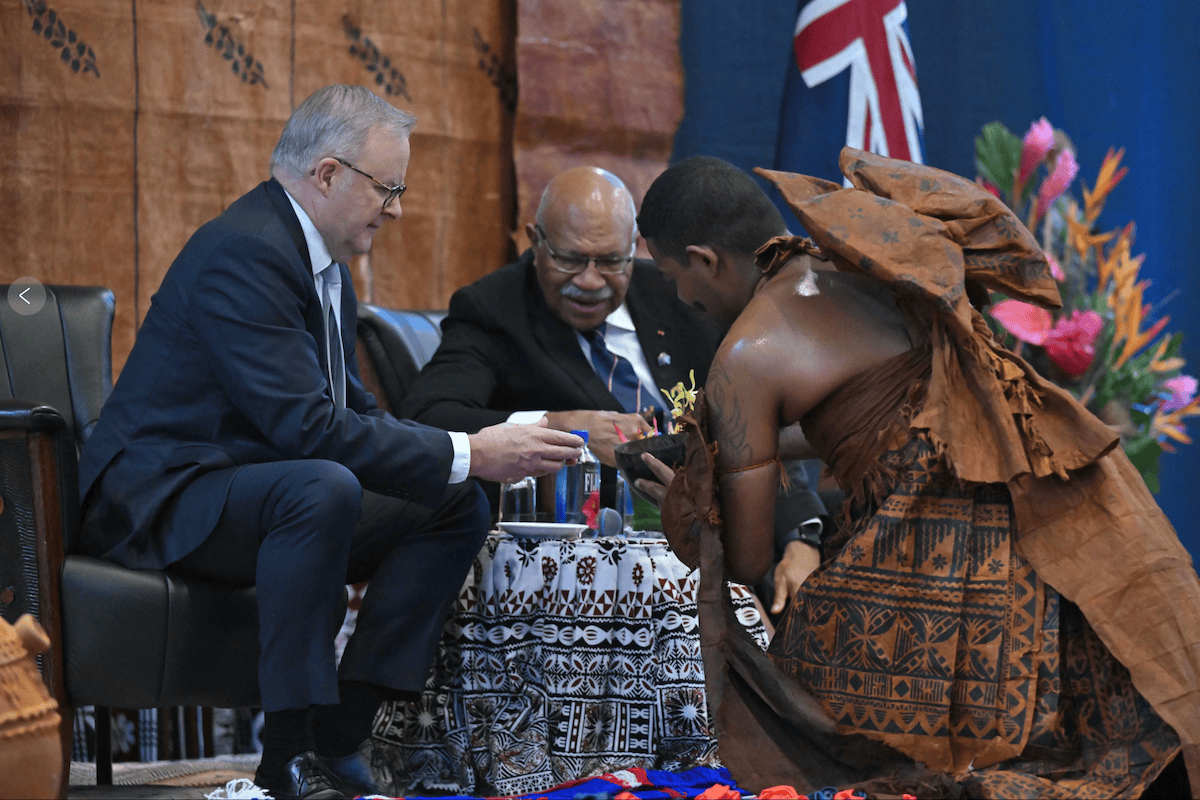

The treaty Australia and Fiji signed in Suva on July 6 is no ordinary defense pact.
The Ocean of Peace Alliance, also known as the Veitacini Treaty, is explicit: An armed attack on either party in the Pacific is treated as a threat to shared security, and both governments have committed to act against it through their domestic processes. Fiji now becomes Australia’s formal ally, joining the US, New Zealand and Papua New Guinea.
What stands out is that the treaty was built to be open: Other Pacific nations can join, provided every existing member agrees. That openness is the heart of the whole document, asserting that regional security should be led by the Pacific itself, not steered from outside.
Alongside the security treaty, Australia and Fiji also signed the Vuvale Union, a package reportedly worth about A$1 billion (US$690 million) over 10 years, covering climate and economic cooperation.
A similar pattern emerged earlier with the Nakamal Agreement with Vanuatu, reportedly valued at about A$500 million, and the PukPuk Treaty with Papua New Guinea last October.
The timing coincided with a Chinese ballistic missile test in the Pacific. Australia’s foreign minister confirmed that Beijing had given advance notice of the blast, though Canberra still called the move a threat to regional stability.
It is hard to read that overlap as pure coincidence — it looks more like a signal, a reminder that Beijing’s fleet can move whenever regional pressure calls for a response. To be sure, none of this geopolitical shift happened in a vacuum. It traces back to the broader rivalry between the US and an increasingly assertive China.
Chinese firms have already built a major footprint across eastern Indonesia, controlling much of the nickel processing in Halmahera, North Maluku, a key link in the global electric-vehicle battery supply chain.
That presence comes with ports and logistics infrastructure sitting right at the Pacific’s front door, which is one way of saying the fight over critical minerals and the fight over maritime security are really the same contest.
From a Western vantage point, the Fiji-Australia alliance is easy to frame as a diplomatic win for the US and its partners, as a way to hem in China.
Every additional Pacific nation drawn into Australia-led pacts strengthens the impression that the region is being pulled back into the Western security fold, especially after the alarm triggered by China’s 2022 pact with the Solomon Islands.
But that reading oversimplifies the actual position of Pacific nations. For Fiji, aligning with Australia is not a matter of bowing to Washington’s agenda. It reads more like an attempt to protect its own autonomy while managing two pressures at once: the pull of Chinese capital that comes with strings attached, and pressure from the US and its allies to fall exclusively in line.
There is another way to view this whole picture: as a survival strategy for small islands. For the people who live there, a threat to the ocean that sustains them, such as deep-sea mining for polymetallic nodules, can feel just as serious as a military threat.
Seen that way, a pact like this becomes a tool for maintaining control over one’s own fate, not simply a matter of choosing between two giants. Pacific nations like Fiji face a tangled vulnerability, caught between two rival giants and further squeezed by a worsening climate, so their efforts amount to a fight for survival.
So the real story emerging from all this isn’t about who is winning the contest between the US and China. It is about how small Pacific states are trying to build collective leverage amid two opposing pressures.
This treaty is one attempt at that. Whether it will hold up against the pull of two great powers over the long run is still an open question – one that depends on how the treaty is applied and on how the wider dynamics across the Pacific unfold in the years ahead.
M. Guntur Cobobi is a member of the Central Board of the Youth Association of Indonesian Muslim Intellectuals (PEMUDA-ICMI) and a researcher at the Center for Global and Melanesian Studies, Universitas Khairun.