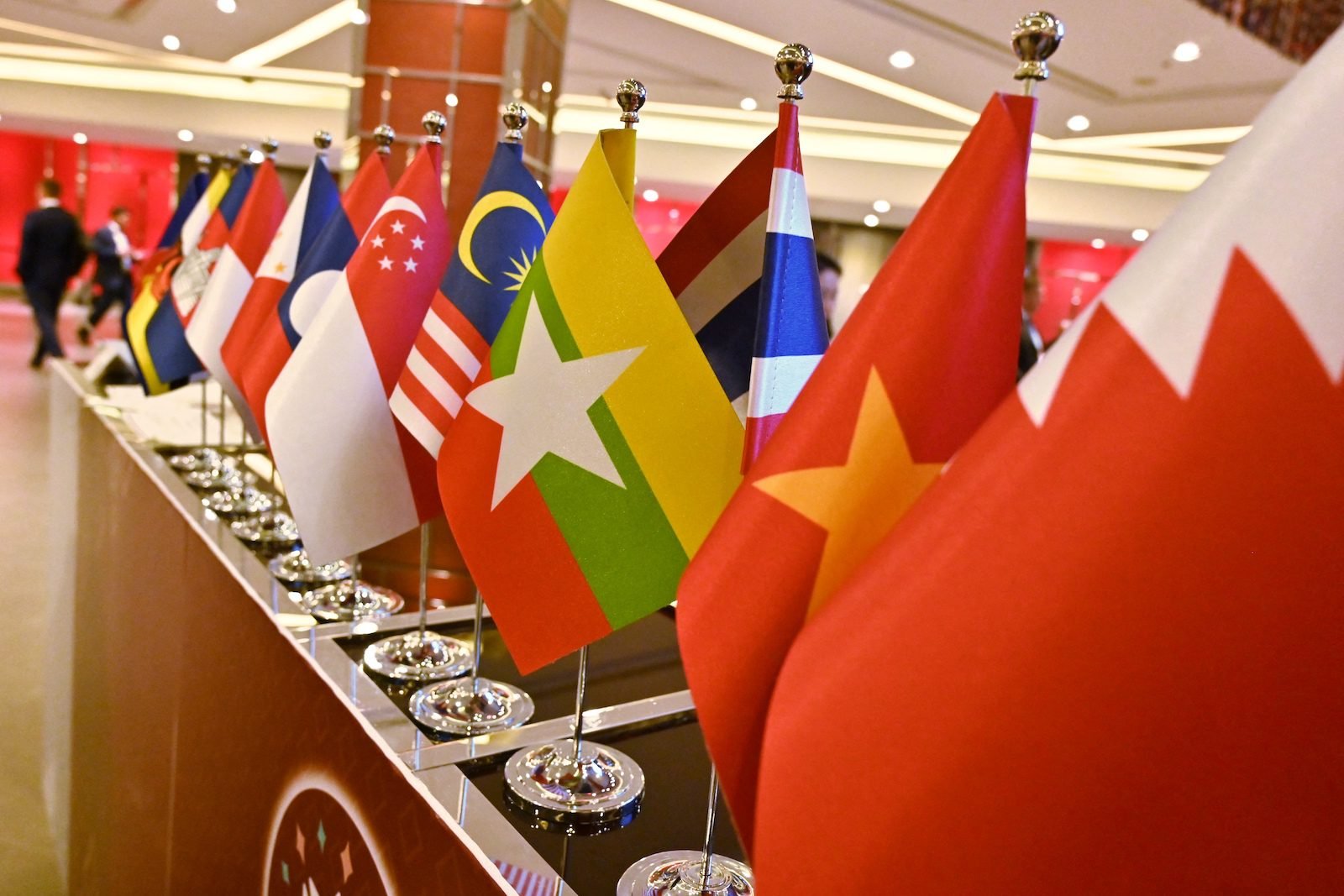
With the Quadrilateral Security Dialogue (Quad) losing much of its diplomatic momentum, the Association of Southeast Asian Nations (ASEAN) has been gradually reclaiming its centrality in the Indo-Pacific.
The clearest evidence emerged this week as Manila hosted the ASEAN Foreign Ministers’ Meeting along with the ASEAN Regional Forum, the East Asia Summit, ASEAN Plus Three and the ASEAN Defense Ministers’ Meeting-Plus, showcasing ASEAN as the region’s diplomatic nerve center.
Over three days, US Secretary of State Marco Rubio, China’s Foreign Minister Wang Yi, Russia’s Foreign Minister Sergei Lavrov, India’s External Affairs Minister S. Jaishankar, the European Union’s High Representative Kaja Kallas, and their counterparts from Japan, Australia, South Korea, Canada and 11 Southeast Asian nations converged under ASEAN’s umbrella to discuss virtually every geopolitical fault line, from the South China Sea to the Strait of Hormuz.
By the end of the three days, as Asia’s strategic landscape grew increasingly fragmented, Quad foreign ministers endorsed the ASEAN Outlook on the Indo-Pacific — and Manila demonstrated an enduring truth: When serious diplomacy matters, the region still returns to ASEAN.
Back at the center
For much of the last decade, ASEAN’s much-vaunted centrality appeared to be waning. The rise of the Quad, AUKUS and BRICS expansion had encouraged predictions that ASEAN was tilting toward China, and that its consensus-driven diplomacy — often derided as “progress as no progress” — was too cautious and slow, prompting the Quad to take charge. Yet the Manila meetings revealed exactly the opposite.
ASEAN’s strength never rested on military power. Its influence derives instead from its unmatched convening authority. Home to 705.2 million people and a combined economy of $4.51 trillion, ASEAN sits at the strategic maritime crossroads connecting the Pacific and Indian oceans. It remains the institutional hub around which most regional dialogue partnerships continue to revolve.
No other regional institution routinely assembles the United States, China, Russia, India, Japan, Australia, South Korea, the European Union and 11 Southeast Asian nations under one diplomatic roof.
That institutional legitimacy, painstakingly cultivated over nearly six decades since ASEAN’s founding in 1967, remains its greatest strategic asset, keeping ASEAN in the driver’s seat of regional security architecture.
Where rivals still meet
Indeed, the Manila agenda reflected a changing Asian security architecture. Predictably, the South China Sea dominated deliberations, as continuing confrontations between China and the Philippines reinforced ASEAN’s long-standing demand for an effective and substantive Code of Conduct.
Equally pressing were concerns over tensions across the Taiwan Strait following recent Chinese military activity, alongside continuing instability in Myanmar, where ASEAN’s Five-Point Consensus framework continues to face serious setbacks.
Yet what distinguished Manila from previous ministerial meetings was its widening geographical scope. The disruption of global shipping through the Strait of Hormuz following the US-Iran war reminded economies heavily dependent on Gulf energy imports that instability in West Asia has become inseparable from Indo-Pacific security. As a result, ASEAN’s agenda stretched from the western Indian Ocean to the western Pacific.
Economic security featured just as prominently. Ministers discussed resilient supply chains, semiconductor cooperation, cybersecurity, digital connectivity and the governance of artificial intelligence — issues once considered purely economic but now recognized as central to strategic planning. ASEAN’s agenda has expanded from traditional territorial disputes to encompass technology, energy, maritime commerce and critical infrastructure.
Perhaps the most closely watched engagement occurred on the sidelines, where Rubio and Wang met amid continuing strategic competition between Washington and Beijing. Although substantive disagreements remained, the symbolism was unmistakable.
Even the world’s two principal strategic competitors continue to rely on ASEAN-hosted meetings to stabilize communication, and reportedly used the occasion to advance preparations for a coming Trump-Xi summit. Few institutions today command that degree of diplomatic credibility.
Beyond the Quad
The Manila meetings also highlighted an important distinction between strategic coalitions and diplomatic institutions. Second-tier meetings of the Quad continue to drive cooperation on maritime security, critical technologies and resilient supply chains across the Indo-Pacific. Successive Quad foreign ministers’ meetings have strengthened coordination ranging from undersea cables to vaccine partnerships and emerging technologies.
But unlike the Quad, ASEAN imposes neither ideological tests nor strategic exclusivity. Unlike AUKUS, it is not a security alliance, and unlike BRICS, it is not organized around revisionist ambitions. Its comparative advantage lies in its inclusiveness. Democracies and one-party states, treaty allies and strategic rivals, established powers and smaller states — all find diplomatic space within ASEAN-led forums.
Far from being displaced by newer institutions, ASEAN increasingly complements them, providing the only genuinely inclusive forum where Asia’s competing strategic visions can still be debated at the same negotiating table.
If Manila reaffirmed ASEAN’s convening power, it also allowed participants to recalibrate their bilateral relationships. India’s External Affairs Minister S. Jaishankar represented India in various multilateral sessions and also held a series of bilateral meetings with America’s Rubio, China’s Wang and Russian Foreign Minister Sergei Lavrov.
Those meetings demonstrated why New Delhi has consistently treated ASEAN centrality as a key principle and an article of faith. For India, ASEAN is not merely the geographical gateway to its Act East policy; New Delhi sees ASEAN-centric architecture as allowing competing powers to remain engaged without compelling smaller states to choose sides.
Jaishankar’s discussions ranged from India-US cooperation in critical and emerging technologies and defense, to managing the gradual stabilization of India-China relations, to sustaining India’s long-standing strategic partnership with Russia. Given India’s inability to host a Quad summit, its talks under the ASEAN umbrella were instructive of things to come.
Centrality reimagined
The Manila meetings also exposed ASEAN’s enduring paradox: It remains institutionally indispensable but politically constrained.
Myanmar continues to test ASEAN’s credibility. The long-negotiated South China Sea Code of Conduct remains unfinished. Consensus decision-making often produces cautious communiqués, and ASEAN lacks coercive capability or enforcement mechanisms.
ASEAN, however, was never designed to impose solutions on great powers. Its enduring success lies in ensuring that strategic rivals keep talking even when agreements remain elusive. In an era defined by geopolitical fragmentation, technological competition and overlapping security coalitions, ASEAN’s sustained dialogue is itself a strategic public good.
This is precisely why repeated predictions of ASEAN’s decline have consistently proved premature. The Quad will remain an influential minilateral grouping, AUKUS will deepen defense cooperation, and BRICS will continue expanding its outreach. None, however, currently combines ASEAN’s inclusiveness, legitimacy and convening power.
ASEAN’s centrality does not derive from commanding Asia’s strategic order but from facilitating Asia’s diplomatic communication. In a region increasingly divided by rivalry yet bound together by economic interdependence, ASEAN remains the one institution capable of convening all the principal stakeholders without demanding ideological conformity or strategic alignment.
The way forward
The irony of 21st-century Indo-Pacific geopolitics is therefore striking. ASEAN is no longer the region’s strategic center in the traditional sense. Military balances and technological competition are shaped elsewhere. New security coalitions continue to proliferate.
Yet whenever tensions escalate — whether in the South China Sea, across the Taiwan Strait, in Myanmar or even in the Strait of Hormuz — Asia’s major stakeholders still return to ASEAN.
Manila therefore marked more than another annual event. It demonstrated that while Asia’s balance of power may be changing, its balance of diplomacy still revolves around ASEAN. For an organization often dismissed as slow, divided and procedurally cumbersome, that is no small accomplishment.
Indeed, in an age of fractured geopolitics, ASEAN’s ability to bring every major power to the same table may prove to be the most consequential form of leadership Asia retains.








 losing much of its diplomatic momentum, the Association of Southeast Asian Nations (ASEAN) has been)