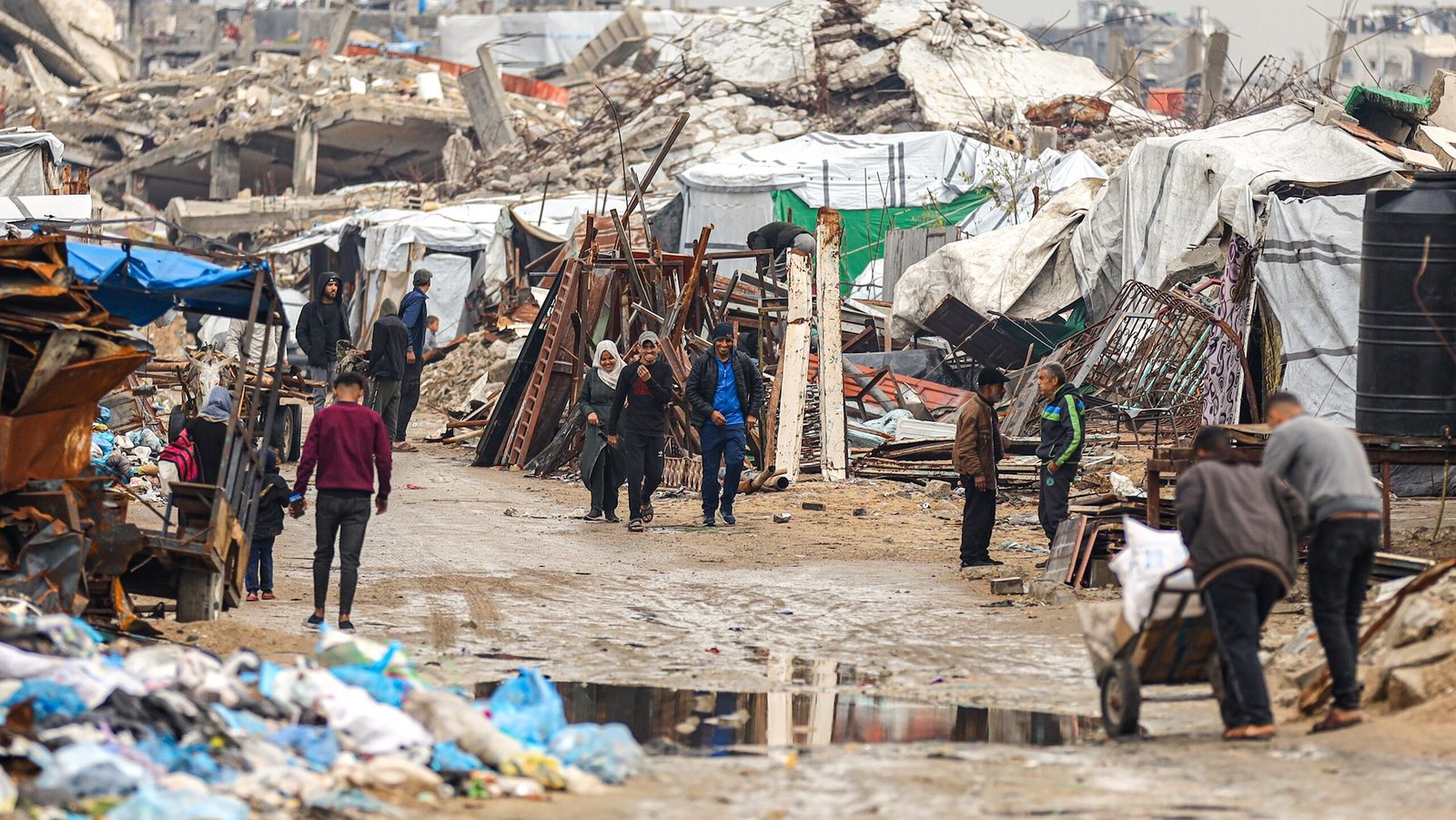
While Israel may accept an arrangement, provided Hamas fully disarms, sources told TML that the technocratic government, even if not in name, is effectively the Palestinian Authority
Any agreement that relies on Israel working with the National Committee for the Administration of Gaza (NCAG), the Palestinian technocratic government, is likely doomed to fail, according to two Palestinian affairs analysts who spoke with The Media Line as decisions are being made about the next steps for governing and disarming the Gaza Strip.
Earlier this month, as US special envoy Jared Kushner was in the country, it was reported that the United States and Israel had reached an understanding that Hamas’ disarmament would involve transferring weapons not only to the NCAG, as originally envisioned, but also to the International Stabilization Force (ISF). The development came after Israel rejected an arrangement that would have placed the weapons solely under the NCAG’s control.
Under the revised plan, according to media reports, US Maj. Gen. Jasper Jeffers, who heads the ISF, would oversee the transfer of the weapons.
While Israel may accept such an arrangement, provided Hamas fully disarms before the next phase of the agreement moves forward, sources told The Media Line that the technocratic government, even if not in name, is effectively the Palestinian Authority. They argue that the PA lacks credibility in Gaza, making any disarmament arrangement that depends on the NCAG unlikely to succeed.
The Palestinian Authority has not changed, according to Arab-Israeli analyst Khaled Abu Toameh. He told The Media Line that the PA is “simply being more careful” in its rhetoric because “the Americans, the Europeans, and the rest of the international community are watching them closely. So they are cautious. They’re being very careful. They’re keeping a low profile. They claim they are embarking on reforms… They called new elections. But the Palestinian Authority remains the Palestinian Authority, based on corruption, bad governance, mismanagement, and nepotism. Nothing has really changed.”
The Americans, the Europeans, and the rest of the international community are watching them closely. So they are cautious. They’re being very careful.
At the end of July, Hamas agreed to move forward with the Board of Peace roadmap, which called for Israel to allow aid into the Strip and withdraw troops as Hamas disarmed. However, Israel backtracked after seeing the final version of the roadmap presented by the United States. Under that plan, Hamas would surrender its heavy weapons, although the term was not clearly defined, while its light weapons would be administered and monitored by the NCAG. According to analysts, the NCAG’s connection to the PA is structured as a near-temporary stewardship.
For now, because Hamas has not disarmed, the Palestinian committee has yet to begin governing the Strip.
The NCAG is intended to operate temporarily in Gaza, restoring basic public services and infrastructure before eventually transferring governance to the PA once the authority completes reforms required by the United States. However, analysts told The Media Line that many NCAG members, including its chief commissioner, have close ties to the PA even if they are not currently PA officials.
Abu Toameh and Maurice Hirsch, director of the Initiative for Palestinian Authority Accountability and Reform at the Jerusalem Center for Public Affairs, said the Palestinian Authority has yet to undertake meaningful reforms.
Only a few months ago, the US State Department reported that Washington could not transfer aid to the PA because it had not ended its so-called pay-for-slay payments or public statements supporting terrorism, despite claiming that it had done so.
“The PA continues to provide a system of compensation in support of terrorism through new mechanisms and under a different name,” the State Department reported in April 2026.
A few months later, Hirsch explained, the PA established a new body to review eligibility for receiving payments, creating the appearance that new criteria had been introduced and that terrorists would no longer receive funds. But Hirsch said those changes should not be taken at face value.
“They’re never gonna stop paying salaries to terrorists because that’s their commitment to their people. They’ve dug that hole so deep,” Hirsch told The Media Line. “There is no Palestinian leader who would be able to say he is no longer going to support the terrorists. That boat has sailed. Now the question is only how do you most effectively hide these payments.”
Hirsch said the world will know that payments to terrorists have stopped when tens of thousands of Palestinians take to the streets complaining that they are no longer receiving money.
“It’s all quiet,” Hirsch said. “In what world does anyone think payments have stopped? We’ll know the end of pay-for-slay when we see mass demonstrations on the streets of Ramallah, Tulkarem, Jenin and Shechem because the ‘freedom fighters’ are no longer getting paid.”
He said he does not believe the Palestinian Authority under its current leadership should be trusted, arguing that one does not have to look far to find evidence that the PA is not promoting peace and coexistence but rather terrorism.
He cited what he described as a basic statistical example. Under the Oslo Accords, Hirsch said, the PA was supposed to employ a 12,000-member civilian police force. Today, he said, it has a force of roughly 70,000.
“Who are they fighting or planning to fight?” Hirsch asked. “When you look at everything, including the incitement in the school curriculum, there is no indication that this is a partner that Israel or the world can trust.”
Abu Toameh expressed similar concerns, noting that the Trump administration’s original framework for the next phase in Gaza called for the PA to undergo reforms. If the administration still wants those changes, he said, it should demand reform, transparency, and accountability from the Palestinian Authority and then verify whether they are actually taking place.
“Go to Ramallah, go to Abu Mazen [PA President Mahmoud Abbas] and check with him and ask him, ‘What have you done so far? We want to see tangible results,’” Abu Toameh contended. “If you’re not, if you’re just demanding, making demands that you’re not following up, then you are just revolving in a vicious cycle.”
He also called on journalists covering the Palestinian Authority to expose what it is doing.
Abu Toameh added that anyone who believes the PA will fight Hamas is returning to an approach tried in the 1990s and early 2000s, when the expectation was that the authority would confront Hamas and Palestinian Islamic Jihad. That approach, he said, failed.
For Abu Toameh, that history raises a fundamental question about the plans now being drawn up for Gaza: If the Palestinian Authority could not fulfill those expectations in the past and has yet to demonstrate meaningful reform, why should Israel or the international community expect a different outcome this time?
Don’t rely on the Palestinian Authority to deliver. The Palestinian Authority has lost its credibility.
“The Palestinian Authority is not qualified and is not capable of carrying out its duties and certainly not according to the roadmap, not according to Trump’s 20-point plan, and not even according to its own obligations under the Oslo Accords,” Abu Toameh stressed. “Don’t rely on the Palestinian Authority to deliver. The Palestinian Authority has lost its credibility. It’s not only lying to the international community, but it’s lying to its own people.”