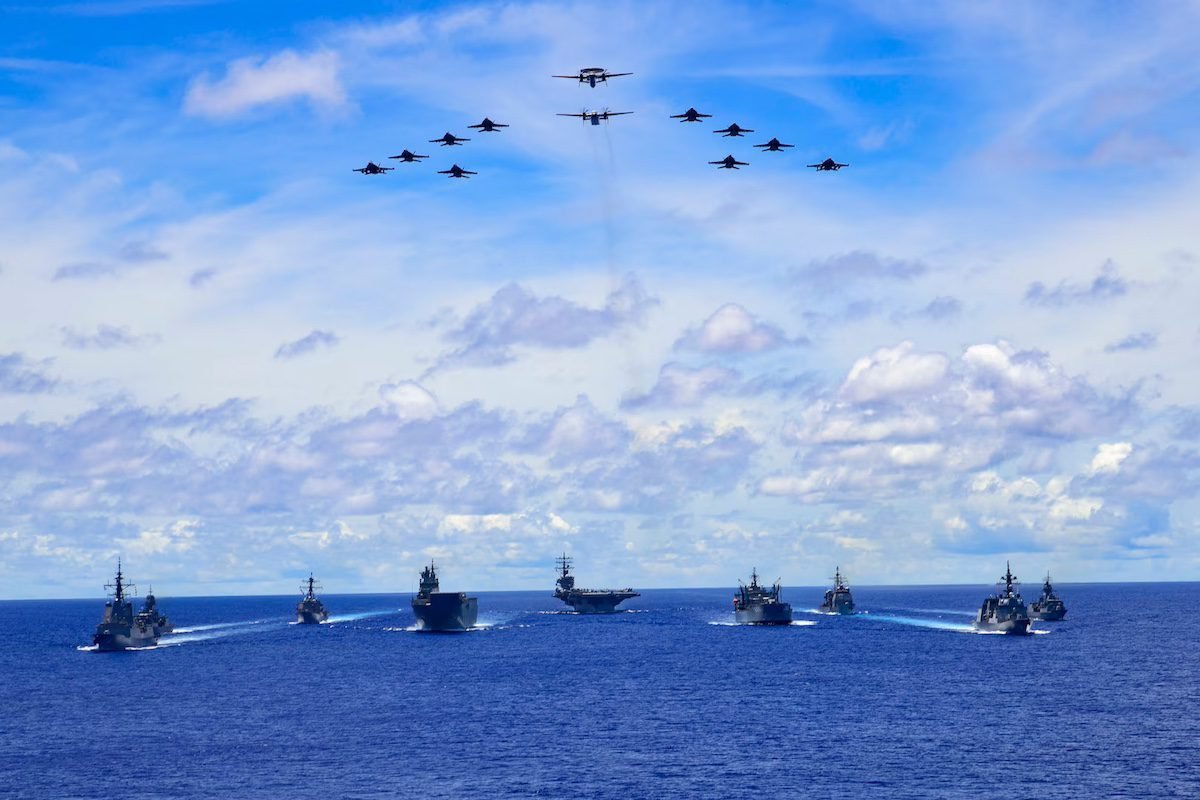
The US is racing to build a new deterrence architecture against China, but the widening gap between its strategic ambitions and its industrial, logistical and political capacity could leave that posture dangerously incomplete when it is needed most.
Last month, the Washington Times reported that the head of US Indo-Pacific Command warned the US Congress that the risk of conflict with China was rising and urged at least US$122 billion in fiscal 2027 spending to strengthen deterrence across the region, citing a private 221-page assessment from April 2026.
Admiral Sam Paparo said the funds were the minimum needed to sustain credible deterrence and prevail if war breaks out, citing China’s military expansion, pressure on Taiwan, territorial ambitions and closer ties with Russia and North Korea.
His request includes $67.4 billion for missiles, $18 billion to disrupt Chinese command-and-control systems, $15 billion for space-based warning and surveillance, and $2.3 billion for drones and other unmanned weapons.
The plan would also expand defenses and potential offensive missile capabilities on Guam, build infrastructure in Hawaii and Pacific islands, strengthen allied basing and exercises, and field lower-cost systems such as Blackbeard hypersonic missiles, Quicksink anti-ship bombs and advanced naval mines.
Paparo said China was preparing for a possible Taiwan operation by 2027 while using legal, economic and information pressure below the threshold of war. The unclassified summary, required under the Pacific Deterrence Initiative, is intended to shape congressional work on the fiscal 2027 defense bill.
Still, Paparo’s $122 billion request is less a procurement wish list than an admission that the existing US force posture in Asia is increasingly vulnerable. The emerging US deterrence network may be ambitious, but its credibility ultimately depends on industrial capacity, allied access and political endurance that cannot be taken for granted.
China’s increasingly capable missile and surveillance networks threaten traditional US power projection in the Pacific. Its anti-access/area-denial (A2/AD) network is designed to saturate and neutralize US carrier strike groups, according to a March 2026 article in Proceedings by Jordan Spector.
Spector notes that the system includes the operational DF-21D “carrier killer,” whose maneuverable warhead is intended to strike ships at long range, and the 3,862-kilometer-range DF-26B, which can target regional bases and naval forces. Spector estimates that China fields about 500 short-range and 450 medium-range ballistic missiles.
Those missiles, Spector says, are supported by a multilayered surveillance network comprising naval and air assets, satellites, coastal and sea-based over-the-horizon (OTH) radars and a maritime militia of thousands of vessels, giving China the capacity to detect, track and target US forces across wide areas of the western Pacific.
To compensate for the vulnerability of carriers and large fixed bases, the US Navy is moving toward a hybrid fleet and more dispersed operations.
George Galdorisi, in a February 2026 article for the Center for International Maritime Security (CIMSEC), describes a proposed 500-ship force comprising 350 crewed vessels and 150 large uncrewed maritime platforms intended to add operational mass at lower cost.
Under Galdorisi’s proposed concept, large uncrewed surface vessels would serve as modular carriers for smaller autonomous craft operating in highly contested waters.
These systems, he says, could perform intelligence, surveillance and reconnaissance (ISR) and mine-countermeasures (MCM) missions in littoral zones while keeping valuable capital ships outside the most dangerous parts of China’s anti-access envelope.
Operating as far as 926 kilometers from shore, he says such human-machine teams could generate mass and improve survivability without exposing additional crews.
The US is also shifting away from reliance on large, permanent garrisons toward a more flexible, distributed regional posture. A January 2026 Asan Institute report by Peter Lee and Esther Dunay says Agile Combat Employment (ACE) and Dynamic Force Employment would disperse aircraft and other assets across temporary, austere airfields secured through regional access agreements.
Lee and Dunay add that Expeditionary Advanced Base Operations (EABO) would similarly deploy small, mobile teams across a network of “lily pad” positions, complicating Chinese targeting while supporting sea control and reducing the vulnerability of concentrated forces.
Still, whether the US can address Paparo’s concerns remains an open question, given formidable practical and political constraints.
A May 2026 report by Seth Jones of the Center for Strategic and International Studies (CSIS) identifies serious deficiencies in US wartime readiness, including three- to four-year production timelines for critical munitions and depleted stockpiles from recent conflicts in the Middle East.
Jones points out that US logistics are also under strain, with sustained operational demands reportedly causing significant wear on more than 40% of deployed naval vessels. He states that forward bases in Japan, the Philippines and Guam remain exposed to Chinese precision missiles and drones, while many lack sufficient hardened shelters and active defenses.
He adds that access to facilities and military support from key allies, including Japan and Australia, is not always legally or operationally assured.
Those military constraints are compounded by political uncertainty. Writing in the New York Times after the May 2026 US-China summit, Anton Troianovski and David Sanger described President Donald Trump as moving away from the more confrontational approach associated with the Biden administration and his own first term.
Trump replaced tariff escalation and talk of economic decoupling with diplomatic conciliation, business re-engagement and public praise for Chinese President Xi Jinping. The shift suggests that the bipartisan consensus behind sustained strategic competition with China may be weakening even as military planners call for a larger and more urgent regional buildup.
Importantly, Troianovski and Sanger say that an accommodationist posture may reduce immediate tensions, but it also risks weakening the political commitment needed to fund, deploy and sustain the deterrence architecture military planners say is urgently required.
Whether the US can translate Paparo’s warning into a credible deterrent will thus depend less on headline spending than on how quickly it can expand munitions production, harden regional bases and secure dependable allied access before a crisis erupts.
If that effort stalls while political accommodation with China deepens, Chinese leaders may conclude that the widening gap between US military plans and its ability to execute them offers a narrowing yet increasingly tempting window for coercion or force.