The forthcoming Miss Kathi: Saving Lives in North Korea is a book-length account in English by an aid worker operating on the ground amid the tensions and threat of conflict perpetually looming over the Korean peninsula. For many North Koreans, Zellweger was the first foreigner they had ever met or even seen. Playing a central role in the early years of international relief efforts in North Korea was a lonely job, as she addressed the humanitarian needs of a suffering people largely ignored by the world because of their citizenship. She befriended local doctors, nurses, and caregivers; negotiated with suspicious government officials; and overcame international doubts about the diversion of relief supplies to the military. This excerpt looks at Kathi Zellweger’s experiences running a small NGO that she created that provided help to people with disabilities and support for children in institutions.
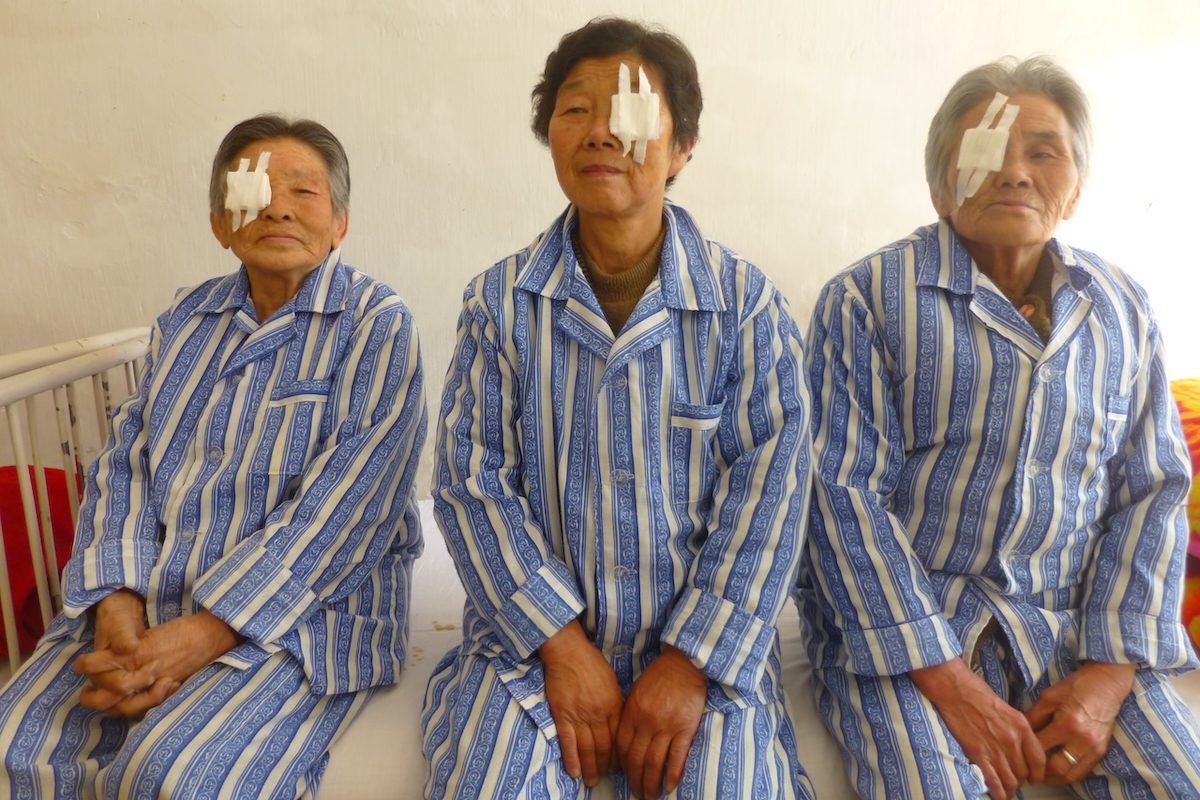
The South Pyongyan Provincial Hospital was a faded four-story building with grimy concrete steps leading to an entrance over which was draped a large propaganda banner. The white letters on a bright red backdrop read, “Let us health workers become the defenders of human life.” The hospital was in Pyongsong, the capital of South Pyongyan Province. Located thirty-two kilometers northeast of Pyongyang, the city was, in better days, known for its automobile industry, as a center of science and technology, and as the home of several universities. On this day in December 2019, I was visiting the ophthalmology unit. There, I met a retired teacher who had just had a cataract operation. With a patch on one eye and tears in his other, he gripped my hand and thanked me over and over, in Korean and in halting English, for helping to restore his eyesight.
It was a moment that brought home to me the value of KorAid, an NGO I had established in Hong Kong in 2015. Among its projects was assistance for cataract operations in the DPRK (Democratic People’s Republic of Korea – North Korea.) North Korean doctors knew how to do the relatively simple procedure but lacked the lenses and special eye medicine needed to carry it out. Once KorAid acquired these items abroad and shipped them, tens of thousands of North Koreans underwent the operation and got their sight back. To meet these patients was incredibly gratifying. It made worthwhile all the challenges and obstacles in setting up and operating a charity in the DPRK.
But it was still North Korea. When the grateful patient at the South Pyongyan Provincial Hospital announced that he wanted to invite me to his home for dinner to thank me, the officials in the room froze. I knew, as they did, that such a gesture, which would be unremarkable in so many other countries, would not be allowed in the DPRK. They got out of the potentially awkward situation when one of the doctors told the patient he would need to remain in the hospital for a few more days to reduce the risk of infection, and that I was visiting only on that day. All of us – including, I suspect, the patient – knew what was actually going on. But that was the way the system worked. Upon hearing this news, the patient gripped my arm even harder and kept saying, “Thank you.” He was eager to pose for a photo.
I had been interested in the plight of people with disabilities since my first trip to North Korea in 1995. I had long thought about trying to establish my own NGO to allow me to continue some kind of humanitarian work in the country. I felt I had the experience, the contacts, and the fundraising background to make it possible. I brainstormed with the people of the Korean Federation for the Protection of the Disabled, with whom I had long maintained a cordial relationship. I had found over the years that the KFPD, which I would call a semigovernmental organization, seemed to operate with slightly more freedom and flexibility than other institutions, and my exchanges with officials there often were more open than I had experienced elsewhere. It became clear that making cataract surgery available to the many people who needed it would be a meaningful endeavor.
My vision for KorAid initially had three main elements: to formalize and expand the cataract operation program by providing the lenses and special medicine to conduct at least three thousand surgeries a year; to support training programs for the staff, parents, and children at the Korean Rehabilitation Center for Children with Disabilities (KRCCD), a care center in Pyongyang for children with multiple disabilities, and to fund the building of a greenhouse at the Mirim orphanage on the outskirts of the capital so better nutrition for the approximately five hundred children institutionalized there could be provided – and hopefully serve as a model for other educational institutions to follow.
It was clear that the North Koreans needed not just inputs but above all training, and my hope was to be able to provide this in a coherent, professional way. I asked friends and colleagues for suggestions about what to call my new organization. In the end, I decided on KorAid. It was short, snappy, and easy to remember.
At the Mirim Orphanage, all the kids were assembled to greet me. They looked generally healthy, but sadly, many were extremely stunted – a legacy of the famine years and the food deprivation that continued long after. In talking about the future of these children, I was told that a very few would go to university, about a dozen would join the army, and the rest were to be assigned jobs in factories or on farms.

The kids slept up to ten to a room. The electricity supply was not bad by North Korean standards, with power cuts lasting just two or three hours most days. The dining room was small, and meals were taken in shifts. I felt that the overall food situation now appeared stable, but the kids clearly needed a more diversified diet than one based largely on rice and maize. Moreover, vegetables were still in short supply, especially in winter. That’s where the greenhouse that KorAid was proposing to support would come in. Not only would it help to provide better nutrition and act as a kind of insurance policy in case the food situation were to worsen again, but the children would learn how to grow vegetables, beginning with cucumbers, tomatoes, leeks, spring onions, eggplant, spinach, watermelons, and others — a valuable skill. More broadly, the greenhouse would serve as a model for other schools in the country, encouraging more educational institutions to be self-reliant.
The biggest event for the staff and the children at Mirim had been a visit from their leader, Kim Jong Un, in July 2016. The staff told that me Kim, impressed by what he saw, said that the school was like a paradise.

It was no surprise that a big slogan hanging from the main building read, “Let us become real sons and daughters of Marshal Kim Jong Un.” My hope was that Kim’s visit to an institution where KorAid was active would further legitimize our work in the eyes of the authorities, thus helping to overcome the bureaucratic difficulties that, given the nature of the North Korean system,even the most positive of projects periodically encountered.
Over time, Koraid began to expand its efforts, including supporting a project at the Hamhung Physical Rehabilitation Center in the far northeast, with the funds going to help produce approximately one thousand orthopedic devices annually. Constrained by a lack of cash and the pressure of international sanctions, the center was unable to acquire the devices on its own.
It was heartbreaking for me to see people, especially young people, who had lost one or both limbs in some freak industrial or car accident. But I was deeply moved by how determined the patients I met were to walk again and to resume as normal a life as possible. One twenty-two-year-old had lost both legs in a railway accident in January 2018. Just admitted to the Hamhung Physical Rehabilitation Center, he was very optimistic that with some practice using his new prostheses, he would be able to walk again. “My new legs are comfortable; I feel fine,” he told me. “I can go to a factory and work there. I feel like flying when I stand up from the wheelchair. The prostheses are my wings.”
It was always heartening to visit a place like this. Not only were thousands of disabled people receiving treatment that would transform their lives, but the treatment – and the degree of independence it would afford the patients – would have an incalculable impact on their family members and friends as well.
At the same time, however, North Korea continued its nuclear and missile tests, reflecting both the steady technical progress of North Korea’s nuclear capabilities and Kim Jong Un’s frustration with American policies that sought to isolate and sanction his country. The military moves completely overshadowed any efforts at humanitarian work. Moreover, they made the job of raising funds, purchasing materials, and shipping goods to North Korea much more difficult. Donors were becoming more reluctant to provide funds for projects in North Korea, making fundraising even more time-consuming and challenging. People frequently asked me if I had seen the list of all the items that the sanctions had mandated denying to North Korea.
Nonetheless, I remained convinced that despite the heightened tensions, the work of KorAid should continue. We were helping people in desperate need of assistance — powerless people who, I believed, didn’t deserve to be deprived of care because of the actions of their government. Moreover, despite the bellicose behavior, my sense was that the North Korean regime was not completely pulling back from international engagement. I felt it was more important than ever to sustain humanitarian and people-to-people contact, however fragile, so long as even in a small way it had the potential to improve understanding and contribute to a lessening of tensions. And so I persevered.
But in the spring of 2023, I received a strange letter from the Hong Kong branch of ICBC, the Industrial and Commercial Bank of China, where I had done my personal banking for years, and which also held the KorAid account. The letter said that both my personal and the KorAid account were being closed. No reason was given. I was shocked, and disappointed. Given China’s own extensive dealings with – and political support for – the DPRK, it didn’t seem to make sense that a Chinese bank would be so afraid of being sanctioned that it would act against a small organization KorAid.
Eventually, a plausible explanation emerged. It had nothing to do with North Korea; instead, according to a number of people familiar with the banking industry in Hong Kong and China, the likely reason was linked to the crackdown on NGOs and civil society that Chinese leader Xi Jinping had initiated. With NGOs a key target of repression in the Chinese mainland, and Hong Kong under a draconian new National Security Law Beijing imposed in June, 2020, major institutions in the territory – especially Chinese banks – would want nothing to do with any NGO, regardless of what it was involved in. This helped explain why an organization providing humanitarian assistance to people in a country with close ties to Beijing would become a target. How ironic it was that it should be the shadow of the Chinese Communist Party and its fear of any independent organization that would lead to the dissolution of KorAid.
The above excerpt from Miss Kathi: Saving Lives in North Korea, to be published September 1 by Post Hill Press, is © 2026 by Kathi Zellweger and Mike Chinoy. It is used with permission.
Kathi Zellweger, a native of Switzerland, is a veteran aid worker who has made 75 trips to North Korea. She played a key role in pioneering the involvement in North Korea of the Catholic humanitarian and development agency Caritas. She was also based in Pyongyang for five years as the country director for the Swiss Agency for Development and Cooperation. She later ran her own NGO, KorAid, a nonprofit serving children in institutions and people with disabilities in North Korea.
Mike Chinoy is a nonresident scholar at the at the University of California, San Diego’s 21st Century China Center. He spent 24 years as a foreign correspondent for CNN, serving as the network’s bureau chief in Beijing and in Hong Kong, and then as senior Asia correspondent. He has visited North Korea 17 times.