Astronomers say the upper stage of a Falcon 9 rocket that launched in early 2025 will strike the Moon later this summer, likely on the near side of the Moon.
Bill Gray, who writes the widely used Project Pluto software to track near-Earth objects, has published a comprehensive report on the impact expected to occur at 2:44 am ET (06:44 UTC) on August 5. The Falcon 9 rocket’s upper stage is 13.8 meters (45 feet) tall and has a 3.7-meter (12 feet) diameter. Since the Moon has no atmosphere, it will strike the lunar surface intact.
Although the Moon will be visible to the eastern half of the US and Canada, and in much of South America, Gray said he believes the impact will probably be too faint to be seen by Earth-based telescopes.
Highly confident in its origin
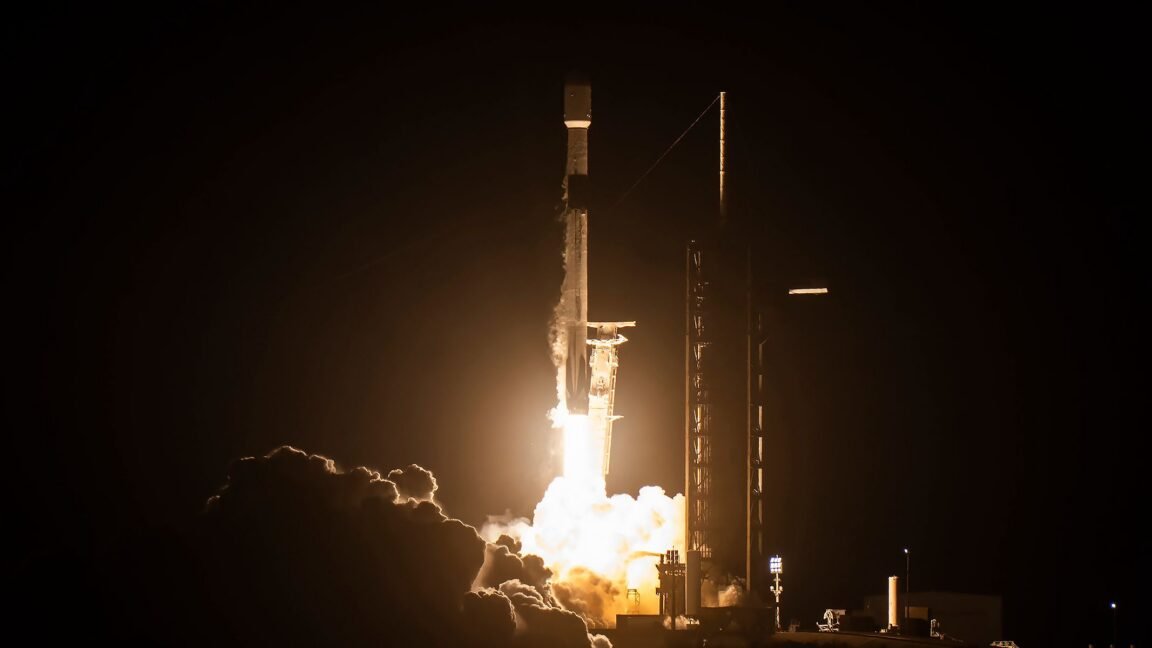
Gray said he and other astronomers are highly confident that this object is the second stage of the Falcon 9 rocket that launched two lunar landers, Firefly’s Blue Ghost and ispace’s Hakuto-R, on January 15, 2025. After the launch, the two landers, a payload fairing, and the upper stage were all tracked following their separation. The two landers reached the Moon (only Blue Ghost successfully touched down), and the fairing reentered Earth’s atmosphere.
“The upper stage, 2025-010D, also kept orbiting the Earth, but was a bit higher and didn’t re-enter,” Gray wrote. “It’s had a few close passes by the Moon and Earth, but nothing that was close enough to look like a possible impact. The asteroid surveys observed it whenever it wasn’t too close to the Sun or Moon to see. As of 2026 February 26, we had accumulated 1053 observations of it.”
Gray estimates the object will be traveling at 2.43 km a second, or 5,400 mph, when it strikes the Moon in or near the Einstein Crater. This is about seven times the speed of sound. It will create a small crater, but otherwise should do no damage.
Not the first time this has happened
Four years ago, Ars reported that astronomers believed another Falcon 9 upper stage would strike the Moon. However, subsequent analysis revealed that the object was, in fact, an upper stage from the Chinese Chang’e 5-T1 mission. Gray said there is no doubt that this object is the Falcon 9 upper stage because it has been tracked since launch.
There is no risk from its impact to anything on the Moon. It is a dead world, and there are no human-landed objects nearby.
However, both NASA and China are deep in the planning stages for establishing semi-permanent outposts near the South Pole of the Moon. As part of that, the cadence of launches on Falcon 9 and other rockets to the Moon is likely to increase by something like a factor of 10 due to the need to land rovers, supplies, habitats, communications equipment, and much more to support human activities.
There is a relatively easy fix for this: With some extra planning and sparing a little fuel, launch companies can put these stages into “disposal” orbits around the Sun and in a path that will avoid hitting Earth or the Moon in perpetuity. For the safety of future operations on the Moon, this probably should become standard operating procedure.