Municipal elections in Deir al-Balah offered rare political participation in Gaza while raising questions about Hamas’ influence, voter freedom, and the Palestinian Authority’s reach
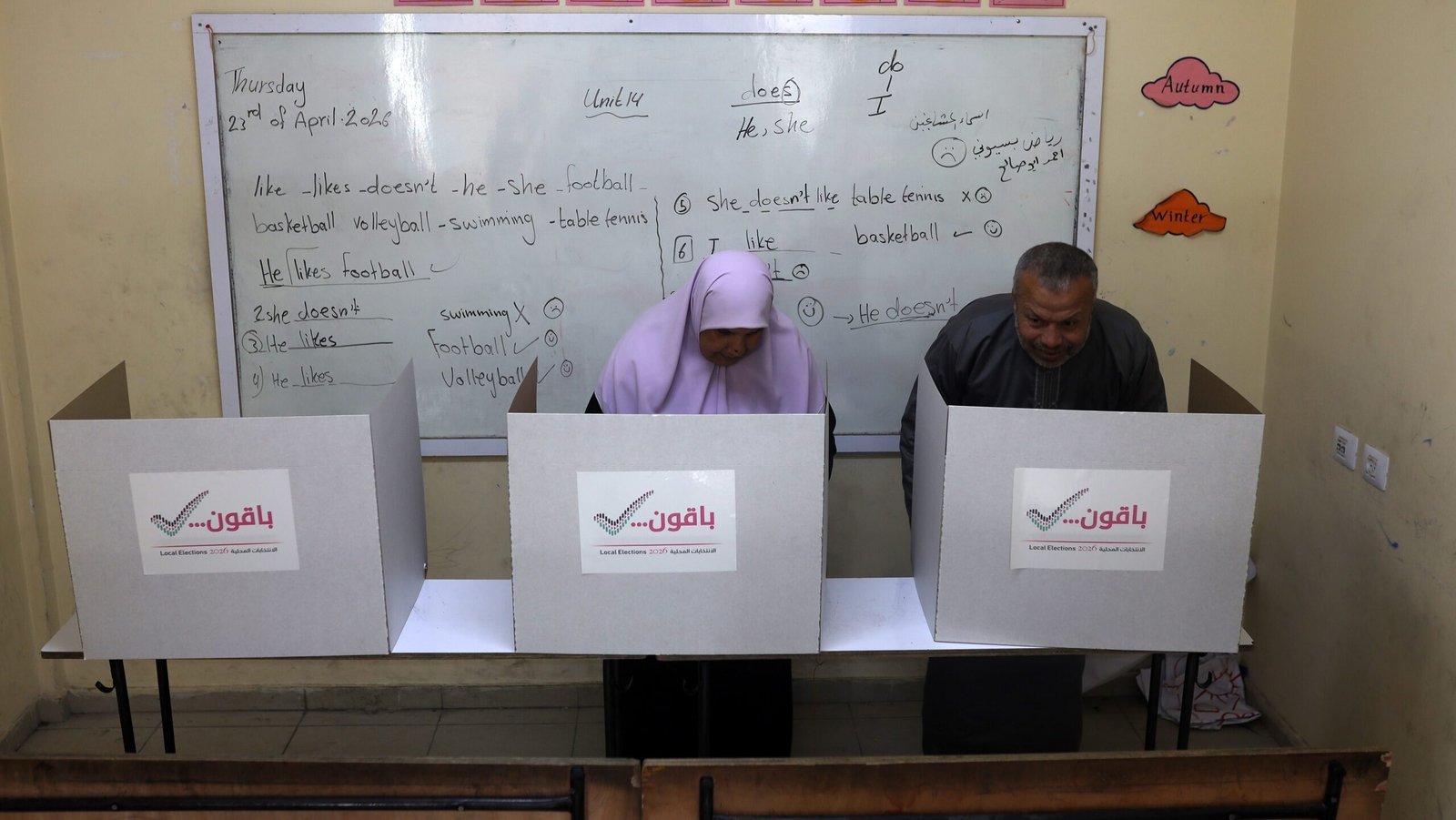
Palestinians voted Saturday in municipal elections in the West Bank and, for the first time in more than two decades, in the Gaza Strip, where voting was held only in the city of Deir al-Balah. The vote marked a rare moment of political participation in Gaza after years of division, war, and the absence of elections. It is also being read as a proxy gauge of Hamas’ standing two years into the war.
Polling stations opened across Deir al-Balah on Saturday morning. The Central Elections Commission operated 12 voting centers out of fiberglass tents. The campaign ran for 14 days, from April 10 to the evening of April 24.
Deir al-Balah was selected for two overlapping reasons. The central Gaza city sustained less war damage than Gaza City, Khan Yunis, or Rafah, making the logistics of polling possible. It also sits in the part of the Strip that Hamas still administers, on the western side of the Yellow Line that bisects Gaza, giving the Palestinian Authority a way to plant a flag in Hamas territory without contesting the roughly 53% of the Strip the Israeli military now holds.
No vote took place in the Israeli-controlled half.
The stakes were higher than the size of the city suggests. An entire generation of Gazans has come of age without ever casting a ballot. Anyone under 39 has never had the chance to vote.
Since 2007, Hamas has appointed every mayor and council member in every Gaza municipality, treating local governance as a function of the movement’s internal patronage rather than as a matter for residents to decide. Saturday was the first time in 22 years that a Gaza city chose its own leadership at the ballot box. Hamas, which still polices the streets of Deir al-Balah, stood aside while it happened. Its uniformed police nonetheless secured the perimeter of every polling station, even as the commission said it had not coordinated directly with either Hamas or Israel ahead of the vote.
Gazans are being arrested, jailed, tortured, shot, and killed daily for social media posts and anything they say that’s perceived as being critical of Hamas
Critics of the timing said standing aside was not the same as letting voters speak freely. Ahmed Fouad Alkhatib, a Gazan-born senior resident fellow at the Atlantic Council who heads the council’s Realign for Palestine project, called the decision to hold the vote now “extremely reckless and irresponsible.” Writing on social media in the days before the vote, Alkhatib argued that “Gazans are being arrested, jailed, tortured, shot, and killed daily for social media posts and anything they say that’s perceived as being critical of Hamas,” and said the elections should have been postponed until after the disarmament process the Board of Peace is trying to enforce.
“I’m very happy to be voting in local elections for the first time in my life
“I’m very happy to be voting in local elections for the first time in my life,” Ahmed al-Buhaisi, a resident of Deir al-Balah, told The Media Line. “This is a moment we have been waiting for a long time, because every citizen has the right to have a voice in choosing who represents them. This right has been denied to us for more than two decades. Today, I feel I am exercising my natural role as a citizen. I hope this step marks a real beginning for change.”
The vote covered 183 West Bank councils and Deir al-Balah. About 522,000 of roughly 1.03 million eligible Palestinians cast ballots, the Central Elections Commission said. Another 197 councils returned uncontested lists, mostly Fatah.
Commission Chair Rami Hamdallah announced final results Sunday. In Deir al-Balah, the “Deir al-Balah Renaissance” list, backed by Abbas’ Fatah movement, secured six of the 15 council seats. The “Future of Deir al-Balah” list took five. The “Peace and Building” list won two. A fourth list, “Deir al-Balah Brings Us Together,” which residents and analysts widely view as aligned with Hamas, won two. The new council will choose the mayor from among its elected members.
For the Palestinian Authority, the simultaneous vote in the West Bank and Deir al-Balah was an opportunity to display unified governance across both territories. The Fatah-led authority has not exercised real influence in Gaza since Hamas pushed it out in 2007. The PA used the day to assert that it remains the only Palestinian institution capable of organizing a vote in both territories at once.
Turnout in Deir al-Balah stood at 22.7%, with 15,962 of 70,449 eligible voters casting ballots, the lowest rate among Palestinian voting areas. Hamdallah blamed the low figure on an outdated civil registry that does not reflect the thousands of residents killed in the war or the entire families that fled the city. West Bank turnout reached 56%, slightly below the 58% recorded in the previous local cycle in 2022, the last time West Bank Palestinians went to the polls. Salfit Governorate posted the highest turnout at 71%.
Voting closed at 5 p.m. in Deir al-Balah, two hours earlier than in the West Bank, to allow counting to finish before dark in a city without reliable electricity. Workers in Gaza built roughly 100 wooden ballot boxes from materials available inside the Strip and printed ballot papers locally after Israeli authorities blocked standard election materials at the crossings, the commission said. To mark voters’ fingers, the commission used blue ink left over from a polio vaccination drive last year.
The vote took place under a new election law that Abbas signed on November 19, 2025. Decree-Law No. 23 of 2025 lowered the candidacy age to 23 to widen youth participation, set a four-year council term, and required candidates to pledge commitment to the program of the Palestine Liberation Organization, which carries with it recognition of Israel and the framework of past PLO agreements.
Hamas, which fielded no list, condemned the legislation in December as an attempt to exclude the movement and independents from local government. Twenty-eight Palestinian civil society organizations called the PLO-pledge requirement a restriction on political expression. Each of the four Deir al-Balah lists fielded 15 candidates, with at least four women on each slate, as the new law required. Across the West Bank, 3,773 candidates competed for municipal seats and 1,358 for village councils. Women made up about a third of declared candidates and headed eight lists. Women won 33% of contested council seats overall.
President Mahmoud Abbas, 90, cast his ballot at the al-Mustaqbal al-Saleh School in al-Bireh, the West Bank city adjoining the Palestinian Authority’s Ramallah headquarters. “We are very pleased that we are able to practice democracy despite all the difficulties we face locally and internationally,” he told reporters at the polling station. He said the local cycle would be followed this year by Fatah movement elections and a Palestinian National Council vote, his first public commitment to a national-level electoral calendar in two decades. Abbas was last elected to a four-year term in 2005. He has not faced a presidential vote since then.
Yusuf al-Slaibi, who directed the polling station at Anan Stadium in Deir al-Balah, told the Palestinian Authority’s official Wafa news agency that turnout was “satisfactory” given the conditions. Wafa reported that participation was heavier in the city’s western neighborhoods, including the refugee camp, the central mosque area, and Nakhil Street, than at polling stations to the east near Salah al-Din Street, which runs along the Strip’s main north-south axis closer to the Yellow Line.
The vote took place in a city that buried its previous mayor a year and a half ago. In December 2024, an Israeli airstrike destroyed the Deir al-Balah municipality building, killing Mayor Diab al-Jarou and members of his staff. The new council will inherit a city of about 75,000 residents that now hosts hundreds of thousands of displaced Palestinians from across the Strip.
The Media Line interviewed Faten Harb, a winning candidate on the Renaissance list, who said holding elections simultaneously in the West Bank and Gaza was “an important development and reflects Palestinian unity.” She pointed to pressing needs in the city, including basic services and humanitarian conditions.
“We face major challenges in Deir al-Balah, with urgent priorities such as securing water and electricity, improving sewage services, tackling the spread of rodents, and dealing with solid waste,” Harb said.
“In addition, the displacement crisis remains one of the most pressing challenges,” she added. “The city hosts more than 40,000 displaced people, which requires special attention to ensure they are accommodated and that their basic needs are met.”
The elections also revived longstanding questions about political control in Gaza and the role of Hamas, which has governed the Strip since its armed takeover in 2007.
The previous local vote in Gaza took place in late 2004 and early 2005, before Hamas won the January 2006 legislative election. International donors refused to recognize the Hamas-led government, and in June 2007, the movement seized full control of the Strip after armed clashes with Fatah forces. The territories have held no national vote of any kind since then. The split between Hamas and the Palestinian Authority has delayed or blocked municipal voting in Gaza repeatedly over the years.
Despite boycotting the current vote and not fielding official candidates, Hamas remained a central presence in how many residents interpreted the election. Two of the candidates on “Deir al-Balah Brings Us Together” had previously been photographed with Hamas officials or members of the Hamas-run police, according to the Center for Peace Communications.
Hamas spokesman Hazem Qassem described the Deir al-Balah vote as “an important step” and called for broader elections at all levels to “rebuild Palestinian legitimacy” after more than two decades without national polls. He said the process should reflect “the will of the people” and emphasized coordination to ensure a “fair and transparent vote.”
Qassem’s call for democratic renewal came from a movement that took power in Gaza by force. After winning the January 2006 legislative election, Hamas refused to share governance with Fatah and, in June 2007, routed Palestinian Authority security forces in six days of street fighting that killed more than 160 Palestinians. Fighters threw rivals from rooftops in Gaza City. In the years that followed, Hamas held no further elections of any kind, jailed Fatah organizers, beat journalists who covered internal dissent, and shot demonstrators during the 2019 “We Want To Live” protests against the cost of living. Alkhatib, of the Atlantic Council, said this month that Gazans critical of the movement on social media are still “arrested, jailed, tortured, shot, and killed daily.” Qassem’s statement made no mention of the movement’s December opposition to the underlying election law.
The statement came two days before Hamas negotiators were set to resume talks in Cairo on Monday with Nickolay Mladenov, the Board of Peace’s envoy for Gaza, on the group’s weapons.
Hamas officials have signaled they will hand over thousands of automatic rifles and other small arms carried by the police and internal security services of the Hamas government. Those weapons would pass to the National Committee for the Administration of Gaza and to a new Palestinian police force operating under the Board of Peace. The same officials say they have already laid the groundwork to fold former Hamas government employees into the new security apparatus.
Hamas has not put on the table the arsenal of its armed wing, the Izzadin al-Qassam Brigades. Negotiators have offered no commitment on the tunnel network, the rockets, drones, and anti-tank missiles the wing still holds, or the underground workshops that produce heavy weapons. Israeli officials estimated this week that the Qassam Brigades have rebuilt their ranks to roughly 27,000 fighters during the ceasefire, while Hamas continues paying monthly salaries to about 49,000 administrators who run the Strip’s day-to-day governance across 13 municipalities, including ministries handling the economy, education, health, and welfare.
The disarmament talks come after two weeks of renewed tensions and mutual accusations of ceasefire violations. Israeli authorities reported multiple incidents involving Palestinian factions between April 8 and 16, while continuing targeted strikes in Gaza. Palestinian officials and residents say some of those strikes have hit populated areas, including an April 23 attack on a police vehicle in Khan Yunis that killed eight people, among them three civilian bystanders.
According to Gaza’s Health Ministry, 984 Palestinians have been killed since the October ceasefire took effect. Israeli authorities say attacks by Palestinian fighters during the same period have killed four Israeli soldiers.
Hamas is also fighting other Palestinian armed groups, including the Popular Forces, which Israel began arming in 2024 and which has remained active despite the December killing of the network’s original founder, Yasser Abu Shabab of the Tarabin tribe. Smaller groups led by former PA security officers Hussam al-Astal and Shawqi Abu Nasira operate in eastern Khan Yunis.
On April 20, Astal’s fighters crossed from Israeli-controlled territory into a Hamas-held area east of Khan Yunis and traded fire with Hamas, which struck the retreating armed group’s vehicle with an anti-tank grenade.
“It is unfortunate to see individuals known for supporting Hamas included on one of the lists,” Hala Saeed, a resident of Deir al-Balah who decided not to vote, told The Media Line. “This raises doubts about attempts by Hamas to return to power through indirect means and increases the sense of concern and mistrust among residents.”
I don’t believe these elections will change anything on the ground or improve people’s current conditions
“I don’t believe these elections will change anything on the ground or improve people’s current conditions,” Saeed said, “especially with the war ongoing and casualties falling every day.”