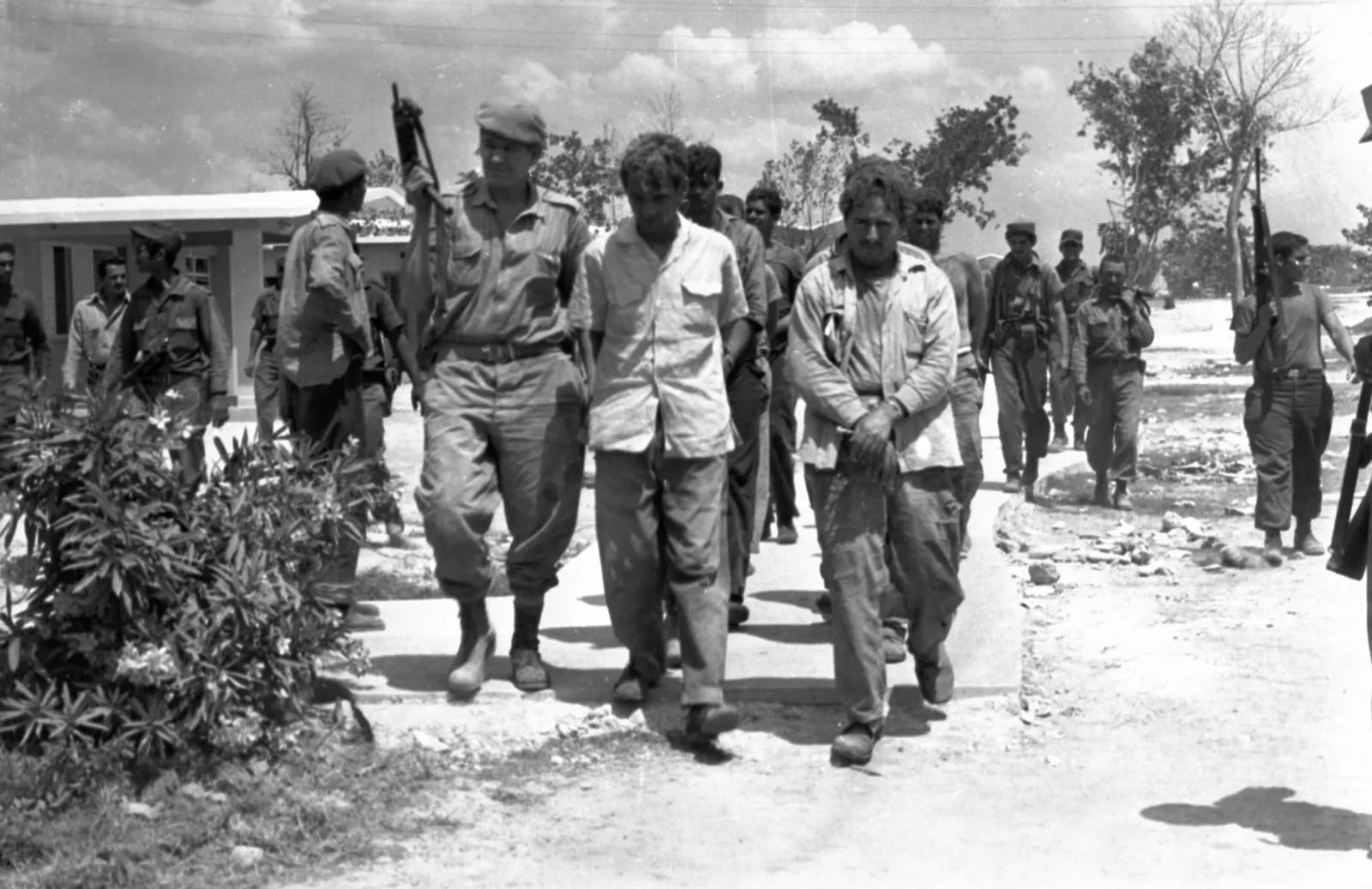
WASHINGTON, April 16, 2026 – In the wake of the failed CIA-led Bay of Pigs invasion, President John F. Kennedy considered reconfiguring and even dismantling the intelligence agency, according to documents posted by the National Security Archive on the 65th anniversary of the paramilitary assault on Cuba.
The President tasked his White House aide, Arthur Schlesinger, to examine “the British intelligence set up” to determine “what of value there might be for our own thinking about CIA reorganization,” according to a little-known secret memorandum to Kennedy dated a month after attack.
“What is of special interest in the British experience is, not the division between intelligence and operations,” Schlesinger advised the President, “but the means by which the clandestine service is kept under continuous policy control.”
The May 18, 1961, document, titled “How to Organize an Intelligence Service: The British example,” along with a second Schlesinger memo declassified in full last year on “CIA Reorganization,” are included in a special collection of formerly secret records posted today by the National Security Archive to commemorate the Bay of Pigs invasion.
The selection also includes a comprehensive secret CIA report on its collaboration with the Mafia to assassinate Fidel Castro in advance of the invasion – a plot paid for out of the invasion budget – as well as Cuban intelligence reports from Central America on the CIA’s preparations to launch an exile attack on the island.
Today’s anniversary posting also highlights the top secret, 100-page CIA “Inspector General’s Survey of the Cuban Operation” – a scathing, self-critical, agency postmortem considered so sensitive that CIA director John McCone burned most of the 20 existing copies to sequester the report from critics, like Schlesinger, who sought to hold the Agency accountable for the Bay of Pigs debacle. “In unfriendly hands,” CIA Deputy Director William Cabell noted in a December 1961 memorandum, the IG report “could become a weapon unjustifiably used to attack the entire mission, organization, and functioning of the Agency.”
After several years of FOIA efforts, the National Security Archive obtained the declassification of the CIA inspector general’s report – the historical Holy Grail of the Bay of Pigs – in the late 1990s.
The inspector general’s “survey” was conducted by CIA veteran officer Lyman Kirkpatrick, who spent almost six months interviewing officials and reviewing thousands of contemporaneous records. Among his main conclusions:
- The operation was predicated on CIA deputy director Richard Bissell’s assumption that “the invasion would, like a deus ex machina, produce a shock … and trigger an uprising” against Castro. Yet, the CIA had “no intelligence evidence that Cubans in significant numbers could or would join the invaders ….”
- What was supposed to be a covert operation became a major overt military project “beyond the Agency’s responsibility as well as Agency capability.” Security around the operation was poor, resulting in major leaks in the media exposing the invasion preparations. “Plausible denial was a pathetic illusion.”
- CIA officials misled the White House into believing that success was still likely. “At some point in this degenerative cycle,” according to the Kirkpatrick report, “they should have gone to the President and said frankly: ‘Here are the facts. The operation should be halted.’”
In March 2001, for the 40th anniversary of the Bay of Pigs invasion, the National Security Archive organized a major conference in Havana, Cuba, with Fidel Castro and his commanders to review the history of the invasion and its aftermath. The US delegation included surviving members of the Kennedy White House, retired CIA officers involved in planning for the invasion and Cuban exile members of the CIA-organized 2506 Brigade, some of whom had not returned to the island since they had been taken prisoner after the failed attack.
During the conference, former White House aide Richard Goodwin provided a personal report to Fidel Castro on a secret post-invasion meeting he had in Montevideo, Uruguay, with Che Guevara. The meeting marked the first time high officials of the two countries held a face-to-face dialogue to address the hostility in US-Cuban relations.
The history-making talks took place in an extremely informal setting. Guevara sat on the floor, Goodwin recalled, and “I was not going to let him out-proletarianize me” so he sat on the floor also. Guevara “wanted to thank us very much for the invasion,” Goodwin reported back to Kennedy on the meeting. “It had been a great political victory for them, enabled them to consolidate, and transformed them from an aggrieved little country into an equal.”
But Guevara’s main message for the Kennedy administration was that Cuba “would like a modus vivendi” and was willing to engage in a dialogue on all the issues of concern to the US, with one exception: Cuba “could discuss no formula that would mean giving up the type of society to which they were dedicated.”
Sixty-five years later, that continues to be Cuba’s position as the post-Castro government of Miguel Diaz-Canel faces the most dangerous threat of US military action since the Bay of Pigs. This anniversary of the Bay of Pigs holds a singular contextual relevance as a reminder of US aggression and Cuban defiance. The Bay of Pigs remains a cautionary history immediately relevant to the need for dialogue over violence to advance the interests of both nations.

The Documents
Document 1
CIA, Minutes, “First Meeting of Branch 4 Task Force, 9 March 1960,” Secret, March 9, 1960
Mar 9, 1960 – Source: Digital National Security Archive collection: Cuban Missile Crisis Revisited: An International Collection of Documents, From the Bay of Pigs to the Brink of Nuclear War
This is a memorandum of conversation of the first CIA Task Force meeting to plan what became the Bay of Pigs, a covert operation to recruit, train, and infiltrate paramilitary units into Cuba to overthrow Fidel Castro. The meeting is noteworthy because the chief of the Western Hemisphere division, J.C. King, states that “unless Fidel and Raul Castro and Che Guevara could be eliminated in one package – which is highly unlikely – this operation can be a long, drawn-out affair and the present government will only be overthrown by the use of force.”
Document 2
May 16, 1960 – Source: Cuban Missile Crisis Revisited
This memorandum outlines the original covert program for what evolved into the Bay of Pigs operation. Dated May 16, 1960, the plan was presented to and authorized by President Eisenhower the next day. Components of the plan include the creation of a unified Cuban opposition, development of broadcasting facilities, and the training of paramilitary forces. The purpose of the operations, according to the proposal, is to “bring about the replacement of the Castro regime with one more devoted to the true interests of the Cuban people and more acceptable to the US in such a manner as to avoid any appearance of US intervention.” The original proposed budget is $4.4 million; by the time of the invasion the budget has risen to $45 million.
Document 3
Jan 12, 1961 – Source: Cuban Missile Crisis Revisited
Four months before the invasion, Cuban intelligence agents filed this detailed report on CIA preparations to invade Cuba. The report focused largely on Guatemala, where the CIA had established a training base for a large exile force. Cuban agents counted an estimated 48 B-26 airplanes that were to be used in the attack and stated that the “majority of the planes are unmarked and most are painted black.” Nighttime “parachute drills” were being conducted as part of the training of the invasion force, and “training sessions are being held using real firepower.”
Document 4
May 6, 1961 – Source: Cuban Missile Crisis Revisited
This May 5, 1961, report, written by Colonel Jack Hawkins, the paramilitary chief of the Bay of Pigs operation, is the first detailed post-mortem on the Bay of Pigs operation. His 48-page report cited poor CIA organization, and “political considerations” imposed by the Kennedy administration, such as the decision to cancel D-day airstrikes which “doomed the operation,” as key elements of its failure. “Paramilitary operations cannot be effectively conducted on a ration-card basis,” the report concludes. “The Government and the people of the United States are not yet psychologically conditioned to participate in the cold war with resort to the harsh, rigorous and often dangerous and painful measures which must be taken in order to win.” Hawkins also recommended that further covert operations to depose Castro, unless accompanied by a military invasion, “should not be made.” Castro, according to the report, could “not be overthrown by means short of overt application” of US force.
Document 5
May 18, 1961 – Source: Obtained by National Security Archive senior analyst William Burr at the National Archives
In this little-known memo to President Kennedy dated a month after the failed attack on Cuba, White House aide Arthur Schlesinger Jr. reports on his assignment to research the organization of British intelligence agency MI6 and its relations with the British Foreign Ministry. The President has tasked Schlesinger to examine “the British intelligence set up” to determine “what of value there might be for our own thinking about CIA reorganization” – reflecting Kennedy’s consideration of reconfiguring the CIA in the wake of the Bay of Pigs debacle. “What is of special interest in the British experience is, not the division between intelligence and operations,” Schlesinger advised the President, “but the means by which the clandestine service is kept under continuous policy control.” In his conclusions, Schlesinger argued that large scale covert operations could not be kept secret and that efforts to create cover stories for such operations would invariably damage U.S. values and credibility at home and abroad.
Document 6
White House, Memorandum, “CIA Reorganization,” Secret, June 30, 1961
Jun 30, 1961 – Source: JFK Assassinations Records Act collection, March 2025 release
In this lengthy memo to the President, White House aide Arthur Schlesinger Jr. lays out a detailed argument for “reconstituting” the CIA in the aftermath of the failed Bay of Pigs invasion. He suggests that the agency should be brought under the control of the State Department and that its intelligence gathering and operational functions be separated into two new entities with the ”blameless” titles of the “Foreign Research Agency” and “The National Information Service.”
Document 7
Aug 22, 1961 – Source: John F. Kennedy Presidential Library
In this memorandum of conversation, White House aide Richard Goodwin recounts for President Kennedy his meeting with Ernesto “Che” Guevara—the first back-channel dialogue between Washington and Havana. Guevara wanted to establish a “modus vivendi” with the US government, Goodwin reports. He also “wanted to thank us very much for the invasion – that it had been a great political victory for them—[and that it had] enabled them to consolidate and transformed them from an aggrieved little country to an equal.”
Document 8
Oct 1, 1961 – Source: National Security Archive Freedom of Information Act request by Peter Kornbluh
This internal analysis of the CIA’s Bay of Pigs operation, written by CIA Inspector General Lyman Kirkpatrick after a six-month investigation, is highly critical of the top CIA officials who conceived and ran the operation and places blame for the embarrassing failure squarely on the CIA itself. The report cites bad planning, inadequate intelligence, poor staffing – and misleading of White House officials including the president – as key reasons for the failure of the operation. “Plausible denial was a pathetic illusion,” the report concluded. “The agency failed to recognize that when the project advanced beyond the stage of plausible denial it was going beyond the area of agency responsibility as well as agency capability.” The declassified report, obtained under the Freedom of Information Act, also contains a rebuttal to Kirkpatrick from the office of deputy director Richard Bissell, challenging those conclusions.
Document 9
CIA, Memorandum, “Maheu, Robert A.,” Secret Eyes Only, June 24, 1966
Jun 24, 1966
The CIA’s director of security, Howard J. Osborn, sends a detailed summary to the deputy director on the CIA-Mafia collaboration to assassinate Castro before the Bay of Pigs invasion. The history starts with the authorization from the deputy director for plans, Richard Bissell, for “a sensitive mission requiring gangster-type action. The mission target was the liquidation of Fidel Castro.” The report describes how Robert Maheu was used as a CIA “cutout” to approach mobsters Johnny Roselli and Sam Gold. It also describes how the CIA’s Technical Services Division “developed a pill that had the elements of rapid solubility, high lethal content, and little or no traceability” as an assassination device. Six pills were produced and passed initially to a Cuban official with mafia ties, Juan Orta. When he got “cold feet,” the pills were passed to a member of the Cuba Exile Junta, Anthony Verona, to pass to operatives in Havana. But, the report states, “Verona’s potential was never fully exploited as the project was cancelled shortly after the Bay of Pigs episode.”
Peter Kornbluh is the National Security Archive’s Cuba Documentation Project director and is the author of books including Bay of Pigs Declassified. This article is republished from the original, which can be read here.