US President Donald Trump’s announcement that the US Navy would impose a blockade of the Strait of Hormuz, announced after failed face-to-face talks in Islamabad, signals a perilous new phase of the Iran war, one that threatens to prolong the oil shock’s impact on the global economy and entrench US forces in a long-term conflict.
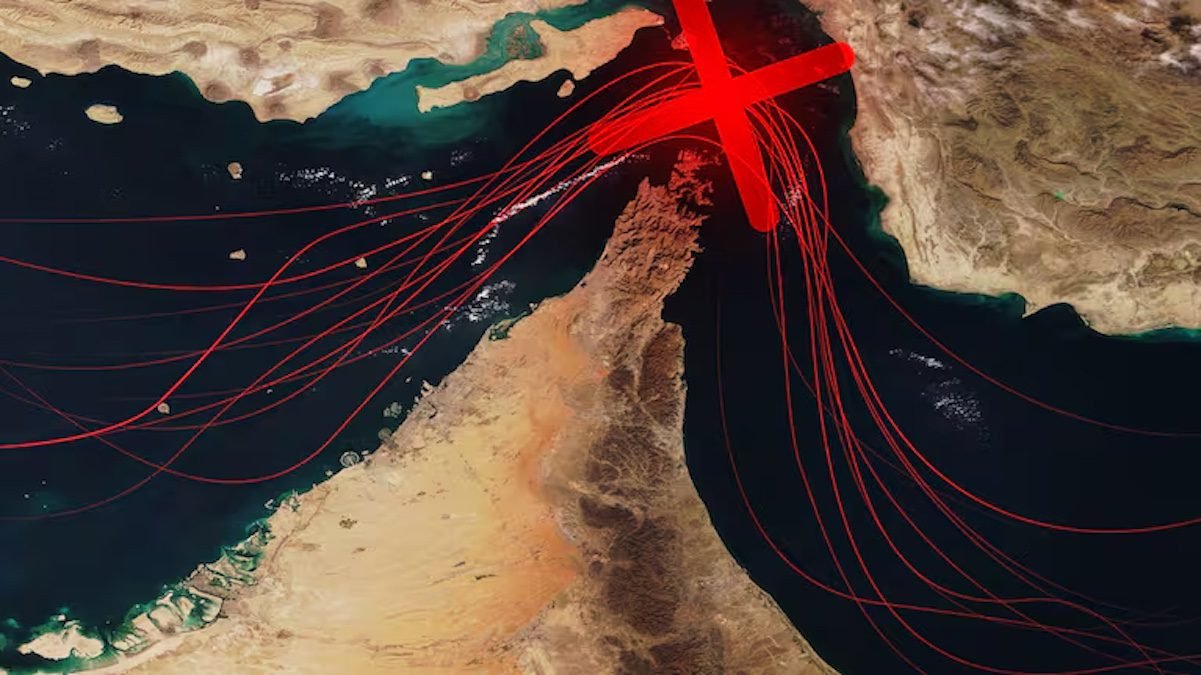
Trump’s move, labeled as “illegal” by some, aims to challenge Iran’s equally legally dubious sovereign claim to what until recently had been a de facto free international waterway, through which an estimated 20% of the world’s oil and liquified natural gas shipments flow.
Iran has recently mined the strait, raising concerns that it may not be able to locate all the mines. The US Central Command says its forces have begun mine-clearing operations, a move Iran has said violates the ceasefire.
Iran’s Islamic Revolutionary Guard Corps has imposed what analysts describe as a de facto toll-booth regime, requiring vessels to submit documentation, obtain clearance codes and accept IRGC-escorted passage through a single controlled corridor, with fees of up to US$2 million per ship reported.
Tehran is thus now acting as a “marine highwayman,” demanding tolls from shippers of favored nations to facilitate passage. Trump’s threatened blockade, set to take effect on April 13, aims to upend that arrangement, which the International Maritime Organization’s secretary general has said violates international law and urged nations not to pay, citing the “very detrimental” precedent it would set for global shipping.
CENTCOM has clarified that the US blockade targets vessels entering or departing Iranian ports specifically, rather than all traffic transiting the strait — a distinction that may bear on how its legality is assessed under UNCLOS.
Freedom of navigation through the Strait of Hormuz was more or less unquestioned until February, despite proclamations by Iran in 1959 and by Oman in 1972 to extend their territorial seas to 12 nautical miles, practically choking the strait, which at its narrowest point is only 21 nautical miles wide. Both countries had promised to allow “innocent passage,” and Iran’s actions are in clear breach of that promise.
During the Iran-Iraq War in the 1980s, the US used force to keep the strait open and shot down an Iranian plane over the waterway, killing all 290 aboard. The Reagan administration wrote to Iran expressing regret and paid $61.8 million in compensation to the families but did not accept responsibility. Iran again claimed control in 2011 but did not enforce it; the 2015 Iran nuclear accord did not address freedom of navigation in the strait.
Iran has made sovereignty over the strait a formal condition of any peace deal, alongside demands for an end to all uranium enrichment restrictions, a halt to the dismantling of its nuclear facilities, war reparations and the release of frozen assets abroad. Tehran is not merely seeking leverage but asserting a permanent legal claim over the strait, making a negotiated settlement unlikely.
Trump’s announcement of a blockade has raised the risk of renewed hostilities after the two-week ceasefire expires. Trump has said he is considering resuming limited military strikes after the failed talks in Pakistan.
Significantly, the US blockade still lacks allied backing. The United Kingdom, which Trump claimed would send minesweepers, said it would not participate in a blockade, with a government spokesperson stating that it is “urgently working with France and other partners to put together a wide coalition to protect freedom of navigation.”
Britain has been hosting talks with roughly 40 countries on reopening the waterway independently of US military action. This matters legally: a multilateral freedom-of-navigation coalition operating under UNCLOS would rest on far firmer legal ground than a unilateral US blockade, and would present Iran with a broader international front.
Issues of international law have been raised over US-Israel attacks on Iranian civilian and energy infrastructure and the US torpedoing of an Iranian naval vessel in the Indian Ocean.
Now, with legal issues being raised about the threatened US blockade, it may be useful to examine the legal position. The UN Convention on the Law of the Sea (UNCLOS) is a reference point, even though the US and Israel have never signed it; Iran signed but has not ratified it; Oman is a party to the convention.
Articles 37–44 of UNCLOS describe the rights and duties of ships transiting straits used for international navigation between two parts of the high seas. The Strait of Hormuz is accepted by most jurists to fall within this category.
The rights of ships include “unimpeded” passage and “freedom of navigation,” while the duties entail transiting without delay, refraining from any threat or use of force against the states bordering the strait and not carrying out research or survey activities during the transit.
If the bordering states wish to designate sea lanes and traffic separation schemes for transit passage, they have to get these adopted by the competent international body.
The bordering states are prohibited from hampering transit or exercising any discrimination “in form or in fact among foreign ships.” The articles state that “there shall be no suspension of innocent passage through such straits.”
Iran denies that the transit passage regime is part of customary international law and seeks to enforce its domestic 1993 law, under which innocent passage is subject to prior authorization based on Iran’s national security interests.
Iran’s position seems untenable; the right of innocent transit has been well recognized in the case of archipelagic sea lanes as well as in canals and straits. The Permanent Court of International Justice held that even the passage of a belligerent man-of-war does not compromise the neutrality of a sovereign strait.
If a bordering state wants to close an international waterway, it has to do so under an agreement or convention; under the 1936 Montreux Convention, Turkey can close the Bosporus Strait if it is at war or threatened.
A bordering state, however, may not unilaterally impede transit or enforce a discriminatory regime through a strait connecting two seas, much less charge a passage fee, as Iran is now.
The International Court of Justice denied that right to Albania when it tried to exercise discretion over foreign warships’ innocent passage through the Corfu Channel.
The Strait of Hormuz is clearly an international shipping lane connecting multiple countries through the Persian Gulf, the Gulf of Oman, the Arabian Sea and the Indian Ocean.
Iran’s insistence that it is open only to countries not hostile to Tehran is belied by the facts of toll collection and mine-laying; traffic through the Strait of Hormuz has been reduced to a trickle by Iran’s blockade actions in recent weeks.
The human and economic cost of the closure is high and rising. Brent crude surged past $120 per barrel after the strait closed in early March and jumped another 7–8% on news of the US blockade announcement.
A Columbia University energy economist warned Sunday after talks broke down that elevated prices are likely to persist into late 2026 even after hostilities end, because shippers will not re-enter the Gulf until they are confident any ceasefire is durable. Meanwhile, damaged oil facilities will take months to repair.
In the Gulf states, 230 loaded oil tankers are waiting inside the strait unable to exit; the maritime blockade has disrupted over 80% of the region’s food imports, which depend on the same route. The strait is also central to the global fertilizer trade, with over 30% of the world’s urea exported through it, threatening food security far beyond the Middle East.
Any doubt about innocent passage through the Strait of Hormuz being part of customary international law is clarified by Resolution 2817 (2026), adopted by the UN Security Council on March 11, 2026.
It recalls Resolution 552 (1984), which reaffirmed the right of shipping in the Persian Gulf region for vessels traveling to and from ports of states not party to the hostilities. The 2026 resolution deplores the attacks and threats on ships in and near the Strait of Hormuz and their adverse impact on international trade, energy security and the global economy.
Of the 15 council members, 13 voted in favor while Russia and China did not exercise their veto and abstained.
In spite of the legal weaknesses in Iran’s position, it is unlikely to forgo leverage on this issue. Perhaps the only option other than war is to take it to the International Court of Justice, though doing so faces a procedural hurdle — Iran has not accepted the ICJ’s compulsory jurisdiction, meaning a case would require either Iranian consent or a specific treaty basis, neither of which is assured.
The proceedings may be lengthy, and the court may, based on historical practice, be inclined to grant an interim injunction prohibiting both Iran’s interference with commercial shipping and the US blockade.
This would give a face-saving opportunity to both Trump and Iran’s embattled regime. It is quite likely that Iran may ignore the ruling, as China did with the orders of the Permanent Court of Arbitration in the case against its nine-dash line claim to the South China Sea.
In that situation, it will help diminish US-Israel isolation in handling the Iranian regime. With an ICJ injunction, other countries would feel legally enabled, indeed even obligated, to join action against Iran to maintain their shipping rights.
Iran’s pronouncements have made it clear that it seeks sovereignty over the Strait of Hormuz. If this legally dubious precedent is established, China may next declare similar sovereignty over the Taiwan Strait. That would expose all the nations bordering the East China Sea and the South China Sea to the hegemony of China’s communist government over crucial waterways.
Silent spectators to Iran’s de facto blockade of the Strait of Hormuz and the potential dangerous precedent it sets would thus be wise to remember the words of Nobel Peace Prize laureate Archbishop Desmond Tutu, who famously said, “If you are neutral in situations of injustice, you have chosen to be on the side of the oppressor.”