On the home stretch of their nine-day mission, the four astronauts flying aboard NASA’s Orion spacecraft are just beginning to reflect on their experience of flying beyond the Moon.
Their memories of Monday’s encounter with the Moon are still fresh as they return to Earth, heading for reentry and splashdown in the Pacific Ocean on Friday evening.
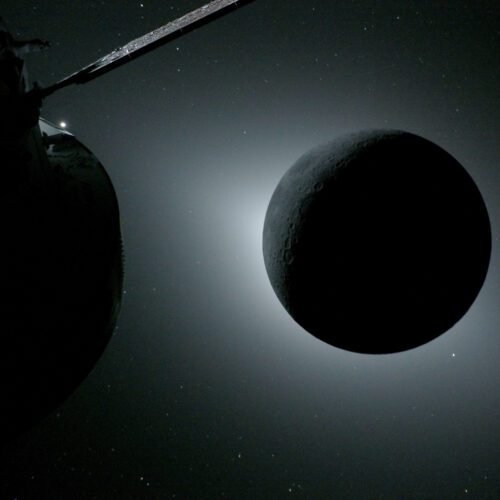
“I’m actually getting chills right now just thinking about it. My palms are sweating,” said Reid Wiseman, commander of the Artemis II mission. “But it is amazing to watch your home planet disappear behind the Moon. You can see the atmosphere. You could actually see the terrain on the Moon projected across the Earth as the Earth was eclipsing behind the Moon. It was just an unbelievable sight, and then it was gone. It was out of sight.”
Flying more than a quarter-million miles from home, father than any humans in history, the astronauts flew into a radio blackout for 40 minutes. Out of contact with Earth, the crew continued snapping pictures and shared a batch of maple cookies supplied by Canadian astronaut Jeremy Hansen, the first person not from the United States to ever travel to deep space.
“We took about three or four minutes, just as a crew, to really reflect on where we were, and then it was right back into the science,” Wiseman told reporters in a long-distance press conference Wednesday night. “We still haven’t even begun to reflect on this mission. We had a little bit of a light work day yesterday, and we were starting to journal and reflect a little bit. And there’s a lot that our brains have to process. Human minds should not go through what these just went through, and it is a true gift.”
Soon after reaching their closest point to the Moon, some 4,000 miles away, the astronauts flew into the shadow of the Moon. For Victor Glover, pilot of Artemis II, this was one of the “greatest gifts” of the mission.
“When that actually happened, it just blew us all away,” Glover said. “I mean, you heard the reaction real-time… Launching on April 1 meant the far side wasn’t as illuminated as we were hoping.”
Artemis II launched April 1 on the first opportunity in a six-day launch window. Launching on that date meant only about 20 percent of the far side of the Moon would be in sunlight when the Orion spacecraft reached the point of flyby. But the trajectory set up by an April 1 launch allowed for a rare cosmic alignment, with the Moon passing directly between the Orion spacecraft and the Sun. A launch later in the April window would have seen more of the far side in sunshine, but no eclipse.
The real-time reaction to the eclipse was pure joy. “We just went sci-fi,” Glover said at the time of the flyby. “It is the strangest-looking thing.”
Glover also noted the stark view of the Moon’s terminator, the transition between day and night. “There were holes, craters that appeared to be just endless, bottomless pits, and then peaks that seemed to be, I couldn’t tell how high,” Glover said Wednesday.
More to come
The astronauts beamed down some of their lunar imagery through the Orion spacecraft’s laser communications link. The rest of the photos, along with more detailed recordings of their observations, will come back to Earth when the mission ends on Friday.
The Earth is getting larger in Orion’s windows as gravity pulls the astronauts back home. Their speed will increase until they hit the top of the atmosphere at some 25,000 mph. After streaking high over the Pacific Ocean, the capsule will deploy three main parachutes to slow its descent for a gentle splashdown off the coast of Southern California, where a US Navy recovery ship will await its homecoming.
The splashdown will mark the end of Artemis II’s nine-day voyage, the first trip to the Moon by humans since 1972. Artemis II is a test flight designed to pave the way for future crew landings near the Moon’s south pole, and the eventual construction of a lunar base. It is also the first time people have flown inside NASA’s Orion Moon ship, a capsule somewhat larger than the three-person Apollo command module.
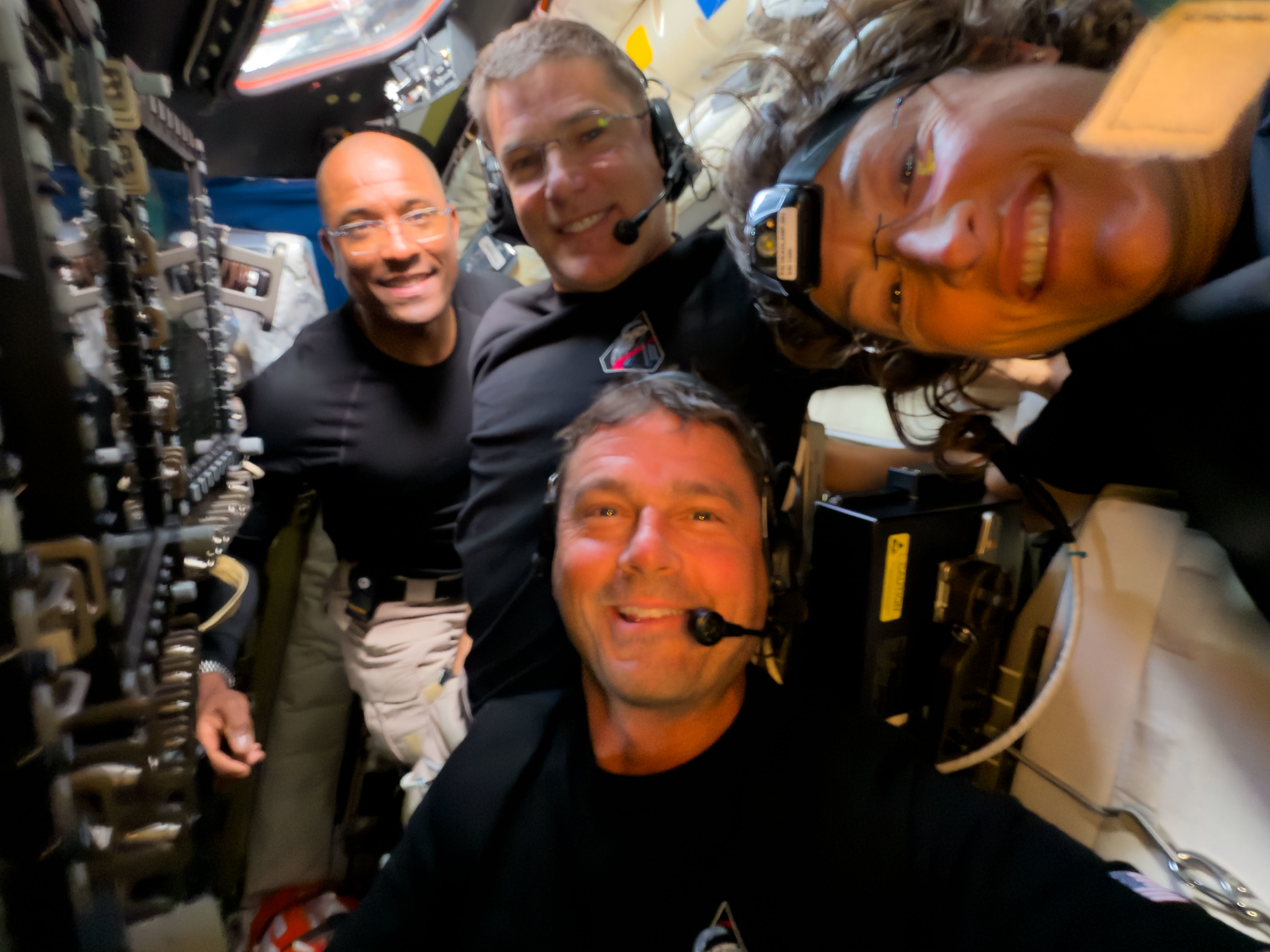
“We have loved living in Orion,” said Christina Koch, mission specialist on Artemis II. “In fact, we’ve all said that sometimes you can forget where you really are, because we’re in this small space that just gives us everything we need.”
Living in microgravity makes the cramped quarters seem a little more accommodating. The astronauts can take advantage of every corner of the spacecraft.
“It is bigger in microgravity, and yes, we are bumping into each other 100 percent of the time,” Koch said. “A phrase that you often hear in the cabin is, ‘Don’t move your foot. I’m just going to reach for something right under it.’”
NASA named the crew members for the Artemis II mission three years ago. Now, the astronauts will have their names in the history books. With Artemis II, the number of people alive who have traveled to the vicinity of the Moon has nearly doubled. Just five of the 24 men who flew to the Moon are still alive. Four of them walked on its surface.
“I will miss this camaraderie. I will miss being this close with this many people and having a common purpose, a common mission,” Koch said. “This sense of teamwork is something that you don’t usually get as an adult. I mean, we are close, like brothers and sisters, and that is a privilege we will never have again.”
One of the most poignant moments of the mission was a tribute to Wiseman’s late wife, Carroll, who died of cancer in 2020. On Monday, as the crew neared the Moon, Hansen radioed down the crew’s request to name a crater for Carroll.
“When Jeremy spelled Carol’s name, C-A-R-R-O-L- L, I think, for me, that’s when I was overwhelmed with emotion,” Wiseman said. “And I looked over and Christina was crying. I put my hand down on Jeremy’s hand as he was still talking. I could just tell he was trembling, and we all pretty much broke down right there. And just for me, personally, that was kind of the pinnacle moment of the mission. For me, that was, I think, where the four of us were the most forged, the most bonded, and we came out of that really focused on the day ahead.”
One big test remains in front of the Artemis II crew. Reentry and splashdown will be one of the riskiest moments of the mission. On Artemis I, the first unpiloted test flight of the Orion spacecraft, the capsule’s heat shield began to break apart during reentry. The thermal barrier on the bottom of the capsule had enough margin to withstand the charring, and the spacecraft safely splashed down. If astronauts had been onboard, they would have been fine.
On Artemis II, NASA will fly the capsule at a different angle during reentry to ease the thermal stress on the heat shield. “We’ve still got two more days, and riding a fireball through the atmosphere is profound as well,” Glover said.
Soon after Wednesday night’s call with reporters, the crew pointed a video camera out of one of Orion’s windows. Nearly 200,000 miles away, the crescent Earth appeared to hang in a black void, resembling the smile of the Cheshire Cat in Alice in Wonderland. It was a reminder of the words of astronaut Jim Lovell, who remarked on the “vast loneliness” in deep space as he flew around the Moon on the Apollo 8 mission in 1968. “It makes you realize what you have back there on Earth. The Earth, from here, is a grand oasis in the big vastness of space,” said Lovell, who died last year.
Hansen, Artemis II’s Canadian crew member, added to this sentiment.
“We live on a fragile planet in the vacuum, in the void of space,” Hansen said. “We know this from science. We’re very fortunate to live on planet Earth. Another perspective that I’ve sort of learned from others through life is that our purpose on the planet as humans is to find joy, to find the joy in lifting each other up by creating solutions together instead of destroying. When you see it from out here, it doesn’t change it. It just absolutely reaffirms that. It’s almost like seeing living proof of it.”