China has pledged to accelerate its lunar exploration program after NASA’s Artemis II mission completed a successful flyby of the moon and began its return journey, marking a renewed phase of strategic competition in deep space.
In a 10-day mission launched on April 1, Artemis II carried four astronauts aboard NASA’s Space Launch System rocket and Orion spacecraft on a lunar flyby before returning to Earth. It marks the first crewed test of the Artemis program.
Beijing is targeting a crewed lunar landing by 2030, while Washington is aiming for 2028, underscoring a tightening timetable in what is increasingly framed as a high-stakes technological and geopolitical race.
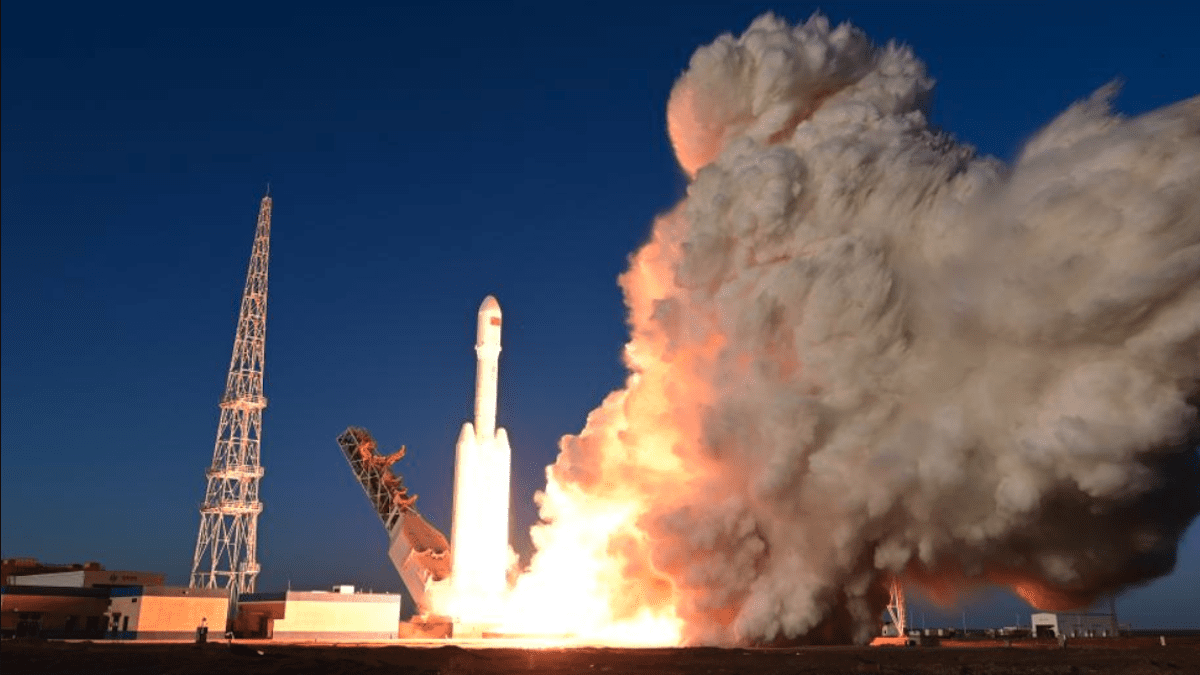
To support its crewed lunar ambitions, China is accelerating development of heavy-lift infrastructure including the Long March 10A rocket, which is designed to carry astronauts and lunar landing hardware.
China Manned Space Agency (CMSA) has approved a plan to use the Lijian-2 rocket as the upper stage and the Long March 10A as the first stage (booster stage) to launch navigation satellites into lunar transfer orbit (LTO), or trans-lunar injection (TLI), in mid-2026, Chinastarmarket.cn reported, citing Lian Jie, deputy chief engineer of the Lijian-2 program.
This will be the first mission for Long March 10A, signaling a clear push to accelerate China’s crewed lunar mission. Besides, the mid-2026 launch will mark the first time a commercial Chinese firm’s rocket enters cislunar space – the area “on this side of the Moon” where Earth and Moon gravity interact.
Lian delivered the remarks after CAS Space, a commercial firm spun off from the Chinese Academy of Sciences, successfully launched three satellites into their planned orbits with its self-developed Lijian-2 rocket on March 30. Lijian-2, also known as Kinetica-2, is similar to SpaceX’s Falcon 9 rocket in that it uses kerosene and liquid oxygen as propellants.
Lian said a carbon-monitoring satellite mission focused on terrestrial ecosystems is scheduled for September, with an upgraded Lijian-2 rocket expected to significantly boost payload capacity.
Last year, CMSA said it planned to launch Long March 10A for space missions in 2026 but did not provide a specific timetable.
On February 11, the Long March 10A first stage completed a controlled sea-landing test in Wenchang in Hainan, verifying key recovery technologies. The trial also confirmed low-altitude flight and maximum dynamic pressure escape conditions for the next-generation crewed spacecraft, supporting a maiden flight later this year.
Spaceship assembly towers
Chinese media reports indicate further progress on ground infrastructure, with CMSA having completed two assembly towers in Wenchang to integrate the spacecraft and launch vehicles. The facilities are designed to streamline parallel processing and shorten preparation cycles for crewed lunar missions.
“Some netizens say China looks slow while Artemis II is already flying around the moon,” a Sichuan-based columnist says. “There’s no need to worry as China has its own schedule and plan.”
He said that:
- the Long March 10A maiden flight is scheduled for mid-2026;
- tests of the Mengzhou crewed spacecraft are expected in the second half of the year;
- a combined Long March 10A and Mengzhou test is likely around November.
“If these milestones are achieved, a crewed lunar landing becomes a matter of timing. A 2030 landing remains well within reach,” he adds. “Preparations are being advanced step by step, and only after the landing program is fully completed can China move toward building a sustained presence on the moon.”
According to public information, the Long March 10A can lift 14 tons, or a spacecraft carrying up to seven people, into low Earth orbit (LEO) and is reusable.

To carry out its crewed lunar landing mission, China needs to add two boosters to a Long March 10A rocket to make it become the Long March 10 rocket. With a total thrust of 26,250 kN, the strengthened rocket can lift 70 tons to LEO and 27 tons to TLI.
For comparison, when Apollo 11 made its historic lunar landing on July 20, 1969, the Saturn V rocket lifted about 43.5-47 metric tons to TLI.
To surpass that benchmark, China plans a dual-launch architecture for its 2030 lunar mission. One Long March 10 rocket will send the Mengzhou crewed spacecraft with three astronauts, while a second launch will carry the Lanyue lunar lander.
The two vehicles will rendezvous and dock in lunar orbit; two astronauts will transfer to the lander and descend to the surface, while one remains in orbit. After surface operations, the crew will ascend and re-dock with Mengzhou. The two vehicles will return to Earth together.
Artemis III, targeted for 2028, is expected to deliver the first crewed lunar landing of the US program, followed by Artemis IV around 2029, which will begin assembling the Lunar Gateway space station in orbit. Both missions rely in part on SpaceX’s Starship as the human landing system (HLS), responsible for transporting astronauts from lunar orbit to the surface and back.
Artemis V, currently planned for around 2030 or later, will expand sustained operations on and around the Moon. The mission is expected to use Blue Origin’s Blue Moon lander under NASA’s second HLS contract.
In February, SpaceX founder Elon Musk said in a social media post that the company aims to establish a permanent human settlement on the Moon within the next decade, placing greater near-term emphasis on lunar development alongside its longer-term ambitions for Mars.
Some observers say that as the US and China intensify competition to build lunar bases, more funding will flow into lunar infrastructure, creating clearer commercial opportunities for space equipment suppliers and related industries than for more remote Mars missions.
China’s long-term plan
In August, China plans to launch the Chang’e-7 probe to the Moon’s south pole to search for water ice.
Sun Zezhou, a senior researcher at the China Academy of Space Technology, said Chang’e-7 will study the local environment, analyze lunar soil and conduct high-precision surveys of the Moon’s surface, composition and geological structure, while targeting areas of permanent shadow and extreme cold that may preserve large amounts of water ice that can be turned into hydrogen and oxygen.
The mission underscores China’s push for international cooperation, carrying six foreign payloads from Italy, Russia, Egypt, Bahrain, Switzerland and Thailand.
Bian Zhigang, deputy head of the China National Space Administration, said Chang’e-8 is planned for launch around 2028 to test in-situ resource utilization technologies and lay the foundation for a future lunar research station. He added that after Chinese astronauts land on the Moon in 2030, China will move toward building its initial International Lunar Research Station (ILRS) around 2035.
The ILRS is planned as a Moon-based research network linking the surface, orbit and ground systems, designed for long-term operation with occasional human missions. China is developing it with international partners, including Nicaragua, the Asia-Pacific Space Cooperation Organization and the Arab Union for Astronomy and Space Sciences.
Read: China steps closer to landing on moon by 2030
Follow Jeff Pao on Twitter at @jeffpao3