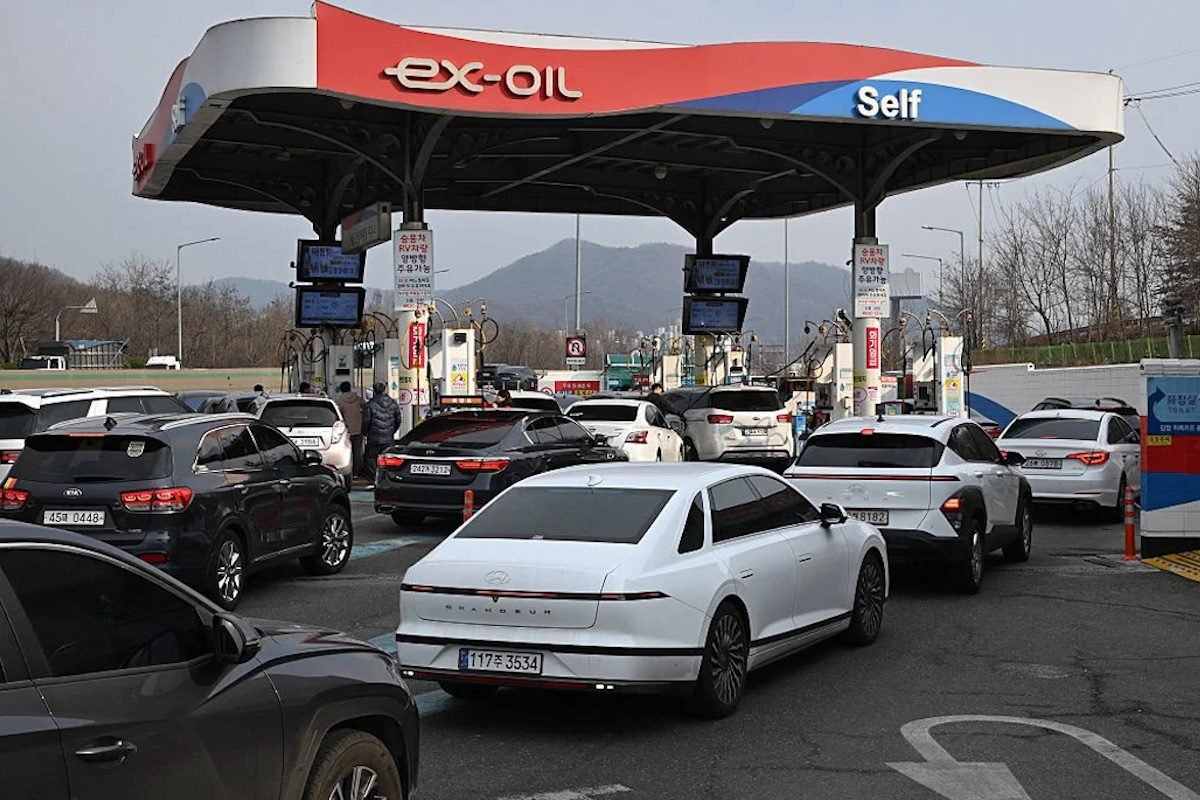
The Iran conflict has sent oil prices higher — and has stripped bare a long-ignored vulnerability in South Korea’s energy system.
While the headlines focus on Middle Eastern tankers, the crisis reveals that this is not merely a supply problem dictated by geopolitics, but a demand problem baked into the national infrastructure. In a desperate attempt to protect consumers, Seoul recently took the unprecedented step of imposing wholesale price caps for the first time since 1997.
Just two weeks after the initial freeze, the government again announced plans to significantly hike those ceilings on March 27 to reflect surging external supply costs: gasoline rose from 1,724 won to 1,934 won per liter, diesel to 1,923 won, and kerosene to 1,530 won.
This quick change shows that while price caps can help in the short term, they can’t stop global market swings. Ultimately, the country must break its heavy dependence on oil and move toward more stable energy sources.
South Korea is one of the world’s largest oil consumers, accounting for approximately 2.5% of global oil consumption and having an annual demand of about 125 million tonnes. Moreover, about 90% of the country’s energy sources are from abroad, with a substantial share of crude oil coming from the Middle East. It has built an economy structurally exposed to geopolitical shocks it cannot influence.
Breaking South Korea’s oil habit is difficult because the fuel is baked into everything from petrochemicals to major exports. But the most obvious place to act – and the one that continues to lag – is transport, which accounts for 26.4% of demand.
Unlike complex factories, transport is where drivers consume oil directly, daily, and at scale. That makes it the most direct route to cutting oil demand at the source: transition to electric vehicles.
Yet this is precisely where progress has stalled. About 3% of cars on South Korea’s roads are fully electric. South Korea’s automotive market is overwhelmingly dominated by domestic players, particularly Hyundai Motor Group (including Genesis) and Kia, which together account for over 90% of domestic car sales among Korean brands and hold a 74.3% combined market share, including imports.
Their strategy does not just influence the transition – it effectively determines whether it happens at all. So far, that transition has been steered toward hybrid vehicles rather than a rapid shift to fully electric models.
Accelerating South Korea’s transition to electric vehicles requires systematically overcoming a set of clear, fixable barriers, including uneven charging infrastructure, high upfront costs, and inconsistent policy support.
This challenge is compounded by a deeper structural reality: the country has built a system around heavy reliance on private cars, particularly outside major urban centers. This means that fully electrifying these vehicles – at speed and scale – is the most direct way to cut oil demand.
History suggests that crises like today’s oil shock can be turning points. The oil shocks of the 1970s helped Japanese automakers such as Toyota, Nissan, and Honda capture global markets by prioritizing fuel efficiency. Today, Chinese manufacturers are doing the same with electric vehicles – and are already pulling ahead.
This is South Korea’s inflection point. Higher fuel prices are already speeding up the move toward electric vehicles, which shield drivers from the roller coaster of the oil market. Countries that moved early – notably China and Norway – are less exposed to oil price spikes linked to the crisis in Iran, because a larger share of their transport runs on electricity rather than gasoline or diesel.
While this crisis has caused serious disruption to the global energy market, it has also, unexpectedly, created commercial opportunities for some EV makers. Bloomberg recently reported that across Asia, after the war broke out, showrooms for brands like BYD and VinFast are packed with customers rushing in to swap their gas-powered cars for electric ones. Korean manufacturers, by contrast, risk ceding this demand if they move too slowly.
But this shift cannot rely on consumers alone; it requires urgent, coordinated action from the government and carmakers. While the government has set long-term carbon targets, current policies—like the recent extended fuel tax cuts—actually stall progress.
Such “administrative inertia” undermines the economic viability of transitioning to electric vehicles. Continued reliance on internal combustion engines risks delaying the transition, while insufficient investment in public transport and EV charging infrastructure limits viable alternatives.
What is needed is alignment: a binding timeline for phasing out internal combustion engines; stronger and more consistent incentives for electric vehicles; accelerated deployment of charging networks; and a serious commitment to reducing reliance on private cars through better public transport.
Crises have a way of exposing what normal times conceal. South Korea’s oil vulnerability to oil shocks is not theoretical. It is immediate – and costly. The question is no longer whether the country will transition away from oil, but whether it will do so fast enough to remain competitive in a rapidly changing global economy.
This is not just about fuel prices. It is about economic resilience, energy security, and industrial leadership in the decades ahead. And right now, South Korea is moving too slowly on all three.
Erin Eunseo Choi is a climate and energy campaigner based at Greenpeace East Asia in Seoul.