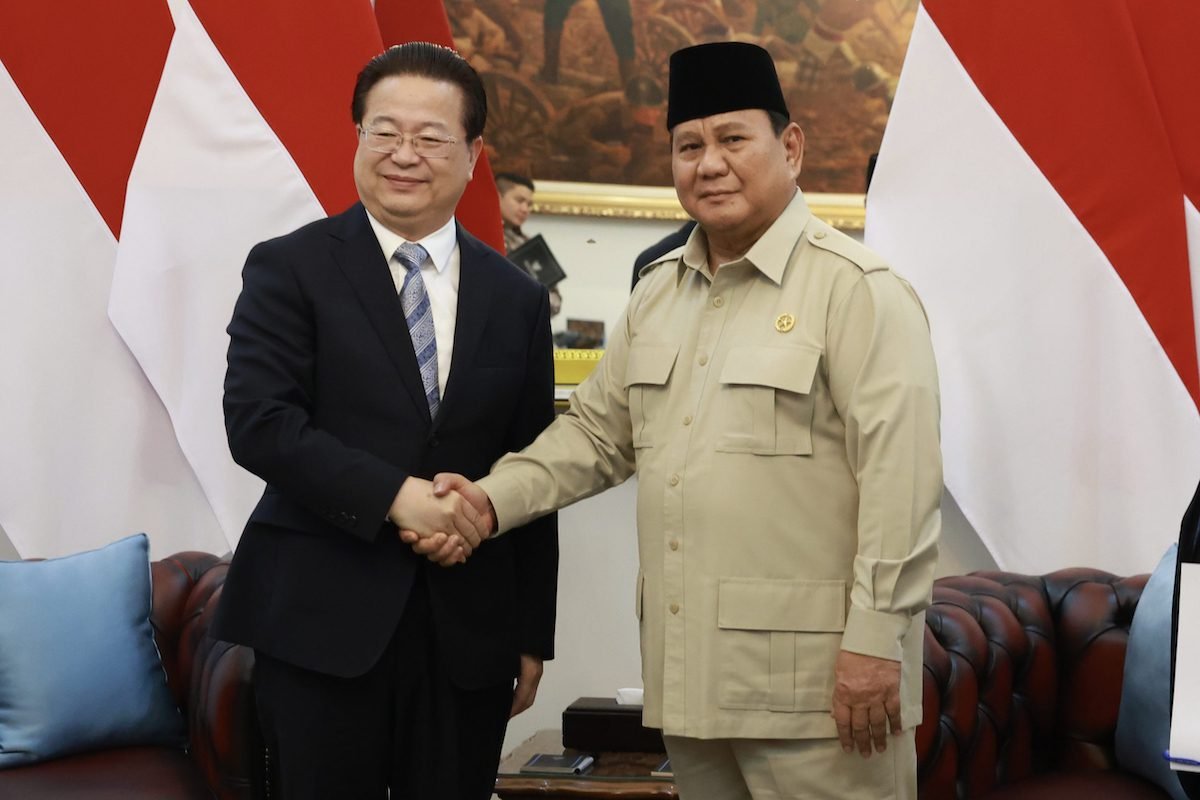

On March 27, Indonesian President Prabowo Subianto received China’s Minister of State Security, Chen Yixin, at the State Palace in Jakarta. The meeting, attended by Indonesia’s intelligence chief and senior cabinet officials, was described in familiar diplomatic terms: warm, cooperative, focused on stability. But the substance — and the context — suggest a more layered story.
According to official accounts, the two sides discussed strengthening cooperation to maintain security stability in Asia and globally, with particular emphasis on closer ties between China’s Ministry of State Security (MSS) and Indonesia’s State Intelligence Agency (BIN).
That alone is noteworthy. Intelligence cooperation is among the most sensitive forms of international engagement. It signals not just alignment of interests, but a willingness to share information, build institutional linkages and, over time, shape how each side understands risk.
Still, it is important not to overstate what happened. There was no alliance, no treaty, and no public commitment beyond general language about cooperation and mutual benefit. Both sides framed the meeting in broad terms — “friendly countries,” “shared stability,” and economic growth. The tone was cautious, even conventional.
Yet several takeaways stand out. First, the nature of the visit. China did not send a diplomat or economic official. It sent its top security official. That choice suggests that Beijing is placing greater emphasis on security and risk management in its external engagement — not instead of economic ties, but alongside them.
Second, the centrality of “stability.” Both Beijing and Jakarta framed stability as a priority — and for good reason. Indonesia views regional stability as essential to sustaining economic growth, while China, as a major trading economy, depends heavily on predictable global flows of energy and commerce.
In that sense, the language of stability reflects a shared concern rather than a coordinated strategy. It provides a common vocabulary for cooperation without requiring formal alignment.
Third, the institutional dimension. The discussion of deeper MSS–BIN cooperation points to a gradual expansion of the relationship into more sensitive domains. This is consistent with Indonesia’s broader foreign policy approach, which seeks to strengthen national security while remaining active in a “multipolar” international system.
Such cooperation does not necessarily signal a shift in alignment. But it does suggest a willingness, on both sides, to explore more practical forms of engagement.
Fourth, the form of China’s approach. Beijing continues to favor flexible partnerships over formal alliances. Its emphasis on “friendly countries” and mutual benefit reflects a network-based model — one that builds connections without binding commitments. For Indonesia, which has long pursued a “free and active” foreign policy, this approach is broadly compatible with its own strategic preferences.
Fifth, the timing. The meeting comes amid a more uncertain global environment, with geopolitical tensions rising and the international system becoming more fragmented. While neither side explicitly linked the visit to specific conflicts, the broader context is hard to ignore. Periods of uncertainty often encourage countries to strengthen communication channels and diversify their partnerships.
Finally, the broader trajectory. China’s engagement in Southeast Asia has long been driven by economics. Increasingly, however, it is also engaging on security issues — not through alliances or military deployments, but through dialogue, coordination and institutional ties. The Jakarta visit fits within that gradual evolution.
For Indonesia, the implications are manageable but real. Expanding cooperation in intelligence and security can offer practical benefits, particularly in addressing transnational threats. But it also requires careful calibration to preserve strategic autonomy — something Jakarta has historically prioritized.
For China, the visit reflects a measured adjustment rather than a dramatic shift. It is seeking to deepen relationships, broaden areas of cooperation and position itself as a partner in managing uncertainty — all without the obligations that come with formal security commitments.
In that sense, the meeting is best understood not as a turning point, but as a signal. It shows how both countries are adapting — cautiously, incrementally — to a more complex international environment. And it underscores a broader reality: in today’s world, even routine diplomatic encounters can carry quiet but meaningful implications.
Muhammad Zulfikar Rakhmat is director of the China-Indonesia Desk at the Jakarta-based Center of Economic and Law Studies (CELIOS) independent research institute.