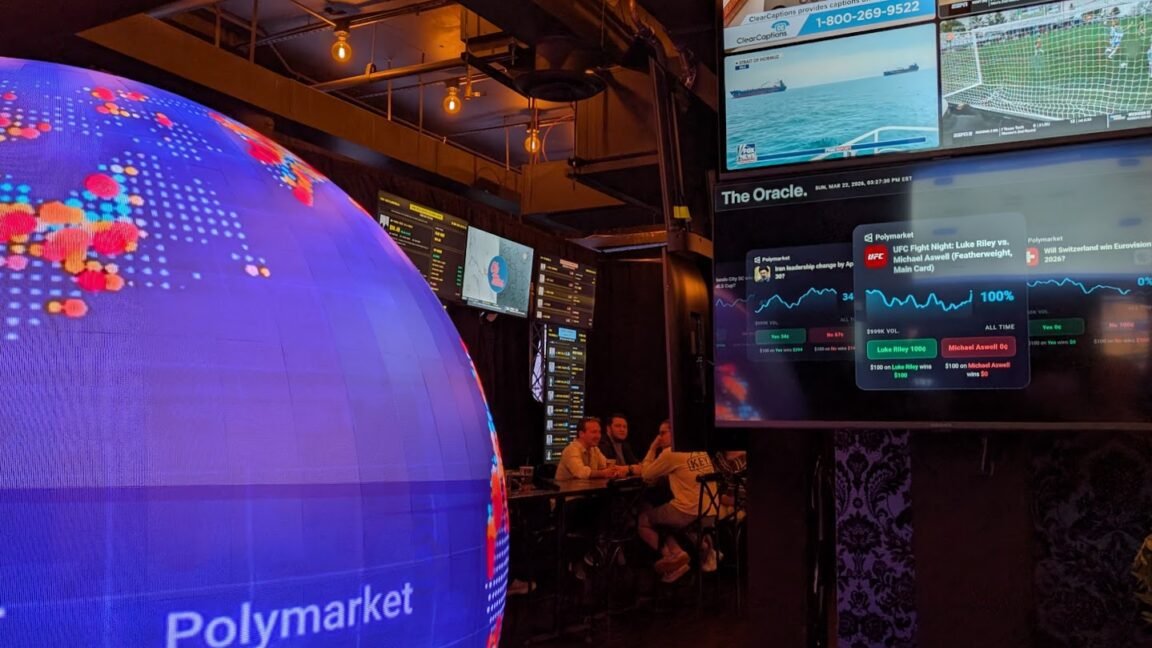
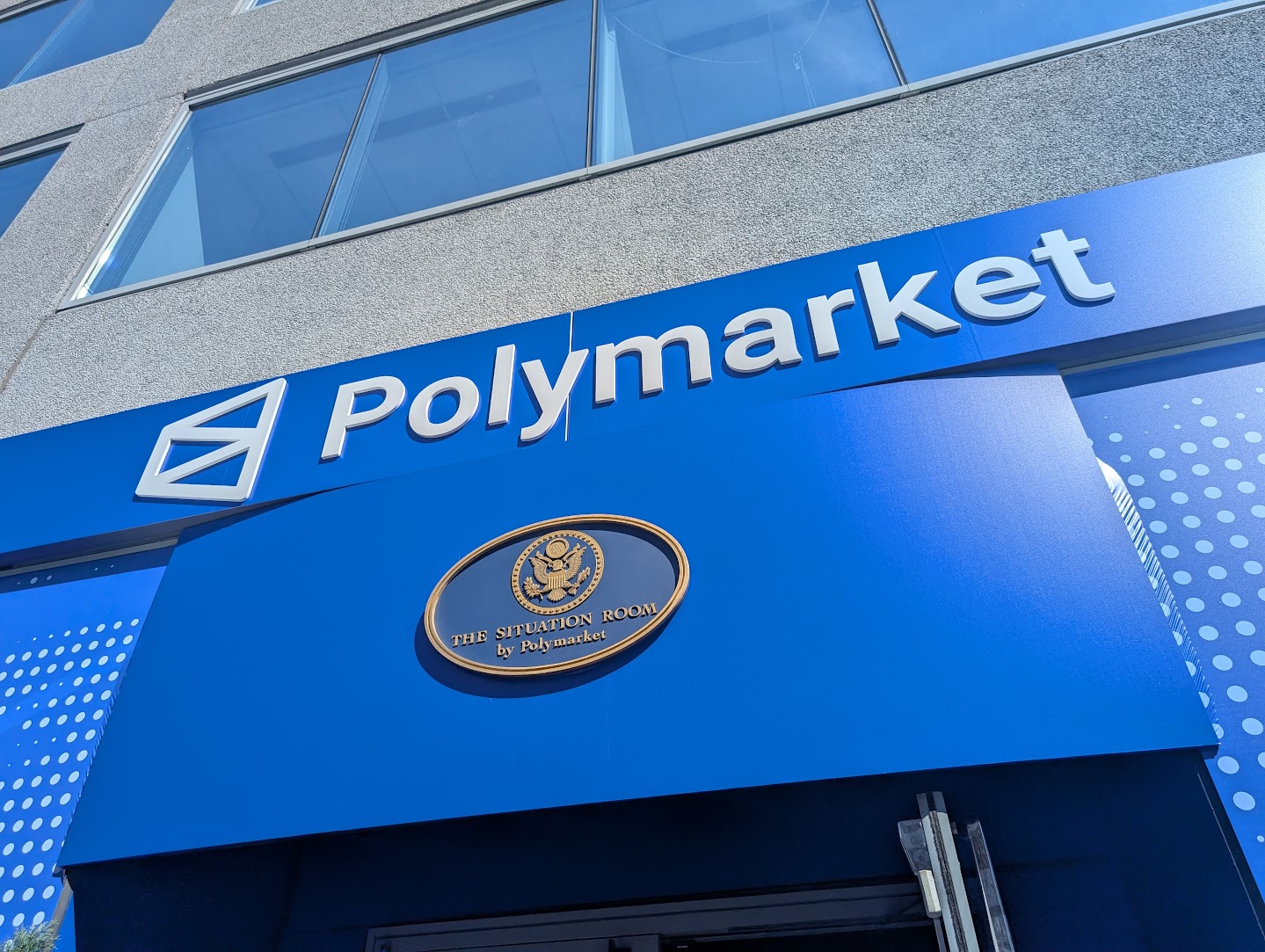
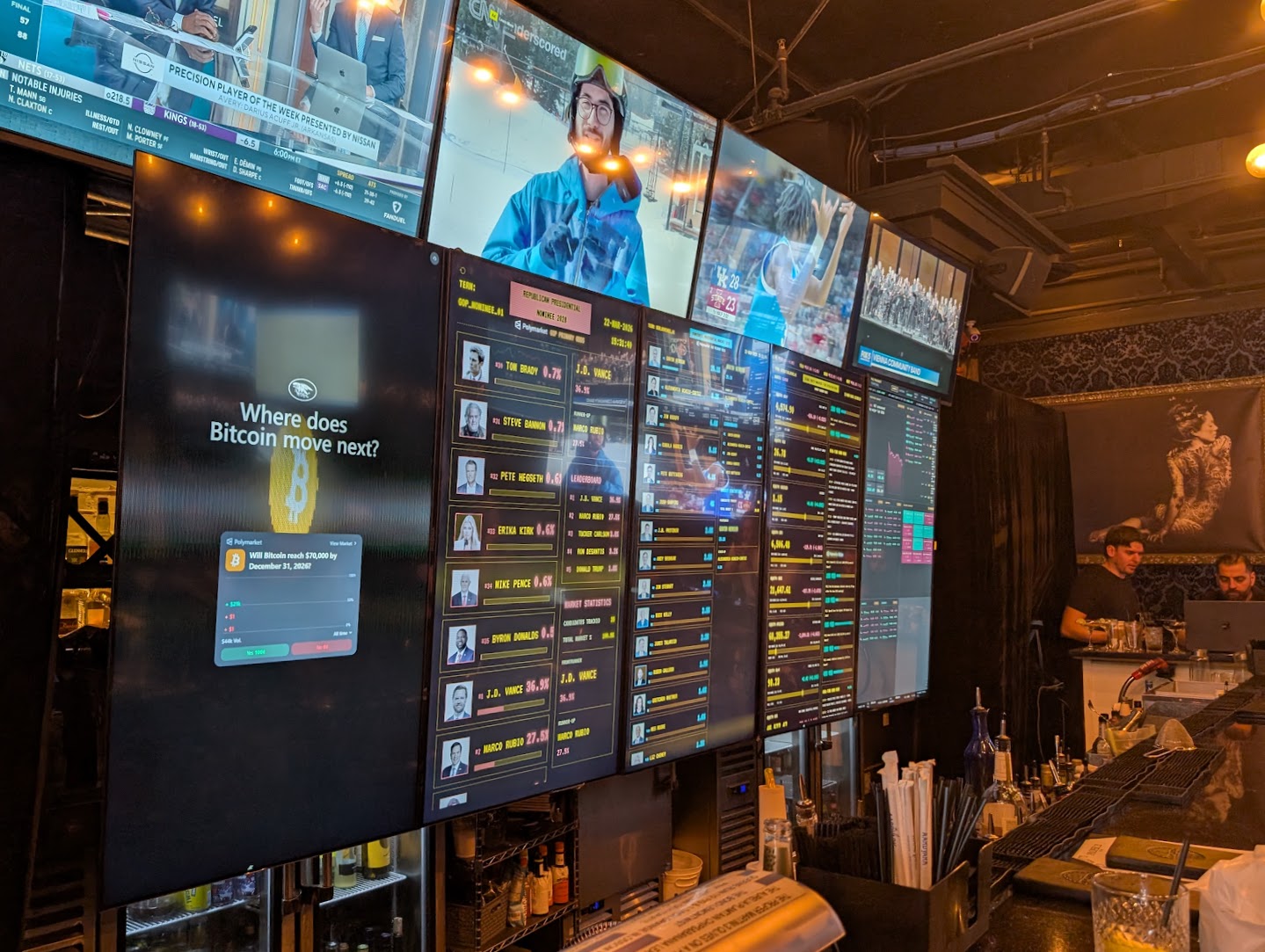
Polymarket’s temporary makeover of a K Street bar as “The Situation Room” yielded a few notable differences from other Washington watering holes: more laptops open, more overheard conversations about cryptocurrency, and more screens—most of which were not showing sports.
The New York-based prediction market announced in a March 18 thread on X that it was opening what it called “the world’s first bar dedicated to monitoring the situation,” touting the availability of “live X feeds, flight radar, Bloomberg terminals, and Polymarket screens.” The bar would only be there for a three-day run.
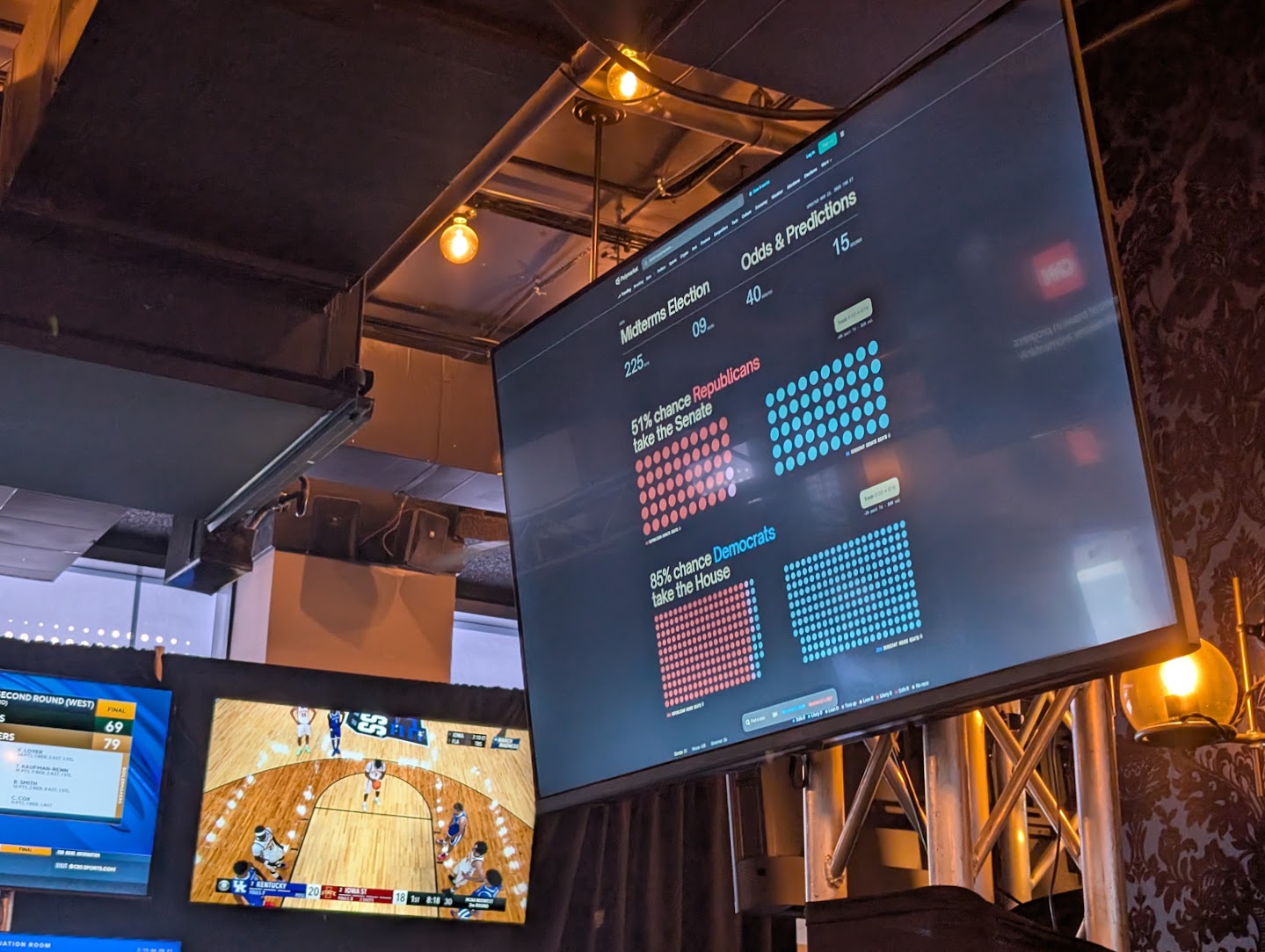
The reality—as reported by journalists who showed up for a press-preview event Friday night—fell vastly short of that, with power and Wi-Fi problems that left all the displays dark. Polymarket fixed the screens the next day, however, and on my own visit on Sunday afternoon, dozens of displays offered a choice of CNN, CBS, the local Fox station, FS1, and various pages on Polymarket’s site. No normal bar would have CNBC or C-SPAN on, but those networks were a logical fit for this one.
What was on offer?
Getting an eyeful of the range of things that Polymarket users will bet on via USDC stablecoins was enlightening.
For example:
- Control of Congress after the midterm elections, with Polymarket users giving Democrats an 85 percent chance of taking the House and Republicans roughly even odds of holding the Senate
- The 2028 presidential nominee for each party, with Vice President J.D. Vance judged the most likely candidate for Republicans and California Gov. Gavin Newsom topping the list for Democrats
- “Will Switzerland win Eurovision 2026?” with Polymarket users giving Swiss artists zero chance
- “Will Jesus Christ return before 2027?” (that ran at 4 percent)
But no Bloomberg terminals were in sight, somewhat to my dismay. I worked in The Washington Post’s business section for over a decade, and seeing one of those fiendishly complex keyboards would have set off some serious nostalgia.
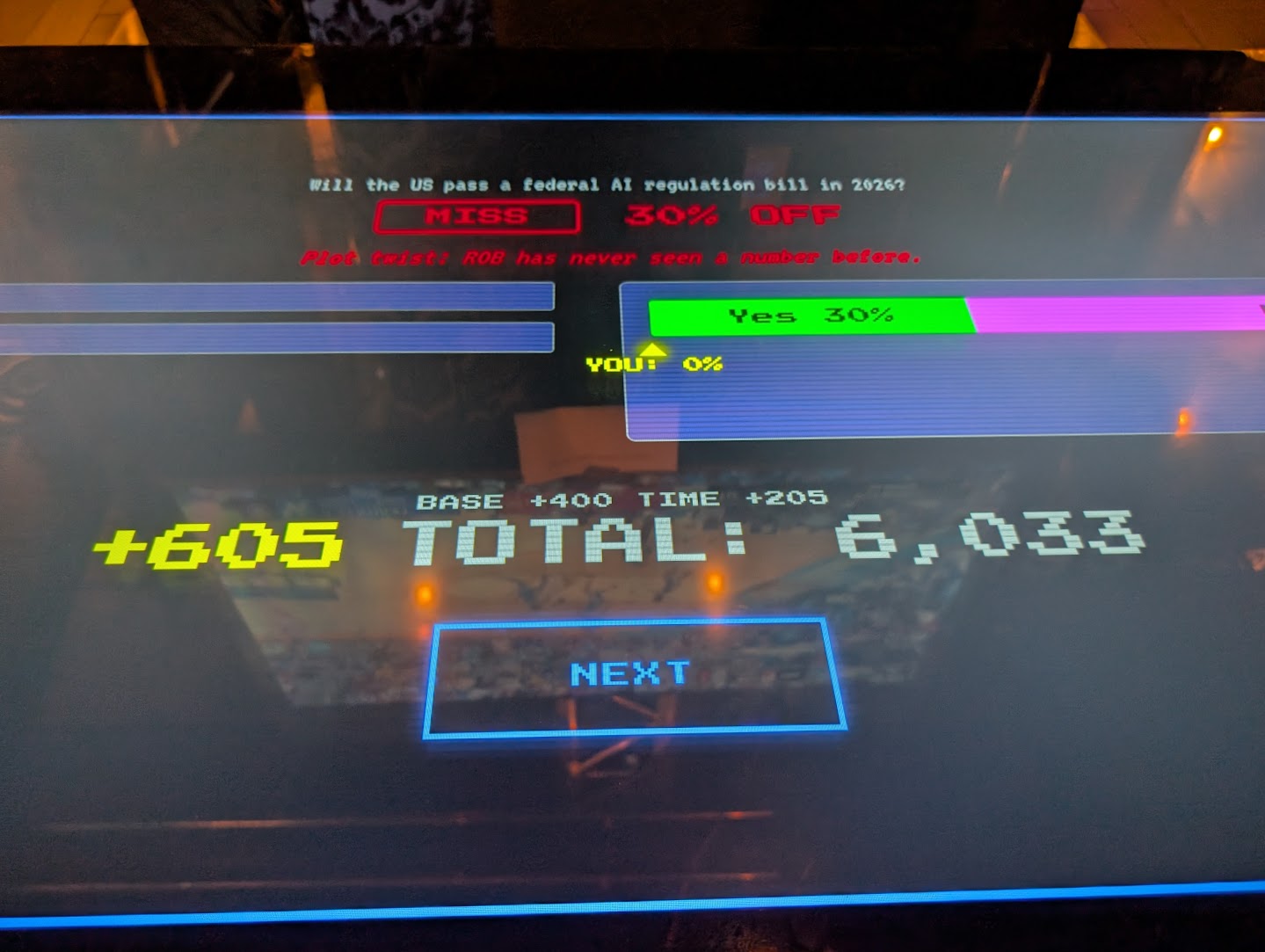
A giant rotating globe highlighted spots around the world that are the subjects of Polymarket betting. You didn’t have to join the wagering—a “Match the Odds” interactive tabletop game let me try my hand at setting odds for questions like “Will the next Call of Duty game set first-week sales records?”, “Will NVIDIA stock hit $200 per share in 2026?”, and “Will the US pass a federal AI regulation bill in 2026?”
None of my guesses matched the odds set by Polymarket’s hive mind, which the game observed by negging me with put-downs like “that guess was a hate crime against probability.”
Still, the game probably had its desired effect. The hive mind gave Congress 30 percent odds of passing an AI bill this year, and seeing that ludicrous optimism made me want to bet against the people dumb enough to think this particularly dysfunctional Congress would do something that ambitious.
Why was it here?
Polymarket did not respond to emails asking about the bar’s operations or whether it had met any success metrics. Tech companies usually come to Washington to curry favor with legislators and policymakers, but this one shouldn’t have much to worry about: President Trump’s son Donald J. Trump, Jr., is a Polymarket investor and unpaid advisor, and the Trump administration quickly dropped earlier moves to rein in Polymarket and its rival Kalshi.
Polymarket has also been busy inking partnership deals with the likes of Substack (to embed live prediction-market data into posts) and Google (to feed info into Google Finance queries).
Outside of the current circles of power in tech and politics, however, prediction markets continue to face questions about insider trading (banned by Polymarket’s rules but difficult to enforce on any anonymity-optimized platform) and the fundamental morality of placing bets on violent conflicts. In March, Arizona Attorney General Kris Mayes charged Kalshi with running an illegal gambling operation for offering betting contracts on four elections in the state.
And some prediction-market users, like certain sports gamblers, seem unable to accept the reality that they placed the wrong bet. Israeli journalist Emanuel Fabian recently received a round of death threats from Polymarket users demanding that he change a description of an Iranian missile attack to align with their own bets; Polymarket said it suspended the users after Fabian went public with this harassment.
Third-party research of cryptocurrency wallet addresses on Polymarket has shown that only a small minority of users—from as low as 7.5 percent to as “high” as 30 percent—show realized profits.
It’s all marketing
In some ways, the marketing at Polymarket’s bar was surprisingly low key. The place offered no discounts or freebies to patrons who opened an account or installed the platform’s apps, and the menu itself was unchanged from the bar’s normal incarnation as a sports bar called Proper 21—foreclosing the possibility of Polymarket puns in cocktail names.
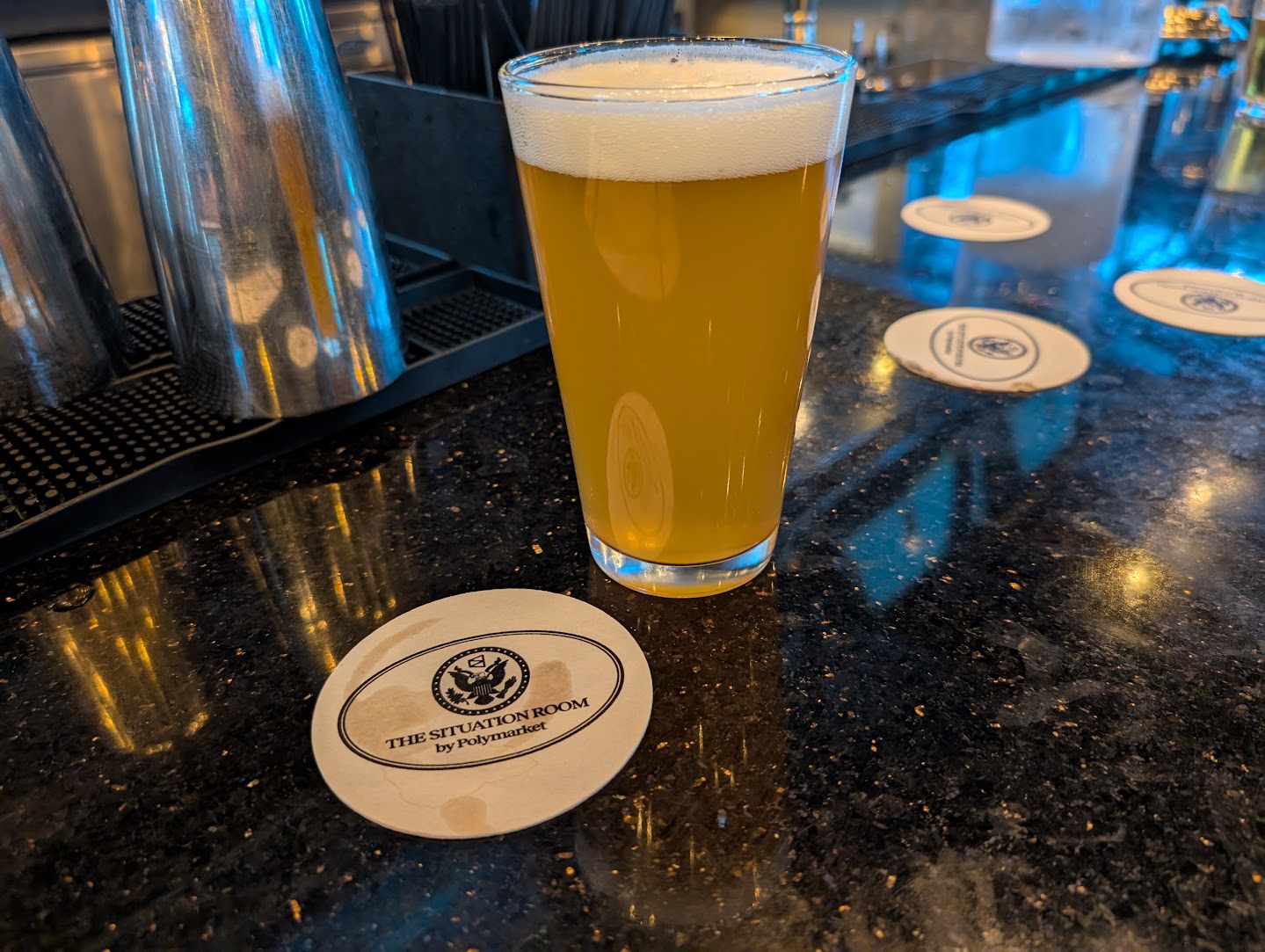
One of the beers I ordered did, however, come in a Situation Room-labeled pint glass. The guys sitting next to me—with whom I had gotten into an involved conversation about self-driving cars—suggested I steal it, but I limited myself to pocketing a Situation Room coaster.
The Situation Room isn’t Polymarket’s first venture in what marketing types call “activations.” In February, it opened a grocery store in Manhattan that offered free groceries—as many as shoppers could fit into a single Polymarket-branded tote bag—for three days.
The company has been telling other news outlets that it may explore establishing a longer-lasting version of the Situation Room. But even if this concept doesn’t appear again, “will Polymarket do more IRL marketing stunts?” seems like the safest of bets.