The furnaces at Vaikunth Dham, the largest crematorium in India’s Maharashtra state, have gone quiet. The operators only had enough liquified petroleum(natural) gas (LNG) for a few more cremations. From here on out, the dead would be cremated by electricity or by wood.
It was a small, grim, seemingly unremarkable administrative decision, thousands of miles from any battlefield. But it demonstrates just how far the shockwaves of the war in Iran and the closure of the Strait of Hormuz can travel.
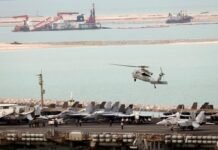
Since the United States and Israel launched strikes against Iran on February 28, the narrow waterway connecting the Persian Gulf to the open ocean has become the epicentre of the worst disruption to global energy markets in half a century.
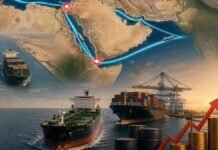
At its narrowest, the strait is just 21 miles wide (33 kilometers). Its two shipping lanes normally carry around 20 million barrels of oil per day, roughly a fifth of the world’s seaborne oil trade, along with vast quantities of LNG.
That traffic has now collapsed to a trickle. Export volumes of crude and refined products sit at less than 10% of pre-conflict levels.

The result has been utter chaos. Brent crude (often the global oil benchmark), which was hovering just around $72 a barrel before the war, surged past $100 within days and peaked at $126 (the highest since 2008).
On Monday (March 23), prices swung violently again, falling more than 11% after US President Trump announced “productive conversations” with Tehran before clawing back some losses by the close.
At this point, the price doesn’t matter as much as the volatility to global energy markets. When the world’s most critical energy chokepoint is held hostage, every presidential tweet, every drone strike, every insurance decision becomes a market moving event.
The blockade that never was
The great irony of the Hormuz crisis is what Iran didn’t do. Remarkably, there was no naval blockade, no underwater mines, at least not initially. There has been no fleet of warships physically blocking passage.
Instead, Iran achieved a de facto closure using asymmetric warfare and one of the cheapest weapons in its arsenal: drones.

A handful of cheap to mid-range drone strikes on vessels transiting the strait was enough. Within days, insurance companies pulled their coverage. Shipping firms refused to send crews into what was now, for all practical purposes, a war zone.
As Helima Croft of RBC Capital Markets put it, all Iran had to do was conduct several strikes in the vicinity, and insurers and shipping companies decided it was simply too dangerous to navigate the narrow S-curve of the waterway.
The ships that did try to push through were met by Iranian speed boats and boarding parties, who often redirected ships to Iranian ports. Currently, 3,200 ships are trapped inside the Persian Gulf.
Iran has since hardened its position, announcing the strait would remain closed to ships from the US, Israel, and their Western allies, which seem to include the Arab countries of the Gulf. But the reality is more nuanced and more cynical.
While the rest of the world’s tankers idle, Iran has continued shipping crude to China. At least 11.7 million barrels have passed through the strait since the war began, all bound for Chinese ports, many on vessels running with their tracking systems switched off.
In what is perhaps the greatest irony of this crisis, the US has temporarily lifted oil sanctions on Iran to help steady the oil markets, all while actively bombing the country. Tehran has even reopened its Jask terminal on the Gulf of Oman as an alternative export route. The message is plain: the Strait is closed to everyone except Iran’s customers.
Impacts far and wide
The immediate price shock was dramatic. But the deeper problem is structural. Oil markets, as we discussed in our previous article on crude oil, are global, and a disruption of this scale is impossible to contain. (Read previous editions of The Geopolitical Pickle’s Crude Realities series here and here.)

Start with the Gulf producers themselves. With the Strait effectively closed, local storage has rapidly filled, and countries like Iraq and Kuwait have had no choice but to cut production. Shutting down an oil well is not like turning off a tap.
It risks damaging the well itself and is expensive to reverse. Every week the closure persists, the timeline for restoring full production stretches further into the future. This means that even if the Strait reopened tomorrow, the market would feel the aftershocks for months, possibly years to come.
Then we have the issue of refining capacity. Much like the supply chain disruption we had post-Covid, the ability for refineries to quickly scale up once the conflict is over is mediocre at best. This means refined oil products such as jet fuel, gasoline, plastics, and much more would see prices rise for the foreseeable future.
More than 3 million barrels per day of refining capacity in the Gulf region has already gone offline, partly from direct strikes on facilities, partly because there is nowhere to send the output. An Iranian attack on Qatar’s LNG infrastructure alone could take three to five years to fully repair, according to QatarEnergy’s CEO.
The global demand for LNG has skyrocketed since the Russian invasion of Ukraine, serving as a safer, more reliable alternative, especially in Europe. LNG supply has been reduced by roughly 20%, forcing Asian and European buyers into a bidding war for the remaining cargoes.
This crunch is felt far and wide and has the potential to plunge the world into an energy crisis. In South Korea, President Lee Jae Myung imposed a fuel price cap for the first time in nearly 30 years after gasoline prices in Seoul breached 1,900 won per litre.
In India, the crisis has sparked panic buying of cooking gas cylinders, with the government invoking the Essential Commodities Act to crack down on hoarding, conducting more than 12,000 raids and seizing over 15,000 cylinders.
Induction cooktop sales on Amazon India surged 30x, while in Australia an impending fuel crisis is developing, owing to limited reserves and domestic refining capacity.

The US, the muscle behind this conflict and its true determinator, is not immune to this oil crisis. US crude prices have risen more than 30% since the war began, and retail gasoline prices have climbed over 50 cents to a national average of around US$3.57 per gallon.
The laws of supply and demand make the calculation extremely simple – that removing a fifth of global supply, while demand remains, prices go up for everyone.
Up, down and all around
On March 11, the International Energy Agency (IEA) announced the largest coordinated release of emergency oil reserves in its 50-year history: 400 million barrels, more than double the release triggered by Russia’s invasion of Ukraine in 2022.
The US pledged 172 million barrels from its Strategic Petroleum Reserve, to be delivered over 120 days. Japan, holding some 80 million barrels in reserve and acutely dependent on Middle Eastern imports for roughly 70% of its oil, moved to release stockpiles within days. Germany, Austria, South Korea, Turkey, and the United Kingdom all followed.
The market’s response was unforgiving. Prices dipped on the announcement, but only for a moment; they then promptly climbed back above $90. Analysts at Macquarie noted that 400 million barrels amounts to roughly four days of global production and 16 days of the volume that normally transits the Gulf.
“If that doesn’t sound like much, it isn’t,” they wrote. Alternative pipelines, like Saudi Arabia’s East-West pipeline, can partially redirect flows but lack the infrastructure to compensate for a full strait shutdown. However, this pipeline has now likely become a target for Iranian drones and missiles.
As one KPMG analyst summarized, there is simply no substitute for restoring access through the Strait of Hormuz. The strategic reserves, the pipeline workarounds, and the floating inventories are palliatives, not cures.
The ghost of 1973
Comparisons to the 1973 oil embargo are now everywhere, and for good reason. The Arab members of OPEC suspended oil exports to the United States in retaliation for American support of Israel during the Yom Kippur War, and oil prices quadrupled.
The resulting economic shock reshaped global politics, birthed the IEA, and ushered in a decade of stagflation. The Dallas Federal Reserve has modeled the current crisis and estimates that if the Strait remains closed for a single quarter, WTI prices would average $98 per barrel and global GDP growth would fall by 2.9 percentage points annualized.
If the disruption extends to three quarters, cumulative GDP losses deepen significantly, with growth falling by 1.3 percentage points year over year. But in several respects, 2026 may be worse.
In 1973, the disruption was a deliberate, coordinated embargo by producing states. Today, the disruption is a byproduct of active warfare in which physical infrastructure is being destroyed, shipping lanes are contested by drones and missiles, and the decision-making of a handful of leaders determines whether oil flows or not.
The unpredictability is the defining feature. Goldman Sachs warned this week that if Hormuz flows remain at 5% of normal traffic for ten weeks, daily Brent prices would likely exceed their all-time 2008 record of $147 per barrel.
Looking forward
As of now, the situation remains fluid in every sense. Trump’s announcement of a five-day pause on strikes against Iranian power infrastructure briefly sent prices tumbling, but no one knows what comes next.
Iran’s new Supreme Leader, Mojtaba Khamenei, has vowed to keep blocking the Strait. The corporate world has set its own informal deadline: roughly two weeks from now for the Strait to reopen, or businesses begin planning for a crisis that stretches into mid-year.
As this conflict rages on, two glaring points have reared their heads. The first is that the vulnerability of the Strait of Hormuz was never a secret. It has been war-gamed, modeled and warned about for decades (despite Trump saying that nobody expected Iran to respond like this).
And yet when the moment came, neither the US nor Israel appeared to have adequately prepared for the scale of disruption that followed. The world built its energy infrastructure around a 21-mile bottleneck and then was shocked when someone put a knife to it.

The second lesson is playing out in the countries that did prepare. China, which has spent years building out wind and solar capacity, now has more renewable power on its grid than fossil fuel capacity for the first time.
Pakistan, scarred by the energy price shock of 2022, invested heavily in household and commercial solar and is now the world’s sixth-largest solar market. These countries are not unscathed, but they are better insulated. The observable pattern is consistent. Exposure to global commodity markets is a perpetual risk and diversification is the only reliable hedge.
For now, the world watches the Strait and waits. Somewhere in Pune, the electric furnaces at Vaikunth Dham continue to operate, serving the city’s dead by a different flame. It is a small adjustment, born of necessity, in a crisis whose full consequences have yet to arrive.
This article first appeared on the Pickle Gazette, a publication from The Geopolitical Pickle, and is republished with kind permission. Read the original here.