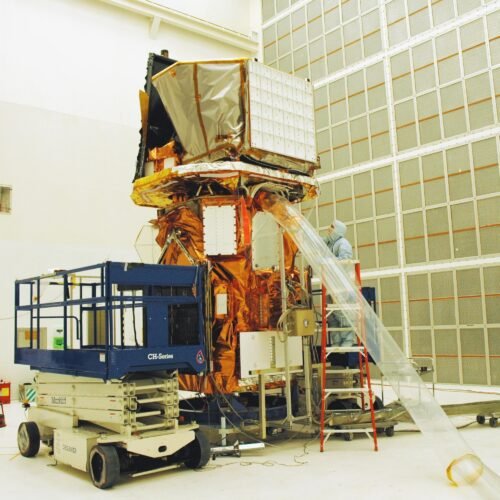
BROOMFIELD, Colorado—One of NASA’s oldest astronomy missions, the Neil Gehrels Swift Observatory, has been out of action for more than a month as scientists await the arrival of a pioneering robotic rescue mission.
The 21-year-old spacecraft is falling out of orbit, and NASA officials believe it’s worth saving—for the right price. Swift is not a flagship astronomy mission like Hubble or Webb, so there’s no talk of sending astronauts or spending hundreds of millions of dollars on a rescue expedition. Hubble was upgraded by five space shuttle missions, and billionaire and commercial astronaut Jared Isaacman—now NASA’s administrator—proposed a privately funded mission to service Hubble in 2022, but the agency rejected the idea.
Swift may be a more suitable target for a first-of-a-kind commercial rescue mission. It has cost roughly $500 million (adjusted for inflation) to build, launch, and operate, but it is significantly less expensive than Hubble, so the consequences of a botched rescue would be far less severe. Last September, NASA awarded a company named Katalyst Space Technologies a $30 million contract to rapidly build and launch a commercial satellite to stabilize Swift’s orbit and extend its mission.
The Swift observatory is flying in low-Earth orbit, where the outermost layers of the atmosphere still exert some aerodynamic influence on satellites. The spacecraft launched in November 2004 on a mission to detect gamma-ray bursts, the most powerful explosions in the known Universe. Despite its age, astrophysicists still rely on Swift’s multi-wavelength instruments to identify and locate gamma-ray bursts for follow-up observations by other observatories.
Gamma-ray bursts happen without warning, when massive stars die and form black holes or during mergers of neutron stars and black holes. Their afterglow can last from a few seconds to up to a few hours. Scientists need satellites like Swift to find and study them. One of Swift’s unique abilities is to quickly turn to point toward gamma-ray sources before they fade, a proficiency that gave the mission its name. Until last month, the mission remained operational and scientifically productive, and there is no other US satellite that fully replicates Swift’s capabilities.
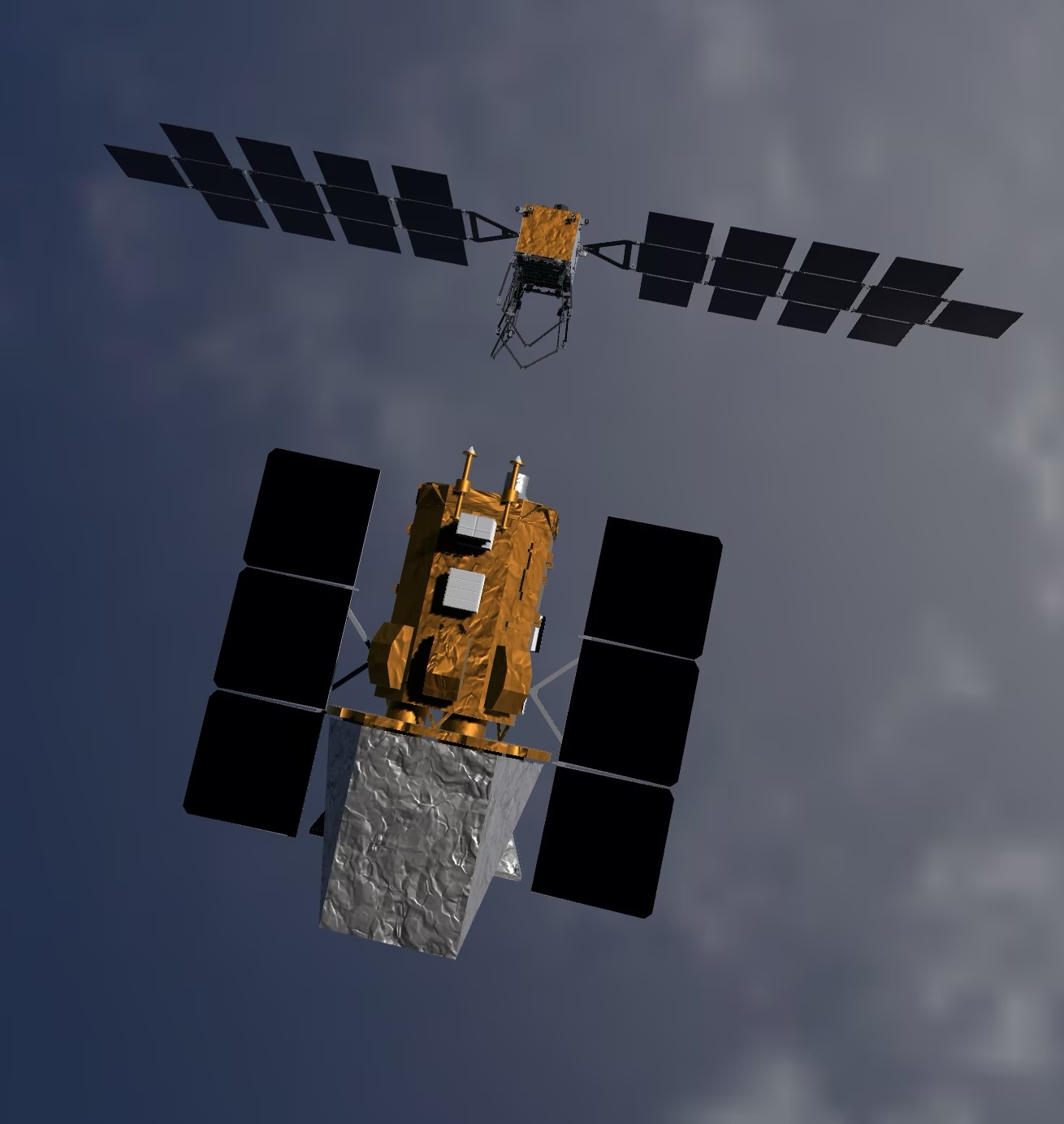
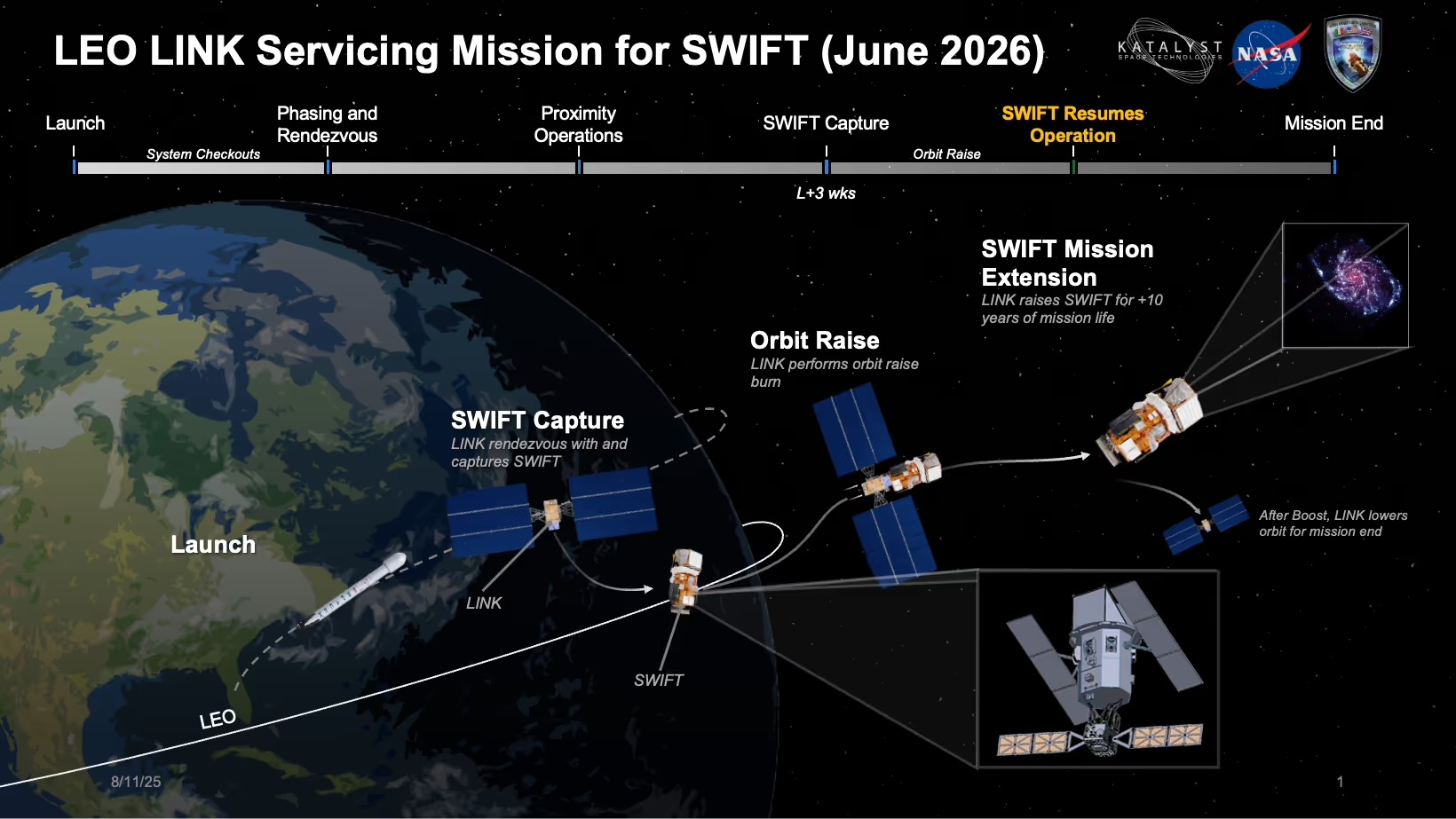
But the Swift spacecraft will surely crash back to Earth, likely before the end of this year, without a reboost. That’s where Katalyst comes in. The company’s robotic servicing spacecraft, named Link, will attempt to rendezvous and dock with the Swift satellite, then raise its altitude to give the observatory a new lease on life.
That is, if everything goes according to plan.
Deadline looming
There are a few things you should know about this venture. First, Swift was never designed to be captured or reboosted in orbit. Second, this mission is the first time Katalyst will attempt to dock with another satellite in space. And third, NASA gave Katalyst a daunting timetable of just nine months to build, test, and launch the rescue mission before Swift’s altitude falls too low for a safe rendezvous.
“This is really technically ambitious,” said Ghonhee Lee, founder and CEO of Katalyst.
Launch is scheduled for June 1, and there’s little margin for error. By late summer or early fall, Swift will slip below 200 miles (320 kilometers), too low for Katalyst to have confidence in controlling its spacecraft. “It’s a lot of drag with two big spacecraft docking together, ” Lee said. “Originally, we thought we had more time.”
NASA’s goals are twofold: first, demonstrate an important capability for the future of space exploration, and second, save Swift from a fiery demise and continue its scientific observations.
“We realized that you can’t get 100 percent guaranteed success on this,” Lee said.
When Ars visited Katalyst in late February, technicians were heads-down at work stations, soldering parts, assembling solar panels, and preparing components for environmental testing. For a traditional government space mission, a project might be at this stage of manufacturing years before reaching the launch pad.
“This is not quite as mature as you would expect,” one company official said. “Keep in mind that we started this whole thing about five months ago, so we are making great progress by those standards.”
Reporters are natural skeptics, but there was little room for doubt among the Katalyst employees I spoke with. The company is working nights and weekends, accepting risk, pivoting to new ideas, and striving for “good enough.” Katalyst has about 40 employees working on the Swift rescue, all within yelling distance on the factory floor.
When Katalyst started ordering parts for the rescue mission, officials found that some subcontractors were unable to provide components on such an unusually short schedule. Katalyst rapidly swapped vendors or, in some cases, decided to build things on its own.
“We’re basically doing it where everything is coming together,” Lee said. “The design, the testing, and the verification are all happening at once.”
A new way of doing business
NASA has long pursued robotic satellite servicing. The agency spent $1.5 billion on a now-canceled project that advanced several key technologies for in-orbit reboost, repair, and refueling, but in the end, it never left the ground. Now, NASA is buying a service from a company that uses a model similar to the one the agency used for the Commercial Crew and Cargo programs.
In a press release announcing the contract with Katalyst last year, Shawn Domagal-Goldman, director of NASA’s astrophysics division, said the rescue mission uses a “forward leaning, risk-tolerant approach” and “is both more affordable than replacing Swift’s capabilities with a new mission, and beneficial to the nation—expanding the use of satellite servicing to a new broader class of spacecraft.”
Only Northrop Grumman, one of the nation’s largest aerospace and defense contractors, has completed a successful commercial servicing mission with a satellite that was not originally designed to receive visitors. Founded in 2020, Katalyst has flown two small satellites in orbit to date, and the company is developing a maneuverable spacecraft platform named Nexus, which is designed to approach, inspect, or service other objects in orbit. The prime market for Nexus will be the US military.
The Link servicing platform selected for the Swift rescue is an intermediate step before Nexus.
“Nothing under this program is inventing new technology,” Lee said. “We’re taking technology that’s already been developed, either here or just in the broader industry, and putting it together in the smart way that allows us to move really quickly. And it’s also only $30 million.”
Katalyst beat out competing proposals from Starfish Space and a team consisting of Cambrian Works and Astroscale to win the contract to save Swift last September.
At that time, officials expected Swift would reenter the atmosphere around the end of this year, or perhaps as late as the first part of 2027. But the Sun has been active, triggering strong geomagnetic storms. With those storms, the Earth’s atmosphere expands, leading to more air resistance in low-Earth orbit. Now, engineers predict Swift will decay sometime between late July and October, Lee said.
Will this actually work?
“No kidding, if we don’t launch in June, there’s real danger that this mission doesn’t come together,” Lee said.
Katalyst is trading reliability for time. “It’s better to put together a functional spacecraft that has a realistic shot pulling off the mission than delaying by two or three months to ensure another 1, 2, 3, 4 percent of reliability,” Lee said. “It’s just better to get it up there. I think NASA understands that.
“That contrasts deeply with the previous idea of ‘do no harm,’” Lee said. “Now, ‘do no harm’ is a fine mentality, but I think that it can lead to stifling innovation because you just never take a chance on anything. This is the perfect mix between operational need and risk tolerance.”
Katalyst is one of a growing roster of US companies interested in RPO, or rendezvous and proximity operations. In many cases, these companies have outrun the government in RPO expertise. NASA spent nearly 10 years developing a government-owned servicing demo mission before its cancellation in 2024. A DARPA program has faced similar delays.
“We’re building on those shoulders, so I definitely want to credit them,” Lee said of NASA. “The problem with those programs is that they never really had a customer or a use case. It was ‘Oh, let’s go do a bunch of different things and hope that somebody will see the value in it.’ The danger of that is you get massive amounts of scope creep, and that’s exactly what happened. The programs were constantly delayed.”
In contrast, the commercial world places a premium on flight demonstrations. “For us, these things have to fly, otherwise our company doesn’t deserve to exist,” Lee said.
Guessing game
No one has tried to rescue a satellite on the cusp of reentering the atmosphere. Last month, NASA suspended most science operations on Swift in an effort to reduce atmospheric drag and slow the spacecraft’s orbital decay. Ground controllers will keep the satellite in an orientation that minimizes drag effects.
If Katalyst is able to launch the rescue before Swift drops too close to Earth, engineers aren’t sure what they’ll find when they pull up to the spacecraft.
“One of the big things in developing this mission is there’s not a lot of great information about Swift looked like prior to launch,” a Katalyst manager said as we stood under a full-scale model of the bottom of the Swift observatory. This is the lab where engineers test the robotic arms that will capture the satellite.
“This view that we have right here, there are no pictures that show this angle. None that we’ve found so far,” the manager said. Katalyst looked through archives from NASA and Northrop Grumman, which built the satellite. “There are pictures of lots of things around here,” the official said. “There isn’t one at the end of closeout where you’re, like, ‘OK, yeah, this is what we should be expecting.’”
Katalyst’s rescue craft has three robotic arms with grippers that will attempt to clamp onto any suitable part of the Swift observatory. Engineers came up with a design they say can handle a number of possibilities.
“We know there’s a radiator on one of these side panels, but that was covered in paint 22 years ago before it launched, and it’s had 22 years of ultraviolet exposure,” the manager said. “The paint is likely to be cracking and peeling off, so that’s not a great place to grab.”
The satellite’s outer layers of insulation have been exposed to the harsh environment of space, including atomic oxygen. This can cause the insulation to crack like glass. NASA discovered this phenomenon on servicing missions to the Hubble Space Telescope.
“As soon as you initiate fracture on it, it will just propagate,” the manager said. “So you have these plastics that now behave more like a glass and can shatter. It’s weird.”
After launch, it will take several weeks for the rescue spacecraft to reach Swift. Katalyst’s servicer will approach slowly, and sensors on the robotic arms will attempt to find edges to grab onto.
“No matter what, we’re going to learn a lot. We don’t know exactly what configuration it is in,” the manager said. “We don’t know exactly which surfaces are grabbable… but that’s why we’re kind of engineering our systems to be as versatile and robust as possible.”
Last Pegasus
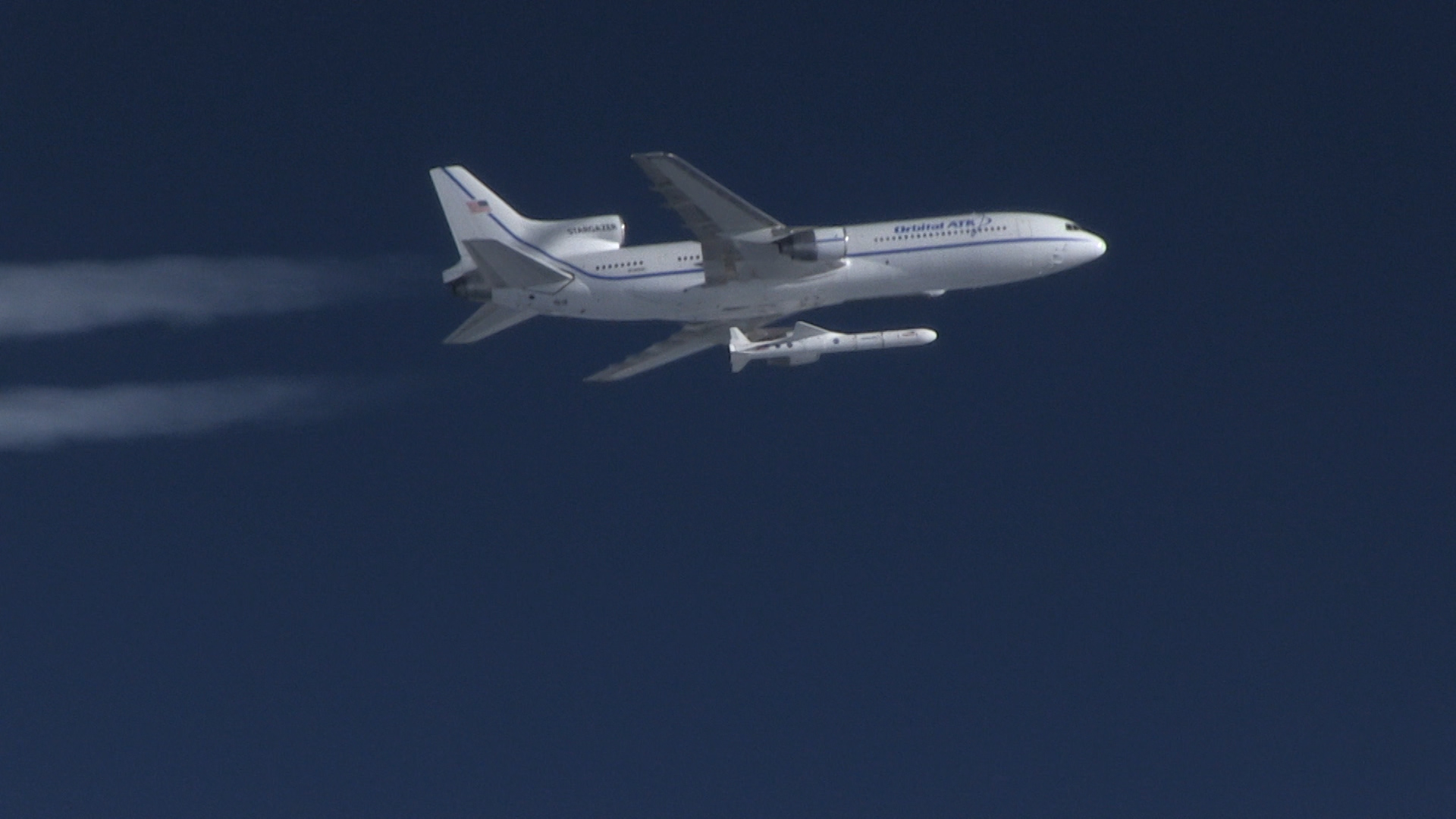
Instead of choosing a well-oiled workhorse like SpaceX’s Falcon 9 to launch the rescue mission, Katalyst selected the air-launched Pegasus XL, a rocket that hasn’t flown since 2021.
Pegasus was the world’s first privately developed orbital launch vehicle. It has launched 45 times since 1990, but the Pegasus program is winding down. Northrop Grumman took over the program in 2018 after acquiring Orbital ATK, itself a follow-on to Orbital Sciences, the rocket’s original developer.
Using the Pegasus rocket for the Swift rescue mission might seem surprising, but a closer examination reveals a good reason for it. Swift flies close to the equator, swinging between 20 degrees north and south latitude on each orbit, to minimize time flying over the South Atlantic Anomaly, a weak spot in Earth’s magnetic field where satellites are exposed to higher doses of damaging radiation. For Swift, this exposure could contaminate science observations.
If launched on a Falcon 9, the rescue mission would require a dedicated ride from Cape Canaveral, Florida, to reach such an unusual orbit. It could not take advantage of SpaceX’s lower-cost Transporter and Bandwagon rideshare missions that routinely deliver small satellites to higher-inclination orbits. And Katalyst’s spacecraft is too heavy for Rocket Lab.
“A lot of people think launch is a solved issue. They see how often that Falcon 9 flies. They see companies like Rocket Lab and Firefly coming online,” Lee said. “But the reality of the situation is launch is a solved issue if you’re able to fit into a Transporter or Bandwagon.”
The mission’s $30 million budget includes the launch. Katalyst has not disclosed how much it is paying for the ride on Pegasus—Northrop charged $28 million for a Pegasus launch in 2021—but rocket motors were already built for one more Pegasus rocket. It’s a safe bet that the company got a good deal.
“Out of the Cape, if we’re going on a dedicated Falcon 9, that’s like $65 or $70 million. So there was just no trade space. Pegasus was actually a really good option because it’s built for this type of mission, going to unique inclinations, being able to be responsive, and then the payload capacity of it was perfect. They have up to 400 kilograms (880 pounds) to this orbit. That’s exactly what we need. Falcon 9 would have been way overkill for something like this.”
The Pegasus system has the advantage of being mobile. The rocket and its airborne launch platform will be assembled together in California, then flown to Kwajalein Atoll in the Marshall Islands, about 600 miles (1,000 kilometers) north of the equator. There, the airplane will release Pegasus to begin its climb into space.
“It’s kind of sad that it’s the last Pegasus because it’s a really good architecture for things like this,” Lee said. “You can imagine that there are going to be other use cases.”