On Monday, a paper announcing that all four DNA bases had been found on an asteroid sparked a lot of headlines. But many of the headlines omitted a key word needed to put the discovery in context: “again.” The paper itself cited similar results dating back to 2011, and the ensuing years have seen various confirmations and more rigorous studies. The new work was less notable for showing that we had found these bases in Ryugu than for solving a previous mystery: earlier studies had failed to detect them there, despite their presence in many other asteroid samples.
Outside the headlines, though, the new work provides some interesting details, as it may answer an important question: how these bases got there in the first place. Understanding that better may be critical for getting a better picture of how the raw materials for life ended up on Earth in the first place.
Searching for bases
Let’s start with a description of what the researchers found. Both DNA and RNA, the two nucleic acids used by life, share a similar structure. That includes the backbone, a chain that alternates between sugars and phosphates that are all chemically linked together. While the specific sugar differs between DNA and RNA, the chain itself varies only in length; otherwise, the backbone of every DNA or RNA molecule is identical.
What gives nucleic acids the identity needed to carry genetic information are the bases. There are four (A, T, C, and G in DNA; A, U, C, and G in RNA), and one is always attached to each of the sugars in the backbone. The order of the bases along the backbone is what carries genetic information, enabling life as we know it. It’s been hypothesized that, before life evolved, the order of bases along RNA molecules determined the sorts of chemical reactions they could catalyze.
So while the bases aren’t everything you need to move from interesting chemistry to life, they’re a pretty big deal. Searching for them outside the confines of Earth is an obvious priority.
The new paper makes no secret of the fact that those searches have been a success. The paper’s abstract mentions their discovery in three different asteroids. An early paragraph cites a 2011 paper describing the discovery of the bases of nucleic acids in meteorites, fragments of asteroids that have survived the plunge through our atmosphere. Similar results have been reported over the intervening years. In every case, the asteroids also contained closely related molecules not used by present living things.
While that’s exciting, it’s impossible to rule out the possibility that these bases resulted either from chemistry driven by the heat from atmospheric entry or somehow resulted from contamination from life on Earth. But we’ve managed to rule that out by going directly to asteroids and retrieving samples in space. When the OSIRIS-REx mission brought back material from the asteroid Bennu, the same bases turned up in that material.
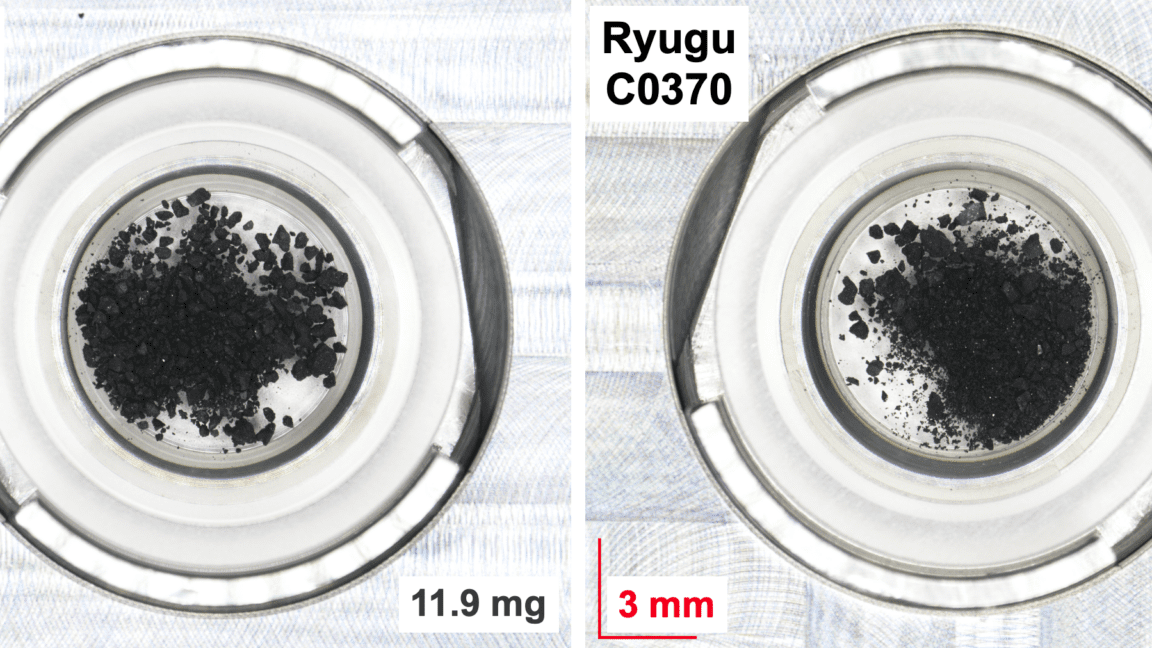
The surprise is that most of the bases weren’t found in Ryugu, which had been visited by the Hayabusa2 mission. One base was clearly present, but most couldn’t be detected in the first round of tests.
The new paper describes an additional set of tests, which both used more starting sample material and higher sensitivity tests. The combination picks up the remaining bases, confirming that all five of the bases (the three common to DNA and RNA, as well as the two specific to one or the other). With that, Ryugu joins the other asteroids that carry critical precursors of nucleic acids.
Beyond Earth
The paper does take a step beyond simply confirming an expected result, though. The bases of nucleic acids come in two forms: two-ringed structures called purines and simpler single-ringed structures called pyrimidines. The chemistry leading to their formation will necessarily be somewhat distinct, so the researchers pooled the purines and pyrimidines and compared their concentrations across multiple asteroids.
They found a correlation between the relative levels of these two chemical classes and the amount of ammonia present in the asteroid. This, they suggest, might tell us something about the chemistry of the reactions that produced these nucleotides in the first place.
And that could ultimately be the most important aspect of this work: extensive research has sought chemical reactions that can produce nucleotides and other key biochemicals under conditions likely to have prevailed on the early Earth. But conditions in space are very different, so a distinct set of reactions should be possible. Information like this can help us constrain the types of reactions we need to consider and thus may help us identify any prebiotic chemistry that could be happening in space.
That’s not to say biochemicals from space are likely to have been essential to forming life on Earth. Some will degrade due to the heat of crossing the atmosphere and impact, and it’s not clear whether any that survive would end up concentrated enough to kick off life. But the Universe is a really big place, and the conditions present in space are likely to be far more common than those typical of early Earth. So finding out more about the reactions that prevail in asteroids may be more relevant to life elsewhere in the Universe.
Nature Astronomy, 2026. DOI: 10.1038/s41550-026-02791-z (About DOIs).