
The United States currently finds itself in a state of strategic paralysis, caught between an administrative push for military confrontation and a wall of resistance that spans from its own halls of power to the capitals of its oldest allies. These synchronized failures – one institutional, the other diplomatic – reveal a fundamental truth: the push for Operation Epic Fury is not a projection of America’s strength but a catalyst for its isolation.
This double-sided rejection marks a definitive collapse of the post-Cold War security architecture. The cracks in the administration’s strategy are no longer mere whispers – they are resounding ruptures.
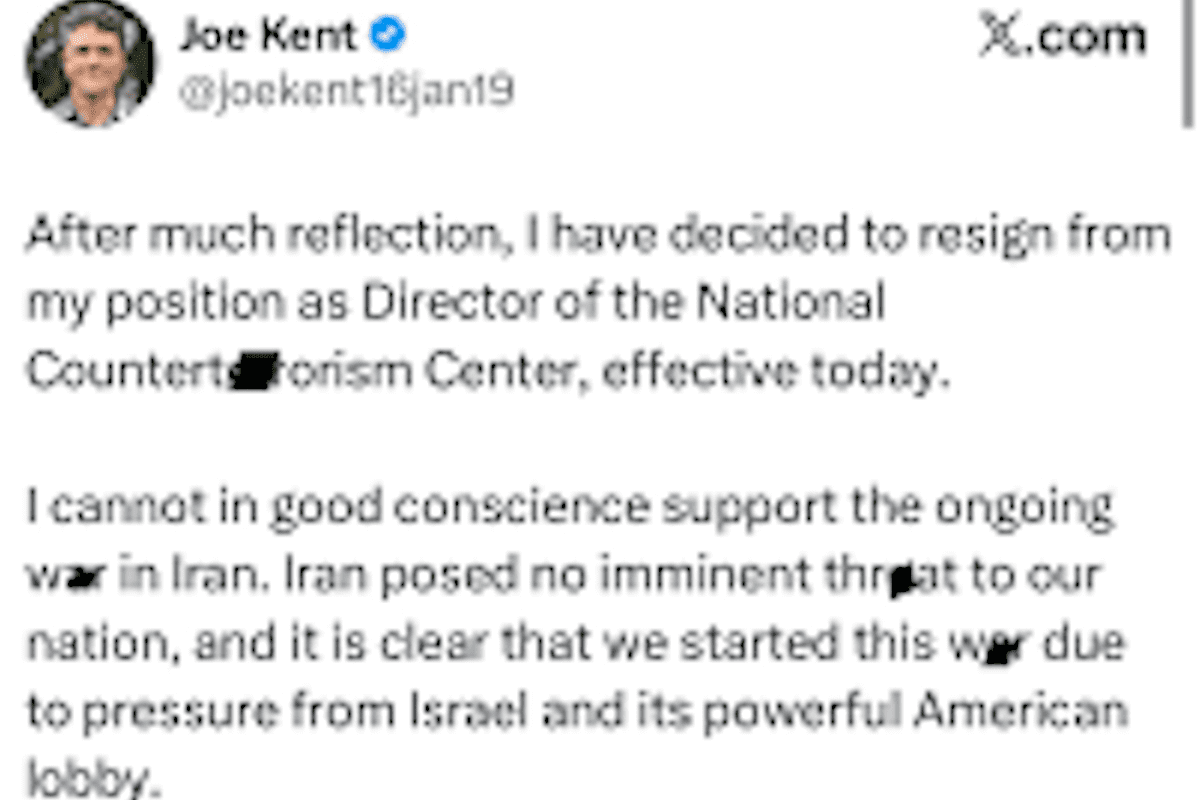
The March 17 resignation of Joe Kent, Director of the National Counterterrorism Center (NCTC), serves as a damning indictment. When a decorated former Green Beret and “America First” stalwart departs in protest, explicitly stating that Iran posed “no imminent threat” and that the war was manufactured under external pressure, the administration’s rhetoric loses its foundational legitimacy. This is a professional rebellion by the very institutions tasked with the nation’s defense. When intelligence professionals like Kent refuse to bend facts to fit a pre-determined war footing, the presidency finds itself governing from a vacuum of credibility.
This institutional dissent is amplified by an unprecedented distancing from the past. In a rare moment of silent alignment, all four living former US presidents recently moved to deny claims made by President Donald Trump that one of them privately endorsed the current conflict. Their collective refusal to provide political cover reflects a deep-seated consensus among the foreign policy establishment: that Operation Midnight Hammer – the prior strikes on nuclear facilities – and the current campaign are destabilizing the region and compromising long-term American security.
Beyond the Beltway, the administration faces a formidable opponent: the American public. Recent Quinnipiac University and Ipsos polling indicates that over 60% of voters believe the administration has failed to provide a clear justification for the war, while 74% of Americans explicitly oppose the deployment of ground troops. This “ghost of Iraq” has become a permanent feature of the American psyche. After two decades of “forever wars,” the public has developed a profound allergy to open-ended Middle Eastern entanglements.
If the domestic situation is a house divided, the international situation is a house empty. The administration’s demand for allies to join naval escort missions in the Strait of Hormuz – a chokepoint for 20% of the world’s oil – was met with a sophisticated but firm diplomatic cold shoulder.
On March 19, 2026, leading nations including the UK, France, Germany, Japan, and Canada issued a joint statement. While they expressed readiness to join “appropriate efforts” for safe passage and energy stabilization, the subtext was an explicit rejection of Washington’s unilateral military path. These nations prioritized a “comprehensive moratorium on attacks” and adherence to UN Resolution 2817 over American war-planning.
German Defense Minister Boris Pistorius summarized the continental mood bluntly: “This is not our war, and we didn’t start it.” The diplomatic rift only deepened as President Trump publicly slammed UK Prime Minister Keir Starmer, labeling his insistence on a “de-escalation first” approach a “betrayal of the special relationship.” Starmer’s refusal to commit Royal Navy assets without a clear path to ceasefire has left London increasingly isolated from Washington’s operational core, signaling a historic low in Transatlantic security cooperation. By ignoring these calls for restraint, Washington is effectively dismantling the very alliances that once granted it global reach.
This strategic isolation is mirrored by a devastating collapse in America’s soft power. A landmark Politico/Public First poll released on March 15, 2026, reveals that public sentiment toward the United States has plummeted to historic lows across Canada, France, Germany and the United Kingdom. In Canada, 57% of respondents now view China as a more reliable partner than the US, while in Germany trust in American leadership has cratered to just 24%. These numbers signal a tectonic shift in global alignment, as traditional allies begin to perceive Washington’s volatility as a greater systemic risk.
This is no longer a mere disagreement between heads of state; it is a fundamental decoupling of Western public opinion from the American project. When a plurality of citizens in London and Paris view US foreign policy as a greater threat to stability than the adversaries it claims to deter, the moral authority required to lead the West has effectively vanished.
Proponents often frame this isolation as “strategic independence” – with a bravado suggesting that a superpower is too potent to be slowed by the friction of consensus. In the unforgiving reality of 2026, however, such isolation is not a mark of strength, but a symptom of strategic decay. When a nation’s internal security apparatus revolts and its oldest partners walk away, it is not leading; it is merely shouting into a void.
The path to stability requires a return to the forgotten virtues of great-power leadership: humility, deliberation, and restraint. Washington must pivot back to evidence-based threat assessments and re-engage with the multilateral frameworks that once successfully constrained Tehran’s ambitions. Stability cannot be bombed into existence; it is a slow architecture built on the bedrock of shared trust and diplomatic endurance.
Ultimately, the Iran crisis is a test of whether the United States still possesses the wisdom to lead or merely the muscle to disrupt. A true great power does not bluster into a regional conflagration while its own house is in revolt and its alliances are in retreat. It acts with a clarity of purpose that commands respect because it is rooted in verifiable truth and collective interest.
Right now, the United States is failing that test. The internal rifts, the rebuffed missions, and the historic collapse of public trust are the signals of a broken policy. Until Washington aligns its rhetoric with reality, it will remain a lonely, volatile power in a world that is already moving on. The “Maximum Pressure” campaign has indeed succeeded in exerting pressure – not on Tehran, but on the very foundations of the American-led order itself.
Jianlu Bi is a Beijing-based award-winning journalist and current affairs commentator. His research interests include international politics and communications. He holds a doctoral degree in communication studies and a master’s degree in international studies.