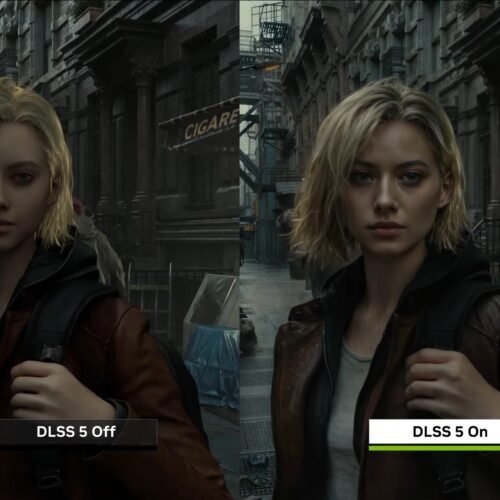
Since deep-learning super-sampling (DLSS) launch on 2018’s RTX 2080 cards, gamers have been generally bullish on the technology as a way to effectively use machine learning upscaling techniques to increase resolutions or juice frame rates in games. With yesterday’s tease of the upcoming DLSS 5, though, Nvidia has crossed a line from mere upscaling into complete lighting and texture overhauls influenced by “generative AI.” The result is a bland, uncanny gloss that has received an instant and overwhelmingly negative reaction from large swaths of gamers and the industry at large.
While previous DLSS releases rendered upscaled frames or created entirely new ones to smooth out gaps, Nvidia calls DLSS 5—which it plans to launch in Autumn—“a real-time neural rendering model” that can “deliver a new level of photoreal computer graphics previously only achieved in Hollywood visual effects.” Nvidia CEO Jensen Huang said explicitly that the technology melds “generative AI” with “handcrafted rendering” for “a dramatic leap in visual realism while preserving the control artists need for creative expression.”
Unlike existing generative video models, which Nvidia notes are “difficult to precisely control and often lack predictability,” DLSS 5 uses a game’s internal color and motion vectors “to infuse the scene with photoreal lighting and materials that are anchored to source 3D content and consistent from frame to frame.” That underlying game data helps the system “understand complex scene semantics such as characters, hair, fabric and translucent skin, along with environmental lighting conditions like front-lit, back-lit or overcast,” the company says.
“When you absolutely, positively, don’t want any art direction…”
You can see how DLSS 5 reinterprets that frame data for yourself in both Nvidia’s announcement video and in a detailed Digital Foundry breakdown (which notes that the demo currently makes use of two RTX 5090s, with one completely dedicated to DLSS 5). But while Digital Foundry described the “transformational lighting” effects as “astonishing” numerous times in its write-up, the reaction from the rest of the gaming world has been overwhelmingly negative so far.
Many of the reactions have focused on how DLSS 5 turns in-game faces into overly detailed, uncanny valley versions of the original models. Reactions have compared the effect to air-brushed pornography, “yassified, looks-maxed freaks”, or those uncanny, unavoidable Evony ads. Others have noted how DLSS 5 seems to mangle the intended art direction by dampening shadows in favor of a homogenized look.
Some game developers have leapt on the “artistic intent” angle, too. Thomas Was Alone developer Mike Bithell added that the technology seems designed “for when you absolutely, positively, don’t want any art direction in your gaming experience.” And Gunfire Games Senior Concept Artist Jeff Talbot said, “in every shot the art direction was taken away for the senseless addition of ‘details.’ Each DLSS 5 shot looked worse and had less character than the original. This is just a garbage AI Filter.”
New Blood Interactive founder and CEO Dave Oshry added that DLSS 5’s “AI dogshit is actually depressing” and lamented that future generations “won’t even know this looks ‘bad’ or ‘wrong’ because to them it’ll be normal.”
Damage control
By way of damage control, Nvidia took to the comments on its YouTube reveal trailer (which are filled with thousands of negative takes) to stress that DLSS 5 “is not a filter” and that “game developers have full, detailed artistic control over DLSS 5’s effects to ensure they maintain their game’s unique aesthetic.” That includes the ability to tweak intensity and color grading or turn the masking off entirely in “places where the effect shouldn’t be applied.”
DLSS 5 OFF // DLSS 5 ON
— Tuba Zef (@tubazef.com) March 16, 2026 at 3:59 PM
Bethesda, one of the many major publishers Nvidia named as an early DLSS 5 partner, piped in on social media to say that these videos are “a very early look, and our art teams will be further adjusting the lighting and final effect to look the way we think works best for each game. This will all be under our artists’ control, and totally optional for players.”
From a public image perspective, though, the damage may already be done. DLSS 5 has quickly become a meme format in its own right, with Internet commenters using “DLSS 5 On” as visual shorthand for “overly cleaned up” or “mangled beyond recognition.” We’re not sure how you come back from that kind of instant infamy, but Nvidia will have until the fall to find out.