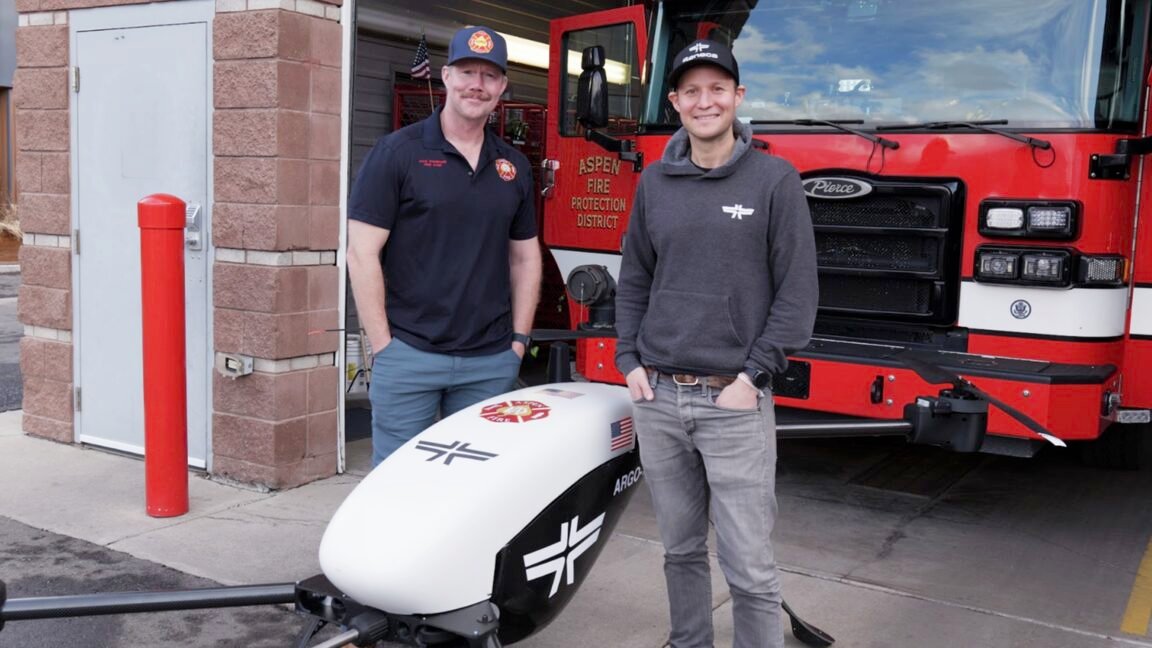
A Bay Area startup that manufactures drones to tackle wildfires has just signed its first customer, the Aspen Fire Protection District.
The company, Seneca, recently announced that its fleet of five drones (dubbed a “strike team”) would be coming to the famed Colorado ski town this summer, making Aspen the first wildfire agency in America to add these types of aircraft to its arsenal.
Each drone is designed to carry enough water “to create over 50 gallons of finished foam suppressant,” which can reduce the speed at which a wildfire consumes fuel. The drones are designed to be able to reach and extinguish a small fire before humans can.
“We’re looking at them primarily as an early suppression resource,” Jake Andersen, the chief of Aspen Fire, told Ars.
“We have [panoramic] AI cameras that are very good at rapidly detecting a fire. What we’re not always good at is getting people there immediately. It’s one thing if it’s on the side of a road, but if it’s not—I’ve hiked into fires in my career that are six or eight miles away. The range [of each drone] is about three to five miles, so this would really be a game changer.”
Seneca, which was founded in 2024, is one of a number of “firetech” companies founded in recent years that are trying to change the way that wildfires are prevented or extinguished.
Nationwide, wildfires are becoming larger, more destructive, and more frequent. According to the Colorado Division of Fire Prevention & Control, “The average core wildfire season is 78 days longer than in the 1970s, with Colorado experiencing large fires every month of the year.”
Similarly, California’s state-level wildfire agency, CAL FIRE, notes that six of the state’s most destructive wildfires have occurred within the last decade.
Two of these (the Palisades and Eaton Fires, which both took place in Los Angeles County) burned within the last 18 months. But it’s worth noting that during the first 12 hours of both blazes, the winds were so intense that no traditional firefighting aircraft could fly, much less drones.
In recent years, numerous wildfire agencies have expanded their use of cameras, infrared sensors, and mapping tools.
However, the act of putting out a blaze—“suppression,” in industry parlance—fundamentally remains a function of how many humans can quickly starve the fire of oxygen, heat, and/or fuel.
The basics behind fighting wildfires haven’t changed that much over the last century, and they primarily rely on manual labor: digging lines, removing fuel, and to a lesser extent, aerial drops of water.
Seneca founder Stuart Landesberg told Ars that his drones aim to supplement the equipment that wildland firefighters already have.
“The goal is: how do we supercharge what our firefighters are capable of?” he said. “We have this incredibly talented, incredibly devoted group of public servants. We want to give them the best technology in the world.”
Aspen Fire’s Chief Andersen added that, currently, his agency doesn’t have its own fleet of aerial resources. Calling in traditional aircraft from sister agencies can take hours.
“What we are getting is a trailer with five [drones, and we’ll drive it] as close as we can to the incident, and we will park and set up a little drone base,” he said, noting that if the initial tests are successful, he envisions permanent drone bases around the area.
“It would be ideal if we detect a fire and we can immediately launch one of these so we can investigate.”