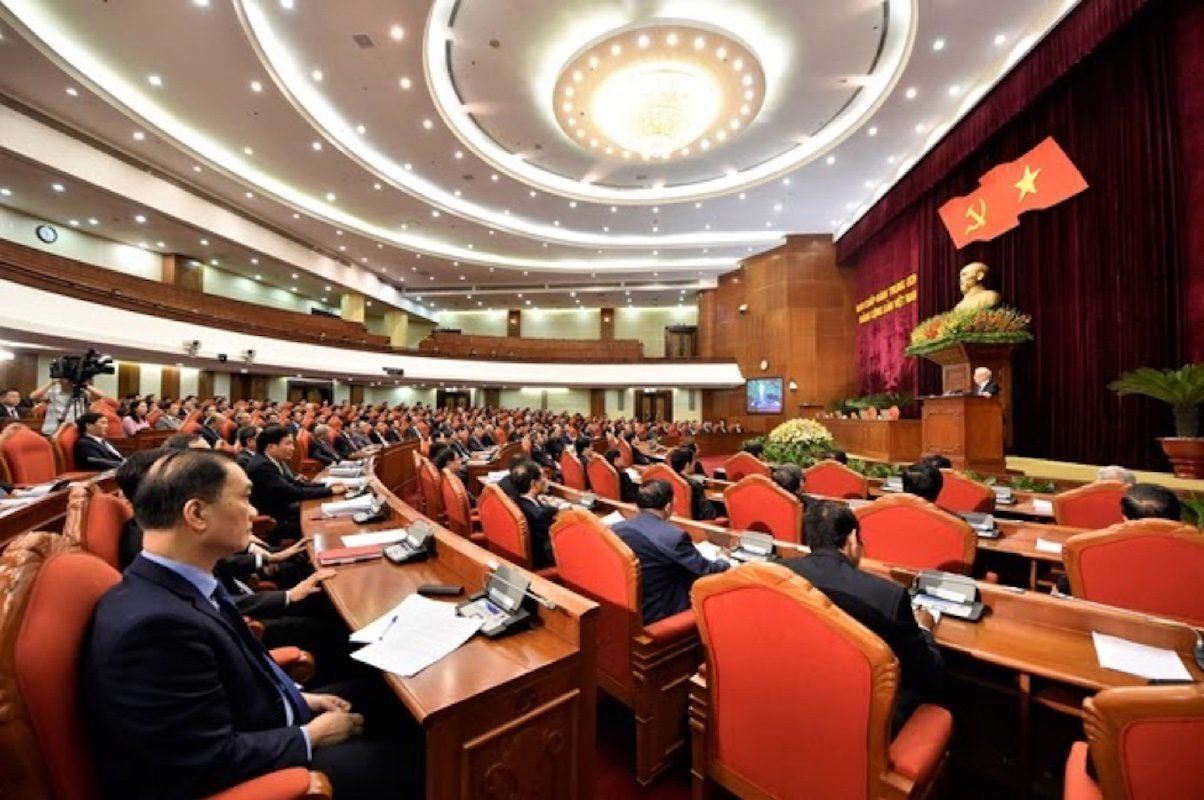
On March 15, 2026, nearly 73.5 million Vietnamese voters headed to the polls to elect 500 deputies to the 16th National Assembly and members of People’s Councils at all levels.
Of 864 candidates standing for the National Assembly, 65 were non-Communist Party of Vietnam (CPV) candidates, and only five were self-nominated. The outcome was thus never really in question.
What matters more is what kind of legislature will take shape under a new political order led by General Secretary To Lam. Though the CPV operates through collective leadership, To Lam has arisen as a strongman leader, having secured a full five-year term at the January 2026 14th Party Congress.
Among the new Assembly’s first tasks will be confirming a new state president, prime minister and cabinet. President Luong Cuong and Prime Minister Pham Minh Chinh were not returned to the Politburo at the party congress, clearing the way for a leadership reshuffle.
There is speculation that Defense Minister Phan Van Giang is a top contender for the state presidency, while Le Minh Hung, head of the Central Commission for Organizational Affairs and a former central banker, is tipped to become prime minister. It’s already clear that these appointments were effectively decided by the CPV leadership; the Assembly’s role will be merely to formalize them.
It is tempting to assess Vietnamese elections through a deficit lens, cataloguing what the system lacks compared with competitive multiparty models. That framing is not wrong, but it misses the more useful analytical question: what does the National Assembly actually do within the single-party system, and in whose interest?
The meaningful contest over who sits in the Assembly takes place months before any ballot is cast. The Vietnam Fatherland Front’s (VFF) three-round consultation process – running from late 2025 through early 2026 – determined who appeared on the final candidate list.
Candidates were nominated through local and central channels, vetted against political, professional and demographic criteria, and confirmed through consensus conferences. The CPV’s Organizational Commission coordinated throughout.
The resulting list met the system’s own representation targets: at least 35% women, at least 18% ethnic minority candidates and roughly 10% under 40. The 65 non-CPV candidates were drawn from professional and social organizations affiliated with the VFF – a designed feature of the legitimation architecture, not a sign of political pluralism. With a candidate-to-seat ratio of roughly 1.7 to 1, the competitive margin was narrow by design.
If there were any lingering ambiguity about the Assembly’s relationship to the party leadership, the 2025 constitutional amendments settled it. To Lam’s apparatus restructuring — merging provinces, abolishing the district tier of administration and streamlining party and state bodies — required changes to the 2013 Constitution.
The National Assembly unanimously passed Resolution 203 in June 2025, amending five articles to formalize a two-tier local government model effective from July 1, 2025.
The speed and unanimity were telling. The Politburo set a June 30 deadline for completion; the Assembly delivered on schedule. The amendments simply retroactively legalized the streamlined apparatus, embedding those structural transformations into constitutional reality. The process was ratification, not democratic deliberation.
For most of its history, the Assembly operated as a straightforward rubber stamp. The shift began in the early 2000s, when Assembly Chairman Nguyen Van An introduced reforms, including the live broadcasting of question-and-answer sessions, known in Vietnamese as chat van, with ministers and government officials.
Politburo Resolution 48 in 2005 on legal system development further formalized the Assembly’s role in policymaking. Over the following decade and a half, deputies grew bolder.
That was seen clearly when the Assembly rejected the north-south high-speed rail proposal in 2010, when individual deputies openly called for Prime Minister Nguyen Tan Dung’s resignation during televised sessions, and when the nuclear energy program was canceled in 2016.
Perhaps the most striking illustration of how far this could go remains the 2018 special economic zones bill. The proposed law, which would have offered 99-year land leases in three strategically sensitive coastal zones, triggered the largest public protests since 1975.
Under combined public and deputy pressure, the Assembly voted to postpone the bill indefinitely. It was a rare moment when popular mobilization and legislative resistance converged to block a government initiative.
Full-time deputies – targeted to make up at least 40% of the new Assembly – tend to be more engaged in legislative and oversight work than their part-time counterparts who hold concurrent positions elsewhere.
The composition of the Assembly’s specialist committees, and who chairs them, will be an early indicator of whether the legislature has the technical capacity to scrutinize the government’s ambitious policy agenda.
This is markedly so when two conditions align: public sentiment is strong enough that ignoring it carries political risk, and the party leadership either endorses the pushback or chooses not to block it. That unstated function can produce genuine consequences for individual officials. But it operates strictly within boundaries the party center sets.
On the big structural questions – the reform agenda, the pace of consolidation and the anti-corruption campaign’s direction and targets – the Assembly remains an instrument of the CPV leadership’s program. The 2025 constitutional process made that unmistakably clear.
There are also signs that even the bounded oversight the Assembly developed over the past two decades is now being actively wound back. The 2025 amendments to the Law on the Organization of the National Assembly formally narrowed the legislature’s lawmaking scope to principles and policy direction, delegating implementation details to the government.
Critical voices in the Assembly have been either marginalized or silenced. And at the Assembly’s final session in December 2025, chat van was replaced with written, not live, questions.
For those watching the 16th National Assembly take shape, the election results matter less than what follows: the committee assignments, the share of full-time deputies and whether the CPV leadership grants the legislature enough latitude to provide credible feedback on policy implementation.
In a system pursuing rapid structural transformation — and staking its legitimacy on delivering a wishful 10% annual GDP growth — even a managed legislature needs some capacity for honest reporting.
Whether that capacity is permitted or constrained will say more about the trajectory of Vietnamese governance than anything that happened at the party-managed ballot box.
Lam Duc Vu is a Vietnam-based risk analyst focused on regional trade and geopolitics