The Arab Gulf states today find themselves in one of the most uncomfortable strategic positions in modern Middle Eastern politics. They are neither the primary combatants in the unfolding confrontation between Iran, Israel and the United States, nor are they distant observers. Instead, they stand directly in the line of fire—geographically, economically and politically.
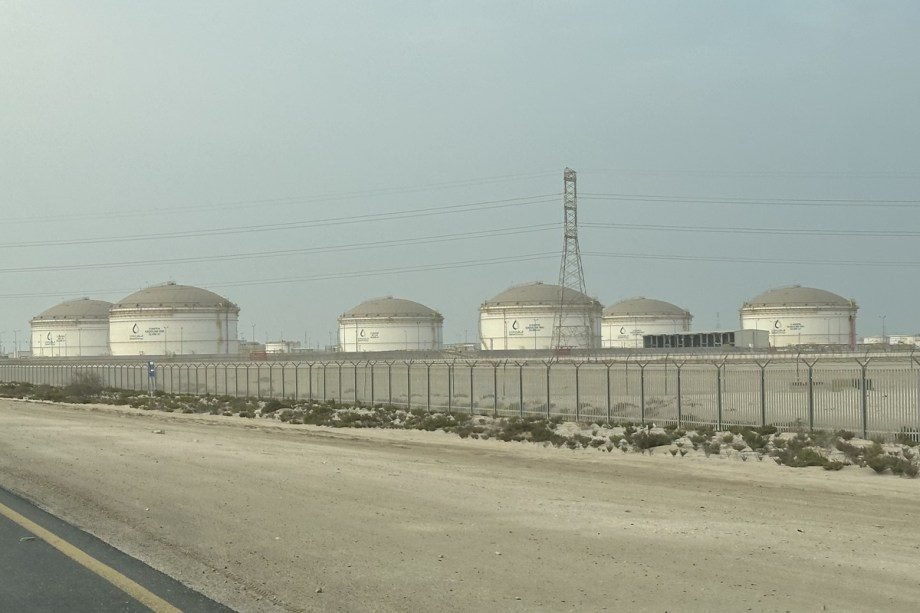
Missiles and drones have struck oil facilities, ports and military installations across the Gulf region. Saudi Arabia’s Ras Tanura refinery, which processes more than 550,000 barrels of oil per day, was among the high-profile targets. Oman’s Duqm Port—an important logistics hub—has also been attacked. Qatar’s liquefied natural gas infrastructure has reportedly been hit, forcing a temporary suspension of LNG production and triggering a sharp rise in global gas prices.
For the Gulf states, these attacks represent more than just security incidents. They have, in fact, threatened the very foundations of their long‑term development strategies.
Over the past two decades, countries such as Saudi Arabia, the United Arab Emirates and Qatar have invested heavily in transforming their economies. Their cities have become global centres of finance, tourism, logistics and innovation. Skyscrapers, energy hubs and trade corridors symbolise a vision of stability and prosperity.
Drone strikes crashing into high‑rise buildings or energy facilities risk undermining that vision. The damage is not only physical—it is reputational whereby investors, tourists and multinational companies watch closely when instability appears in regions they once viewed as secure.
What makes the situation particularly complex is that the Gulf states did not seek this conflict. Many leaders in the region have repeatedly stressed that the current confrontation between Iran and Israel is not their war.
As one regional position has been summarised, the Gulf countries believe firmly that “it’s not our war,” emphasising that their priority remains peace, stability and economic development.
READ: ‘Operation Epic Fury’ burns an estimated $5.82 billion in just 100 hours
Yet geography, in the current Gulf and Iran context, has made neutrality difficult.
Iran has acknowledged launching attacks against U.S. military installations in several Middle Eastern countries in response to joint U.S.–Israeli strikes that killed senior Iranian leaders, including Supreme Leader Ali Khamenei. But in practice, these retaliatory strikes have not remained confined to military targets alone.
Reports indicate that missiles and drones have landed in Saudi Arabia, Qatar, the United Arab Emirates, Bahrain, Kuwait and Oman—countries that were not directly involved in the original confrontation.
Iran’s President Masoud Pezeshkian has insisted that Tehran respects the sovereignty of its neighbours. In a message directed to regional leaders, he stated that Iran believes “the security and stability of the region must be achieved collectively.” However, actions on the ground have complicated that message.
Majed Al‑Ansari, spokesperson for Qatar’s foreign ministry, strongly condemned the attacks, warning that striking a country like Oman—long known for its diplomatic mediation—“constitutes an attack on the very principle of diplomacy itself.” This sentiment reflects a deeper concern among Gulf leaders: that escalation could destroy the very mechanisms needed to prevent a wider regional war.
So far, since the war erupted in the West Asian region, Gulf states have responded with remarkable restraint. Air defence systems across the region have intercepted the majority of incoming drones and missiles. Initial reports suggest interception rates above 90 per cent in several countries. At the same time, the Gulf Cooperation Council has activated joint air‑defence operations and reconnaissance missions while invoking Article 51 of the United Nations Charter, signalling their right to collective self‑defence.
Yet even amid these defensive preparations, voices within the region continue to warn against rushing toward direct confrontation. Former Qatari Prime Minister Sheikh Hamad bin Jassim Al‑Thani cautioned that the Gulf states must not “get dragged into direct confrontation with Iran,” arguing that such a scenario would “exhaust the resources of both parties and allow Israel to emerge empowered in the region.”
This warning by a senior Qatari official captures the strategic dilemma facing the Gulf today.
READ: Qatar says air defenses intercept 13 missiles, 4 drones launched from Iran
On the one hand, continued attacks on energy infrastructure and civilian areas cannot be tolerated indefinitely. On the other hand, direct military escalation could ignite a regional war that no party would ultimately control.
The Middle East has experienced decades of prolonged conflicts—from the Iran‑Iraq war to the wars in Iraq, Syria and Yemen. Each conflict left deep scars on regional economies and societies. Few leaders in the Gulf want to see that history repeated; hence diplomacy remains not only desirable but necessary.
Countries like Qatar and Oman have long served as mediators in sensitive regional negotiations. These diplomatic traditions may now prove more valuable than ever. But the scale of the current crisis may also require the involvement of a broader international mediator capable of speaking to all sides.
In the meantime, Beijing has quietly expanded its diplomatic footprint in the Middle East in recent years. Its successful facilitation of the Saudi–Iran rapprochement in 2023 demonstrated that it can act as a credible intermediary between rival regional powers. Unlike Western actors who are often perceived as participants in regional rivalries, China maintains strategic relations with both Iran and the Gulf states.
Chinese diplomats signalled readiness to help de‑escalate the crisis. China’s foreign minister reportedly praised Saudi restraint and urged all parties to avoid hitting civilian infrastructure. Beijing has already engaged with Gulf leaders by phone in the crisis (reportedly contacting the Saudi foreign minister), suggesting it is trying to play a mediating role. A Chinese‑led effort could complement Gulf initiatives, since China has a vested interest in Middle Eastern stability and has brokered important agreements in the region before.
For Gulf leaders seeking a path out of escalation, a multilateral mediation effort involving China—alongside regional mediators such as Qatar and Oman—could offer a practical way forward.
The objective would not be a grand geopolitical settlement overnight. Rather, it would aim for immediate confidence‑building measures: halting attacks on civilian infrastructure, protecting energy corridors and establishing communication channels to prevent miscalculation.
For policymakers across the Gulf, the challenge now is to balance urgent security imperatives with a longer‑term vision for a stable regional order grounded in international law. A concerted multilateral effort that brings together regional and global actors—including emerging powers like China—could transform this crisis into an opportunity to recalibrate the region’s security architecture and to reinforce collective security frameworks.
READ: US group urge Iran to grant ICC jurisdiction over apparent war crimes
The views expressed in this article belong to the author and do not necessarily reflect the editorial policy of Middle East Monitor.