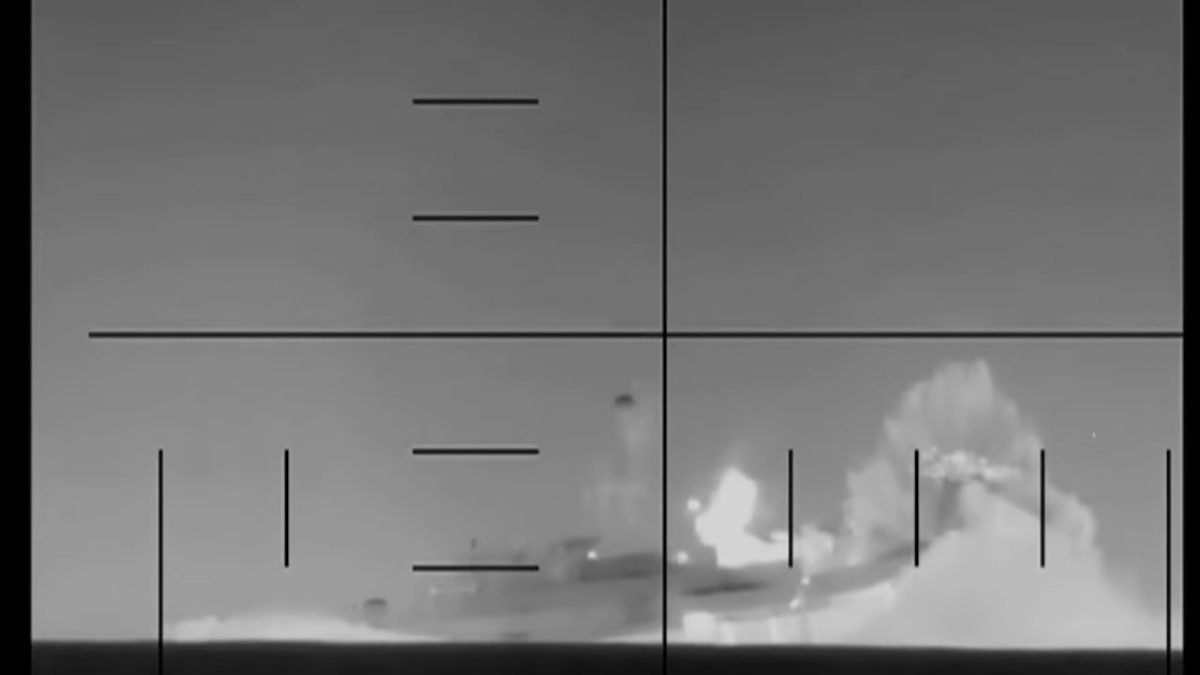
A rare wartime submarine kill in the Indian Ocean this month — when a US nuclear attack submarine sank an Iranian frigate off Sri Lanka — highlights the growing strategic importance of the region’s sea lanes and the vulnerabilities of China’s Middle Eastern energy lifelines.
The sinking marks the first time since World War II that a US submarine has destroyed another vessel with a torpedo. The submarine fired an MK-48 heavyweight torpedo that struck the 1,500-ton Moudge-class frigate IRIS Dena (75), breaking the ship’s keel and sending it to the bottom, Chairman of the Joint Chiefs of Staff General Dan Caine told reporters during a US Department of Defense briefing.
US Defense Secretary Pete Hegseth said the vessel had been operating in international waters after recently conducting exercises in the Bay of Bengal, but was targeted as part of the widening US campaign against Iran under the US–Israel “Operation Epic Fury.”
Caine said the US has sunk more than 20 Iranian vessels and one submarine since the operation began, significantly degrading Iran’s naval presence. Video released by the DoD showed the frigate moments before an underwater explosion.
Sri Lanka’s navy launched search-and-rescue operations after the strike, rescuing 32 Iranian sailors and recovering several bodies while continuing efforts to locate additional survivors, according to Sri Lankan naval officials.
Caine said US Central Command (CENTCOM) would continue striking Iranian infrastructure and naval capability, adding US intelligence, surveillance and reconnaissance (ISR) assets were hunting ballistic missile launchers and “one-way attack” capability.
The sinking of the IRIS Dena may send a strong signal to China, given its dependence on seaborne Middle Eastern energy. Cutting off China’s energy supply could severely affect its economy, already strained by a costly trade war with the US, and complicate any plans to take Taiwan by force.
A May 2025 report from the US Energy Information Administration (EIA) says that 90% of China’s oil travels by sea. A December 2024 Geopolitical Monitor report by Antonio Graceffo adds that 80% of that oil passes through the Malacca Strait, making China vulnerable to a blockade should its supply be cut off from the Middle East, Indian Ocean or Malacca Strait.
The US has noted those vulnerabilities, with the US 5th Fleet based in Bahrain and US forces operating from Diego Garcia serving as its main forces in the Indian Ocean theater. The Indian Navy and the Australian Navy could also assist in interdicting China’s oil shipments in the Indian Ocean.
The US and its allies could also block Chinese shipping routes at the other ends of these supply lines, specifically at the Strait of Hormuz, where the Persian Gulf connects to the Indian Ocean, and at the Bab El-Mandeb, where the Red Sea links to the Gulf of Aden, according to Michael Hanson in a December 2023 Proceedings article.
Hanson suggests the US Navy could position itself outside China’s weapons engagement zones to intercept ships approaching key chokepoints. He adds that submarines might focus on China’s oil tanker fleet, similar to US tactics used in World War II against the Japanese merchant fleet.
Aware of that vulnerability, China has been shoring up its Indian Ocean presence. According to Darshana Baruah in a May 2025 article for the International Institute for Strategic Studies (IISS), China has steadily expanded its military and infrastructure presence across the Indian Ocean region to protect sea lines of communication and support broader maritime ambitions.
Baruah notes that since beginning regular deployments in 2008, China has increased naval activities, including submarine deployments starting in 2014 and the establishment of its first overseas military base in Djibouti in 2017.
She also notes frequent military exercises across the region involving maritime, air and land forces, reflecting efforts to build operational familiarity and defend energy and trade routes.
Baruah also notes that Chinese entities have developed or upgraded numerous ports and infrastructure projects across the region—including Gwadar in Pakistan, Hambantota and Colombo in Sri Lanka, Kyaukphyu in Myanmar and multiple facilities in East Africa—creating a network of logistical hubs supporting China’s growing maritime footprint.
On how China could use its growing Indian Ocean presence to counter US and allied efforts to cut off its energy supply, T.X. Hammes writes in a March 2025 Atlantic Council article that China could use its overseas ports and bases—including those along key maritime routes—to mitigate or counter a US blockade by rapidly converting commercial port infrastructure into military “counter-intervention” nodes.
Hammes says that Chinese-controlled ports could secretly store command-and-control equipment, anti-ship and anti-air missiles, electronic-warfare systems and munitions transported in commercial containers before a conflict.
He adds that personnel could then be flown in quickly to activate these assets, allowing China to protect shipping routes, rearm naval vessels and threaten or disrupt maritime trade at strategic chokepoints if the US imposed a distant blockade.
Beyond securing its Indian Ocean sea lines of communication, China could pursue a continental pivot by deepening its partnership with Russia. As the Financial Times (FT) reported this month, Russia is already China’s largest oil supplier, accounting for 20% of China’s oil purchases.
In the longer term, China and Russia could accelerate energy infrastructure projects such as the Power of Siberia 2 pipeline and expand the use of Arctic trade routes.
However, China’s reliance on Russian oil may depend on the outcome of the Ukraine war. Chinese Foreign Minister Wang Yi has stressed that China does not want to see Russia lose in Ukraine. But not losing does not automatically equate to winning.
China may not be able to afford a Russian defeat in Ukraine, as such an outcome could allow the US to shift its strategic focus, military assets and resources to the Pacific.
A Russian victory in Ukraine that results in the lifting of Western sanctions on Russian energy exports could, however, reduce Russia’s dependence on China. In that case, Russia could maintain its strategic independence and remain a strong competitor to China in Central Asia and the Russian Far East.
A stalemate in the Ukraine war could serve China’s interests by locking in long-term Western sanctions on Russia’s economy and energy exports, deepening Moscow’s dependence on Beijing.
That asymmetric relationship could give China leverage over Russia’s energy exports, military hardware sales and influence in Central Asia, as well as over longstanding territorial disputes in the Russian Far East that Russia may have chosen to keep quiet about due to wartime necessity.
Ultimately, the Indian Ocean is emerging as a critical arena in great-power competition, where US naval power threatens China’s energy lifelines even as China expands its regional footprint and hedges with continental alternatives.