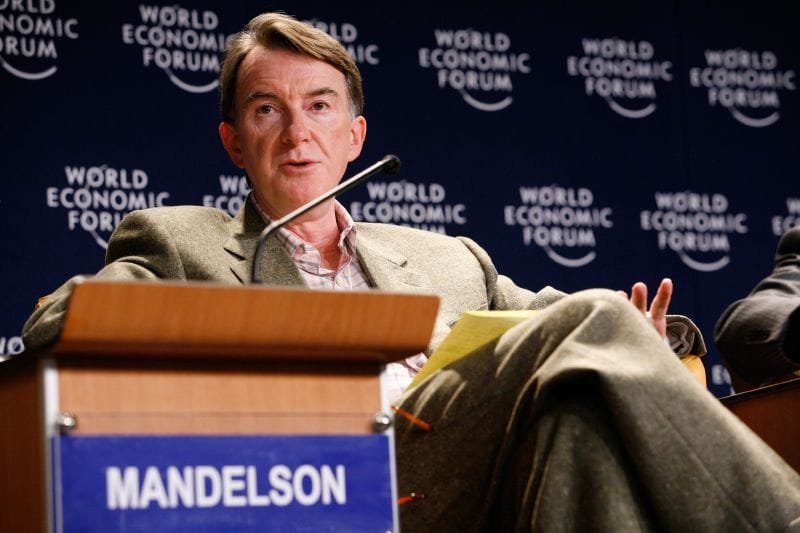
Keir Starmer’s eventual apology to the victims of Jeffrey Epstein is not offered as a matter of genuine conscience, but rather as a matter of political expediency. The astonishing confession by the Prime Minister that he was “lied to” and “deceived” by Peter Mandelson reveals not naivety, but rather a deference to establishment figures which transcends due diligence, morality, and even political instinct.
The latest cache of documents released by the US Department of Justice reveals that Mandelson’s friendship with Epstein endured even after the financier’s conviction for child sex offenses in 2008. The records show that Mandelson sent messages of support to Epstein, calling him his “best pal” even as victims of Epstein’s crimes suffered on. Perhaps even more astonishing, however, are the emails that reveal Mandelson shared top-secret economic information with Epstein during the 2008 financial crisis, when he was Gordon Brown’s business secretary. He betrayed the sacred trust of protecting the government and his oath of duty. The Metropolitan Police have begun a criminal investigation into alleged misconduct in public office.
But the excuse offered by Starmer, namely that he did not know the “depth and darkness” of the relationship between Mandelson and Epstein, strains credulity. As Kemi Badenoch, Leader of the Opposition Conservative Party, pointed out in Parliament, “It was on Google.” The Mandelson-Epstein relationship has been out in the open since 2019, and what Starmer seemingly did not do was pose the most basic questions about a man he was appointing to a position of huge sensitivity.
This is where history should have intervened. Mandelson, known as the “Prince of Darkness” for his skills as a political operator, had twice previously resigned as a minister over financial improprieties involving wealthy donors. The signs were there, the warnings had been given, and yet he was appointed to a position of huge sensitivity by multiple governments, both Labour and Conservative.
But, of course, there is a problem with British politicians and establishment figures: their proximity to power amounts to immunity until disaster strikes.
The echoes of Iraq are impossible to ignore. Sir Christopher Meyer, Britain’s ambassador to Washington from 1997 to 2003, wrote in his memoirs of a crude instruction given by Tony Blair’s chief of staff, Jonathan Powell: “Get up the arse of the White House and stay there.” This posture, which translates into submission, not partnership, got Britain into a war predicated on lies, which cost over one million Iraqi lives. He went on to testify to the Chilcot Inquiry that Mr Blair had signed Britain up to “regime change” at the Crawford presidential retreat in Texas in April 2002, “in blood” a year before Parliament voted for war.
The Iraq disaster ought to have taught Britain’s ruling elite that loyalty to Washington is not rewarded with influence, but with exploitation and sometimes with flagrant contempt. Mr Blair thought he could get a place at the table by being loyal to America’s hegemony. He ended up in the dock of history. The Chilcot report, published in 2016, concluded that Mr Blair had “overstated intelligence, failed to address issues of law, and failed to exhaust diplomatic options.” “The wound remains unhealed, leaving behind some of history’s most enduring scars. Starmer is repeating the same script. He chose Mandelson precisely because his Machiavellian approach to power was seen as useful in dealing with Donald Trump. He chose an individual who was an operator, not a diplomat, a fixer, not a servant of the people.
The scandal has sparked a fierce backlash within his own party, with Labour MPs vociferously doubting his judgment and his party’s poor results in local elections potentially serving as a trigger for a leadership challenge. Health Secretary Wes Streeting branded it “a betrayal of not just one but two prime ministers”.
The common thread between Iraq and Mandelson is not just a lack of judgement, but a deeper malaise that leads leaders to believe that moral compromise is a necessary component of political pragmatism and that proximity to power is a surrogate for principle. Blair believed that loyalty to Bush was a guarantor of British interests; it was a guarantor of British complicity and betrayal of the British people. Starmer believed that Mandelson’s connections would ease British relations with Trump; they secured only British shame.
The timing could hardly be worse for Trump, whose own well-documented connections with Epstein have come under renewed scrutiny, with his administration reportedly finding the scandal “especially awkward” during his state visit to Britain. Trump’s embarrassment, however, does not excuse Starmer’s leadership. Britain has no business judging American excesses when its own government is so spectacularly lacking in judgment.
Leadership is not simply a matter of technical skill or even political skill. Leadership is a matter of character, of drawing lines, asking questions, and refusing complicity even when it is so tempting. Mandelson has resigned from the Labour Party and the House of Lords, his storied career reduced to rubble and ignominy. He is a symptom of a deeper malaise, however: that of a leadership that chose to elevate him despite all available advice.
A nation is not judged on its friends, but on its principles. By that measure, Britain under Starmer is making a mistake that echoes Blair’s: confusing access with influence, submission with strategy, cunning with wisdom. History lacks the petty arithmetic of politics. It does not keep score, it does not forget, and it never grants a pardon. It simply carves its truth into the stone of time.
The views expressed in this article belong to the author and do not necessarily reflect the editorial policy of Middle East Monitor.