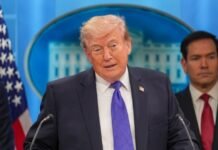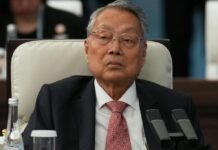
Jury deliberations in the case started overnight in New York just as Trump, Xi and Putin prepared to sit down for a trilateral summit at the APEC 2026 conference in Shenzhen.
The case was brought against the backdrop of escalating US export controls on the sale of top-end Nvidia chips to China and renewed US concerns about China’s engagement with Iran.
Export controls have prompted China to pursue AI chip sovereignty, with Huawei in a leading role, and China has taken an increasingly aggressive stance against US secondary sanctions, which factor prominently in the pending case.
China will likely see a guilty verdict against Huawei as a further provocation by the US, another example of “economic bullying.” Even so, the practical impact of a guilty verdict may still prove to be modest.
Key missing allegation
Given that US officials have consistently presented Huawei as a serious national security risk, it was telling that the charges in this case did not include allegations that China used backdoors in Huawei network equipment to conduct spying operations on US persons.
Prosecutors apparently determined that these more explosive charges, which have never been independently confirmed as a technical matter, could not be proven in a criminal court.
Instead, the prosecution’s case fell into three main baskets: five specific instances of theft of trade secrets of a handful of competitors in the US tech and telecom sectors; bank fraud relating to allegations that Huawei had hid information about its business in Iran from its banks; and an overarching conspiracy charge based on the Racketeer Influenced and Corrupt Organizations Act, known as RICO, which essentially paints Huawei as a wholly corrupt criminal organization and attributing the company’s meteoric rise as a global tech giant to criminal activity.
Over the course of the 11-week trial, the defense countered the allegations by claiming that it was inconceivable that Huawei’s breathtaking success came from theft, racketeering or fraud. Instead, defense counsel argued, this was a case of “competition, not conspiracy; innovation, not theft; ordinary business dealings, not criminal misconduct,” pointing to the company’s extraordinary track record of investment, innovation and ingenuity.
In particular, defense counsel noted that of the company’s 210,000-plus employees worldwide, more than 110,000 are engaged in R&D, and the company invested more than US$100 billion in R&D over the 20 years in question. As a result, Huawei’s patent portfolio covers more than 120,000 patent families in all key jurisdictions worldwide, and partners with hundreds of leading technology companies, including Apple, Samsung, and IBM.
In 2025, Huawei’s R&D investments exceeded 20% of total revenues, placing the company in the top 10 globally.
Rogue employees
On the trade secret theft element, prosecutors tapped into a common view promoted by China hawks in the US: that Chinese tech companies have been able to get ahead only by copying and stealing US technology.
Overall, however, the government’s trade secret theft case was much thinner. Prosecutors presented evidence that, in five separate instances over 20 years, Huawei employees had misappropriated Cisco router software, stolen parts of a T-Mobile phone testing robot arm and taken photos of Fujitsu products at trade fair displays, among other misconduct.
The defense acknowledged misconduct by specific employees in the Cisco and Fujitsu incidents, but said Huawei took appropriate action to address these isolated violations of the company’s code of conduct. Defense counsel argued that the facts did not support the other allegations and that they were isolated, cherry-picked incidents.
Meng in the spotlight
The bank fraud element once again placed Huawei CFO Meng Wanzhou, daughter of company founder Ren Zhengfei, into the spotlight. Canadian authorities arrested her in 2018 at the request of US officials as she transited through Vancouver airport en route to Mexico. Ironically, she was arrested just as Trump sat down to a private dinner with Chinese president Xi at the G20 meeting in Buenos Aires.
The principal evidence against Meng in the Canadian extradition case was a PowerPoint presentation she shared with HSBC bankers in 2013, which the prosecution claimed omitted and mischaracterized key facts about how Huawei conducted business in Iran through cutout companies in contravention of US secondary sanctions.
During the extradition proceedings, it became apparent that HSBC was fully aware of all relevant facts, undercutting the DOJ’s claims. When the Canadian judge noted these concerns in open court, the DOJ moved quickly to enter into a deferred prosecution agreement (DPA) with Meng that contained relatively anodyne acknowledgments of watered-down facts underlying the base charges.
In the pending case against the company itself, the prosecution presented her DPA statements as evidence that Huawei had already conceded the bank fraud charge. The defense, however, highlighted that Meng agreed to the DPA so she could be released to return to China after nearly three years of house arrest in Vancouver, and that the DPA’s wording did not amount to a confession of criminal wrongdoing on her part or Huawei’s.
Iran connection
Prosecutors played to anti-Iranian sentiments by repeatedly seeking to tie the Huawei business to suppression of anti-government protests in Tehran in 2009.
DOJ lawyers opened their case with emotionally charged testimony from Parham Beheshti, an Iranian dissident who worked at MobinNet, an internet service provider in Iran, and was directly involved in procuring Huawei telecom equipment.
He repeatedly expressed anger that China was selected to deliver cutting-edge surveillance capabilities to support what he considered to be a repressive Iranian regime.
Defense lawyers, however, presented evidence that the “lawful intercept,” or eavesdropping, functionalities fully complied with relevant international standards and that Huawei was never in the operational loop. The Iranian network operators and government were left to deploy these functions at their discretion, in accordance with local law.
The final set of issues concerned corporate conspiracy to commit the above acts systematically under the RICO charges. Judge Ann Donnelly noted that this racketeering conspiracy charge was highly unusual.
In a Bloomberg interview at the opening of the trial, Columbia Law School professor Eric Talley called the RICO charge a “kind of a throw-in” designed to tie together the first two clusters of allegations and provide a foundation for additional penalties. To prove the RICO charges, the government would still need to prove the other two sets of charges, known as “predicate offenses.”
Talley further noted that the key question was whether the specific events presented by the government would be enough to convince the jury that the underlying conduct was not only significant events in and of themselves but that the underlying acts “were part of a continuous organized kind of orchestrated pattern,” while Huawei could correctly argue that the alleged misconduct is in fact normal business practice in a highly competitive industry.
At trial, Huawei’s lawyers pointed out that the so-called predicate acts were committed in different regions at different times by different employees who did not know each other, undermining the government’s claim that senior management orchestrated them. Which side will prevail on this key question now rests with the jury.
Cost of doing business
If Huawei is found guilty, the trial would then enter the penalty phase. Criminal penalties for Huawei as a company may include debarment from US government contracts, fines and potential reputational damage.
Huawei’s access to the US market and many other G7 countries is already restricted for geopolitical reasons, so debarment will have little impact, and financial penalties for corporate criminal conduct are now typically seen as just another cost of doing business.
Beyond this, as the global order continues to shift away from US hegemony to a new multipolar world, it remains to be seen whether a guilty verdict will tarnish Huawei’s reputation in non-G7 countries to any significant degree. In the end, the market will decide Huawei’s fate, not a jury in New York.
Robert Lewis was admitted to the California bar in 1985 and has worked in top US, UK and Chinese law firms in China for more than 30 years. He previously served as Asia General Counsel for Nortel Networks. He is currently the chairman and co-founder of the Sino-International Professional Advisory Council (SIPAC).
Source: Iwpost.com