<
article id=”post-952824″>
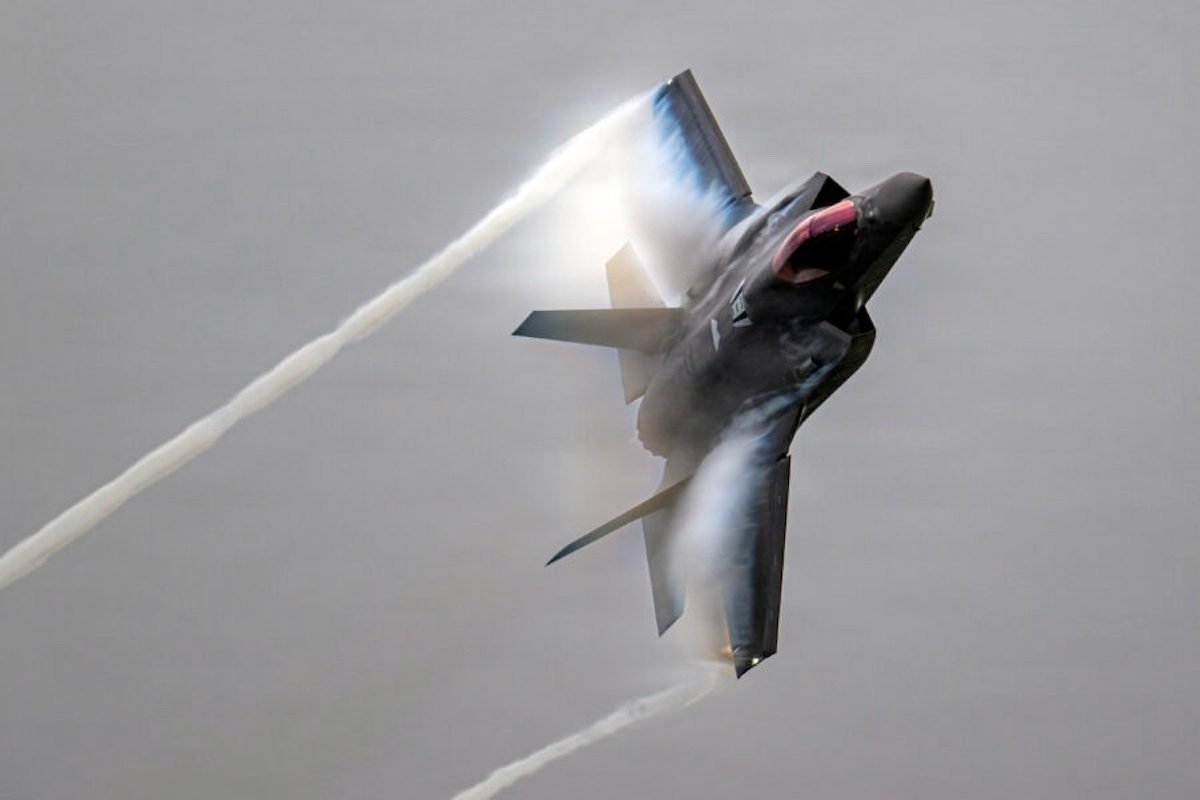
This month, the Government Accountability Office (GAO) released a report stating that the US Department of Defense (DoD) still cannot account for tens of millions of dollars in F-35 fighter jet components because of widespread supply-chain tracking failures and weak logistics security.
According to the GAO report, the F-35 Joint Program Office still does not know the status of over 1 million lost parts worth more than US$85 million and failed to record roughly 17,000 maintenance-bound parts valued at up to $2.5 billion in its property system.
The GAO found that critical vulnerabilities span the program’s $31 billion shared pool of 26 million parts dispersed across more than 700 worldwide locations, noting that US defense officials do not know which sub-tier contractor facilities house certain parts and that in-transit components shipped via commercial freight routinely escape tracking.
Because US defense systems lack real-time integration with prime contractors Lockheed Martin and Pratt & Whitney, records lag by months, and the DoD routinely approves loss adjustments without investigating root causes, the GAO reported.
Ultimately, the GAO warned that these systemic gaps would undermine military combat readiness, obstruct financial audits, and severely cripple US capacity to prevent fraud, waste, or theft across its most expensive weapons program.
The report comes shortly after China reportedly obtained sensitive F-35 parts, including a canopy and weapons-bay doors. In September 2026, US Congressional committees launched inquiries after an Australian F-35 cockpit canopy and weapons-bay door were inexplicably diverted to Hong Kong during commercial transit.
Shipped via UPS on behalf of Lockheed Martin for US repairs, the unserviceable components transited South Korea before China seized and retained them. This severe logistics failure has triggered US recovery efforts and heightened national security alarms that China could exploit intact radar-absorbent materials and specialized stealth geometry to reverse-engineer sensitive fifth-generation technology and counter allied combat fleets.
Noting the vulnerability of US defense logistics, Sam Mullins and others wrote in an October 2026 Foreign Affairs article that deepening US military partnerships and globalized supply chains are creating dangerous blind spots that expose cutting-edge defense technologies to foreign adversaries.
Mullins and others argued that the accidental misdirection of Australian F-35 stealth jet components to Hong Kong demonstrated how routine logistical friction among allied nations, defense contractors, and commercial shippers can inadvertently hand critical capabilities directly to China.
They further warned that as the US accelerates defense production across the Indo-Pacific, complex multinational networks heighten the risk of industrial espionage, intellectual property theft, and sabotage by hostile powers exploiting disparate security standards across vulnerable allied partner nations.
Obtaining F-35 parts through logistics misdirection may be just one facet of China’s broader efforts to acquire sensitive US military technology surreptitiously.
In a report detailing Chinese espionage efforts in the US from 2000 to March 2023, the Center for Strategic and International Studies (CSIS) documented that Chinese hackers first breached the DoD’s Joint Strike Fighter (JSF) project in 2007 to steal core design data, followed by a 2012 intrusion that compromised classified onboard systems.
Beyond military networks, the CSIS report stated that Chinese intelligence operatives also used private conspirators like Su Bin, who breached Boeing’s corporate networks in 2014 to exfiltrate confidential files on the F-35, C-17, and F-22 to accelerate China’s own advanced stealth fighter development programs.
China may already be reaping the benefits of its prolonged F-35 espionage campaigns. In a November 2024 Air & Space Forces Magazine article, US Air Force General David Allvin suggested that placing China’s twin-engine J-35A, which first flew in September 2023, alongside the single-engine F-35 clearly reveals where China obtained its blueprints, citing unmistakable visual similarities.
While declining to discuss classified intelligence, Allvin pointed to China’s documented history of replicating US aircraft designs, though he maintained that copied airframes cannot match the superior training, maintenance, and overall force quality that preserve the US combat advantage.
According to the US Army ODIN database, the J-35A is a single-seat, twin-engine, fifth-generation, multirole stealth fighter built for the People’s Liberation Army Air Force (PLAAF), while a carrier-capable J-35 naval variant features foldable wings and reinforced landing gear. It says twin WS-21 afterburning turbofans power the jet, has a 1,200-kilometer internal combat radius, and a top speed of 1,400 kilometers per hour.
The database also notes that the jet’s low-observable design incorporates seamless airframe shaping and fiber-mat materials effective against L- and Ku-band radars, along with an active electronically scanned array (AESA) radar, distributed optical sensors, and six internal and six external hardpoints for air-to-air missiles and precision-guided munitions.
Still, confirming that the J-35 is a copy of the F-35 would require a detailed forensic investigation of both aircraft, which is very unlikely to happen. Furthermore, other fighters such as South Korea’s KF-21 and Turkey’s Kaan are visually similar to the F-35 and J-35A, suggesting these similarities stem from convergent design for common mission requirements rather than outright copying.
China may also use the J-35 as a tool of influence through foreign sales. As Rahul Manohar Yelwe noted in a December 2025 Royal United Services Institute (RUSI) article, China could offer the J-35 to nations unable to acquire the F-35 because of steep lifecycle costs, strict end-use restrictions, and selective allied eligibility.
Yelwe identified Pakistan, the Middle East, and Africa as viable markets for the J-35, observing that China pairs competitive pricing and concessional loans with politically unconditional transfers free of human rights and governance concerns to cultivate long-term strategic alignment with customers. Yet he pointed out that persistent doubts about Chinese aerospace reliability and after-sales support could still temper international demand.
Even without conclusive proof that China copied the F-35 using stolen technology, China’s espionage efforts present a persistent challenge to US strategic interests.
In a February 2026 interview for Foreign Policy, former US Defense Intelligence Agency (DIA) officials David Shedd and Andrew Badger stressed that decades of espionage have propelled China into becoming a military superpower and fundamentally reshaped the strategic balance across the Taiwan Strait.
Badger warned that unconstrained espionage by China’s Ministry of State Security (MSS) helped build one of the world’s most sophisticated militaries, citing severe vulnerabilities such as Chinese engineers writing code for DoD cloud networks.
Shedd added that China aggressively targets aerospace to eliminate lingering technical deficiencies, warning that the US risks losing its decisive edge as China’s cyber and military capabilities reach parity with the US.
Unless the US urgently hardens its globalized defense supply chains and digital networks, China’s fusion of covert technology acquisition and unconditional arms sales threatens to erode US airpower dominance and diplomatic influence, ultimately tipping the Indo-Pacific strategic balance.
Source: Iwpost.com