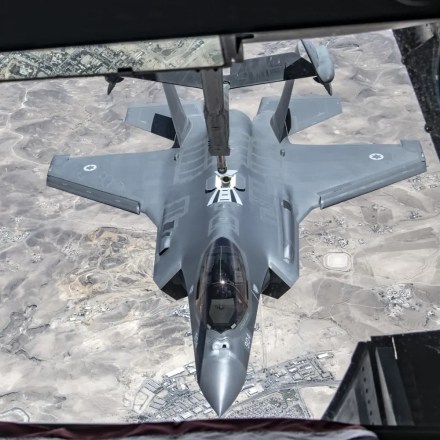
In May 2023, the Pentagon’s shiny new fighter jet was not looking so shiny or new.
Already a decade late and nearly $200 billion over its original cost estimate, the F-35 program faced a new crisis. An internal government watchdog report detailed a cascade of new problems with the program, which was in a period of flux amid plans to upgrade the jet’s engine and cooling system.
The report from the Government Accountability Office criticized the Pentagon for lumping those upgrades in with the overall purchase of the planes. Conflating the two, the authors said, would limit congressional insight into cost increases. And they criticized the contractors behind the aircraft for failing to deliver the F-35 in a timely manner.
For Lockheed Martin, the main defense giant overseeing the development of the F-35, the timing was far from ideal. In a few weeks, Congress was set to debate the Pentagon’s mammoth budget — and with it, new funding for the military’s purchase of F-35 jets.
Collins was the largest recipient of Lockheed cash in the period surrounding the inspector general report.
So Lockheed and its lobbyists went on a charm offensive in Washington. The weapons maker shelled out hundreds of thousands over a two-month period, in what the money-in-politics watchdog Open Secrets described as “one of the largest coordinated lobbying efforts” around that year’s military budget.
No member of Congress benefited more than Sen. Susan Collins, R-Maine, who at the time served as the ranking member on the Defense Appropriations Subcommittee.
From May 1 to June 30, 2023, employees and top executives from Lockheed Martin donated $59,500 to Collins’s campaign committee. The donations were outliers during that period: Collins was among the largest recipients of Lockheed cash; the company was her largest single donor over those two months; and it was the largest spending blitz on Collins by Lockheed compared to the same period in other years.
The effort appeared to pay off for Lockheed. In July 2023, less than two months after the release of the Government Accountability Office report, Collins voted in favor of appropriating funds to purchase 83 new F-35 jets. Later that year, when the final version of the military budget was signed into law, Collins celebrated the economic boon she said it would bring to the state of Maine.
In response to questions from The Intercept, Phoebe Keller, a spokesperson for the Republican-controlled Senate Appropriations Committee, said Collins’s support for the jet had nothing to do with donations from Lockheed or any other firm.
“The F-35 jet program is a longstanding bipartisan defense priority,” Keller said. “Sen. Collins has always publicly supported the F-35 jet program, as dozens of both Republican and Democratic Senators.”
Collins’s position on the Defense Subcommittee of the Senate Appropriations Committee likely played a role in the outsized donations, according to analyst Dan Grazier. And Collins, for her part, would have good reason to approve the spending: The F-35 program, Lockheed claims, has had a nine-figure economic impact in Maine.
Fight of Her Political Life
In the final weeks of the biggest fight of her political career against Democratic challenger Troy Jackson, fresh scrutiny on Collins’s donations from defense contractors has become a sore spot for her campaign.
In some cases, the senator’s interactions with defense firms are the routine for Washington: glad-handing, lobbying, contributions, and directing pork-barrel spending back home. Not all of it, though, is standard.
Last month, a bombshell report in ProPublica detailed an FBI investigation into an alleged pay-to-play scheme. A former defense contractor claimed to federal agents that he worked with figures tied to Collins to disguise campaign donations — and got federal contracts totaling $32 million in return. (The FBI probe fizzled after Trump returned to office and purged the bureau; Collins denied wrongdoing, pushing back on elements of the report.)
On Wednesday, more than 250 Mainers signed a letter to the state’s attorney general asking the official to investigate the allegations of corruption, according to Maine Morning Star, a local news outlet.
And earlier this month, The Intercept reported on donations from another defense contractor, AM General, and its parent company, whose employees gave $58,000 to fundraising committees associated with Collins after a damning assessment from the Army put its federal contracts in jeopardy.
As with the AM General donations, the contributions by employees and lobbyists of Lockheed Martin do not indicate wrongdoing by Collins or her donors. They instead illuminate how companies that garner lucrative contracts zero in on powerful members of Congress, who often tout the benefits to their states.
“This is an example of what’s wrong with our approach to buying weapons,” said William Hartung, an analyst who has written critically of defense spending and influence peddling in Washington. “If we buy things because they’re in the state of a powerful member, we’re not going to have a coherent arsenal.”
Lockheed Giving
Collins was not the only member of Congress to push for funding the F-35, which enjoyed broad bipartisan support — especially from lawmakers with eligible firms and facilities in their states. And she was not the only one to benefit from the largesse of Lockheed Martin.
From May 1 to June 30, 2023, Lockheed’s corporate PAC doled out $421,000 in a bipartisan blitz to various campaign political action committees, campaign funds, state parties, and charitable foundations. (Aside from 2024, the year of the presidential election, contributions in that two-month period in 2023 eclipsed subsequent years. In the same period this year, Lockheed’s corporate PAC made 128 donations totaling $236,000; last year, it gave $286,000 across 158 donations during the same period.)
Collins was by far the biggest single beneficiary of the influx of cash — which came at a time when she was not actively campaigning. And, unlike the donations spread out to other campaign committees, the cash going from Lockheed into Collins’s coffers during those months came exclusively in the form of individual donations by employees and executives, including the firm’s CEO and chief operating officer, data from the Federal Election Commission shows.
Of the 60 donations of $1,000 or more during May and June of that year, 56 went to Collins.
Lobbyists working for Lockheed contributed another $5,000 to Collins during that period, and corporate PACs for Lockheed’s lobbying firms shelled out another $5,500 total, according to FEC disclosures.
Among individual contributions by Lockheed employees, donations to Collins made up more than 10 percent of all donations during the two-month period surrounding the watchdog report.
Only the firm’s in-house employee PAC, which received 75 percent of all employee donations, took in more from figures tied to Lockheed. Collins got more than twice as much as the next highest recipient, ActBlue, the Democratic Party-aligned fundraising vehicle, which received 4 percent of all Lockheed employee contributions in that period, according to FEC data.
The vast majority donations from Lockheed employees and officials were under $1,000. Of the 60 donations of $1,000 or more during May and June 2023, 56 went to Collins.
Virtually all employee contributions from Lockheed workers and executives to Collins during her current term came during that two-month window, according to the FEC.
Lockheed donations made up a quarter of all contributions during May and June 2023 to Collins’s main fundraising arm, Collins for Senator. The next runner-up was telecom giant Charter Communications, whose employee contributions made up just 8 percent of gifts to the Collins campaign in the second quarter of the 2023 fiscal year.
A spokesperson for Lockheed did not answer specific questions regarding the reason for the sudden influx of individual contributions to Collins in 2023.
“Our employee PAC program continues to observe long-standing principles of bi-partisan political engagement in support of our business interests,” the spokesperson wrote in an email.
Another Vehicle Army Didn’t Want
Two years later, a similar pattern played out in miniature when a lesser-known defense firm with a troubled product enjoyed Collins’s support on Capitol Hill.
Collins went out of her way last year to slam the Pentagon for canceling its plans to purchase robotic combat vehicles from Textron and its subsidiary Howe & Howe, the Maine-based developer of the Ripsaw.
Collins has repeatedly hyped the unmanned robotic combat vehicle in Senate hearings and official statements. On June 18, 2025, she took issue with the fact that the vehicle had appeared in a recent military parade, but did not make the cut for further spending.
“It’s the height of irony that you would feature this combat vehicle in your parade as the future of the Army at the same time that you’ve canceled the contract — the cancellation of a contract that was won over a lot of other competitors,” Collins said, describing the decision as “terribly unfair and a real mistake.”
A month later, after the military budget cleared the Senate Appropriations Committee, Collins singled out Howe & Howe, and its plant in Waterboro, Maine, as a potential beneficiary of a portion of $44 million allotted to outfit the U.S. Marine Corps with amphibious and autonomous vehicles.
She gave another shoutout to Howe & Howe in January, after the 2026 military budget was signed into law. This May, during the congressional testimony by then-Army Secretary Daniel Driscoll, Collins again took the military to task for cutting its planned purchase of the Ripsaw.
Textron’s corporate PAC made contributions totaling $4,000 to various PACs associated with Collins just ahead of her vote on the 2026 military budget. $3,000 of the gifts came days after Collins criticized the military for cutting its plans for the Ripsaw program that would have brought millions of dollars to Howe & Howe.
Later in the year, the Textron corporate PAC donated another $7,000 to Collins for Senator and the Collins-linked Dirigo PAC, according to FEC filings. (A spokesperson for Textron and Howe & Howe did not respond to a request for comment. Keller, the Senate Appropriations Committee spokesperson, did not respond to questions about the Textron and Howe & Howe donations.)
Employees of Textron and its subsidiary, meanwhile, made contributions to various Collins-linked PACS totaling nearly $15,000 between September 2025 and October 15, 2026, FEC data shows.
The donations, relatively small in the post-Citizens United era of campaign finance, still illustrate a troubling pattern of how influence plays out in Washington, according to Hartung, the analyst critical of military spending.
“A lot of members lobby to get more units of something built in their state, or craft legislation for a system that only their local firm can produce,” Hartung said. “It’s kind of business as usual, but sometimes business as usual causes great harm.”