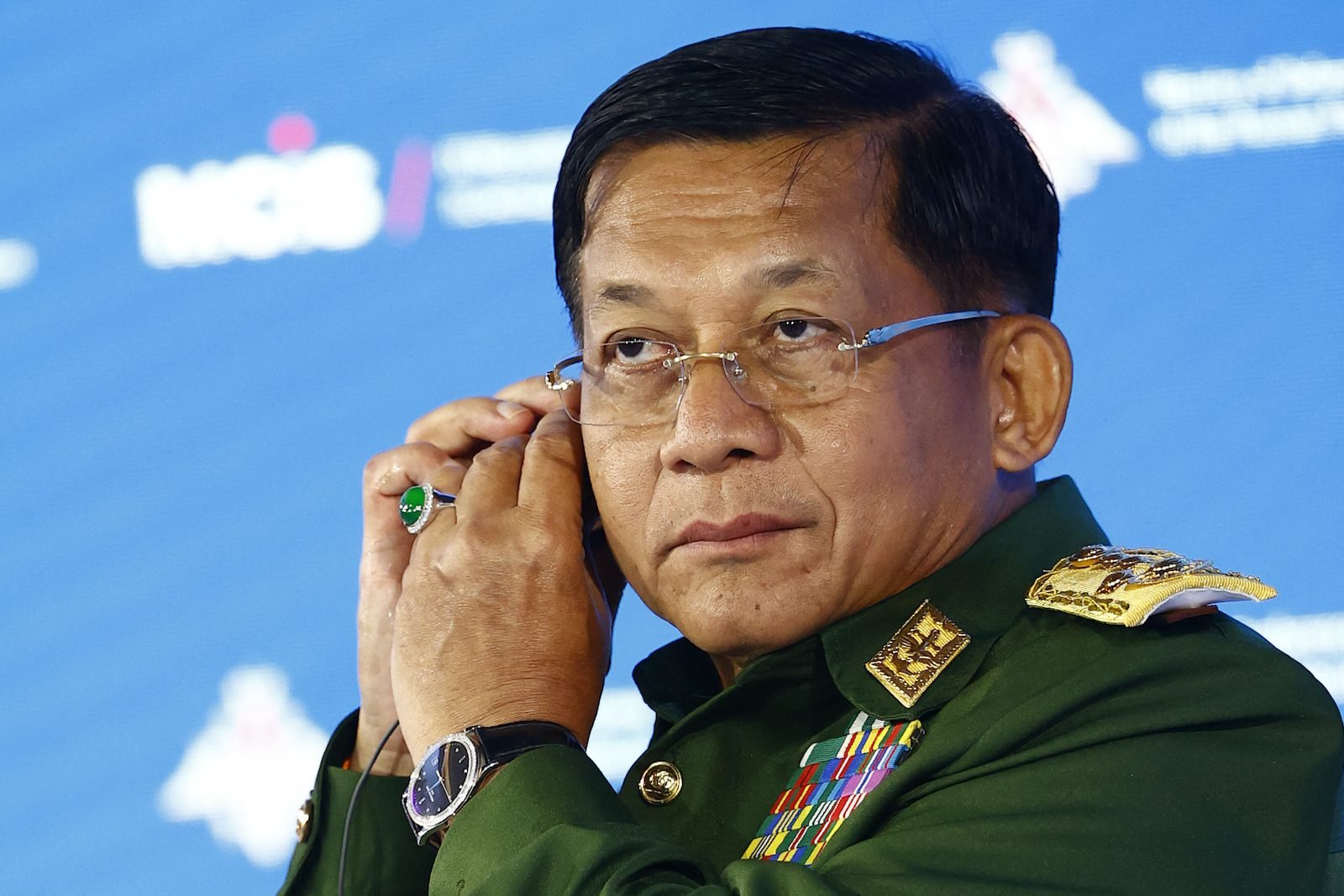
The recent Reuters headline, “US opens direct talks with Myanmar’s generals, reversing years of isolation,” describes a consequential diplomatic change. It is not a verdict that the junta has won, or that Myanmar’s revolution has lost. The distinction matters because an exaggerated reading can spread precisely the discouragement the generals would welcome.
So what did Reuters actually report? Senior US State Department official Michael Vance joined September 15–16 talks with coup-maker Senior General Min Aung Hlaing to secure American businessman Adam Castillo’s release and open further engagement; US outreach focused on scams, while they also discussed mineral access. Castillo was freed, marking a concrete and legitimate American gain. The Trump administration is giving direct bargaining greater weight.
What would overdramatize that news? Turning it into “America has recognized the junta, lifted its sanctions and traded away the revolution for rare earths.” Reuters establishes no new recognition decision, sanctions relief arising from the meeting or completed minerals bargain. Those are possible fears about where policy could lead, not reported outcomes.
What does a headline-only reading miss? Min Aung Hlaing remains sanctioned; Vance has also met with democratic opposition and ethnic armed groups; the US State Department says it raised questions about violence and political prisoners and continues assistance outside military control.
These details contradict a claim of complete abandonment, although official assurances are not proof of adequate support.
Reuters also quotes Gregory Meeks, the top Democrat on the House Foreign Affairs Committee, calling the shift “contrary to both our values and our interests.” He accused Rubio of conferring greater legitimacy while failing to implement congressionally mandated sanctions and deploy appropriated democracy funding. Washington is not united behind the policy. This offers advocates an opening, not guaranteed congressional support.
There is a genuine warning, too. Reuters reports that most opposition-support programs it describes, including airstrike-warning and defection initiatives, were cut during the aid overhaul. Lost resources can weaken protection and resistance capacity. The accurate conclusion is that support has diminished and diplomatic risks have grown, not that defeat is inevitable.
Another revealing detail reverses the apparent direction of need: one source said Myanmar requested official US engagement at the appropriate level in return for Castillo’s release. The junta has sought access to Washington, but an audience gives it publicity, not proof that Washington accepts military rule.
That pursuit predates the meeting. The lobbyist DCI Group reported work rebuilding US relations for the Ministry of Information, including Roger Stone’s consulting role; the Myanmar embassy contracted McKeon Group in August 2025 to develop congressional and administration relationships. These records demonstrate intent, not control of US policy.
OHCHR documents military economic misrule, expanding narcotics and scam economies, and military-linked criminal income, while also implicating other armed actors. Economic distress cannot simply be blamed on sanctions.
Min Aung Hlaing has courted investment abroad and sought Belarusian export credits at reported rates of 2.25%–9.33%, depending on currency and goods, plus insurance. UN reporting identifies money, weapons and legitimacy as essential to the junta, with foreign banking and supply networks sustaining weapons and aviation-fuel procurement. Foreign-exchange relief without safeguards risks replenishing the means of repression.
Targeted sanctions constrain military procurement. The UN Special Rapporteur to Myanmar reports that military purchases of weapons and related materials through formal banking fell by roughly one-third between the years ending March 2023 and March 2024, largely because of sanctions on state banks and arms networks.
To be sure, rerouted supply chains have outpaced enforcement. Those who have imposed sanctions should close those gaps rather than declare them useless because atrocities continue. Why would unconditional relief produce restraint?
Castillo’s case also deserves scrutiny. He had promoted military–Kachin cooperation linked to rare earths and advocated military engagement, while denying that he lobbied for Myanmar’s government or sought sanctions removal for it and its associates. He was subsequently detained over alleged misuse of his chamber of commerce position, charges his supporters referred to as spurious.
The reported release negotiations raise concern about detention being used as diplomatic leverage. But they do not establish that his arrest was engineered for that purpose.
Civilian welfare cannot be expendable. Washington can deprioritize it, but that does not make the choice defensible. The regime’s September 28 market airstrikes reportedly killed at least 50 people in Kyauktaw. This does not prove US talks caused violence; it shows why one successful transaction cannot establish a successful broader policy or change the junta’s behavior.
Washington’s own September 11 determination found Myanmar had “failed demonstrably” on counternarcotics efforts, while preserving a national-interest assistance exception (presidential determination). As discussed in my Asia Times and DVB articles, that means neither guaranteed funding nor political endorsement. Prospective cooperation must answer this adverse assessment.
The Kachin Independence Army controls major producing areas, while its parent, the Kachin Independence Organization, participates in the Steering Council for the Emergence of a Federal Democratic Union, or SCEF. The junta is not the only interlocutor, but neither coalition membership nor mineral control confers community consent.
China-centered processing and transport obstacles also complicate alternative supply chains. Neither US mineral access nor a geopolitical setback for Beijing should be counted as an accomplished gain at present.
The essential rule is measurable improvement before concessions. Even ASEAN’s imperfect Five-Point Consensus supplies a minimum starting point: ending violence, dialogue among all parties, envoy-led mediation, humanitarian assistance and envoy access to all parties.
Washington should demand independently verified implementation, not another promise. It should also require the release of political prisoners and safeguards that prevent benefits from financing weapons, ammunition and jet fuel.
Diplomatic contact and humanitarian assistance should remain possible. Sanctions relief or broader economic benefits should require sustained civilian-protection results, independent access, published benchmarks and reversal provisions. Engagement must not replenish the military’s ability to attack civilians.
Diaspora communities can act now. Constituents should contact their House representative and both senators, request district-office meetings and submit a concise, sourced brief with four requests: verified conditions before concessions; enforcement against military revenue and procurement networks; delivery of appropriated humanitarian and democracy assistance; and congressional reporting on agreements and outcomes.
Ask members to put these questions to the State Department and Treasury, then follow up for written responses.
Concerned communities can share a common evidence brief, record official responses and correct misleading claims without exposing vulnerable contacts. Judge progress by assistance delivered, civilian protection, prisoner releases, humanitarian access and sustained action against criminal networks, not reassuring statements or alarming headlines.
For the democratic opposition, the hints of a US policy shift merit preparation, not despair. Neither the junta nor advocates promoting a preferred settlement should turn uncertain diplomacy into a verdict that resistance is futile. Myanmar’s people need clear analysis and practical responses, not commentary that inadvertently does the junta’s discouraging work.
James H. Shwe is an independent policy analyst and writer on Myanmar and Southeast Asian affairs based in California.