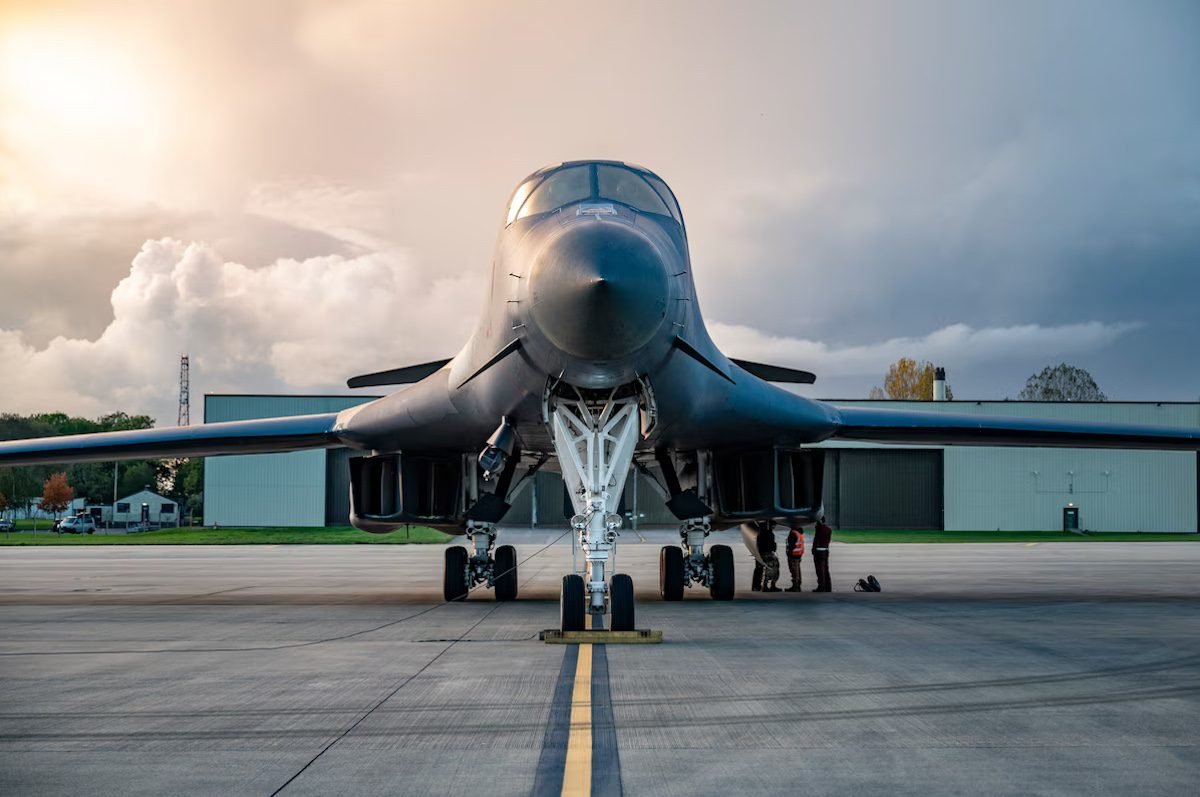

On October 4, the US pulled its 12 B-1 strategic bombers out of Fairford, UK and returned them to the United States. Reports say the planes returned to Ellsworth Air Force Base in Rapid City, South Dakota. The bombers were pulled out when intelligence reported that an attack by armed drones against Fairford was imminent.
While the US may have prevented an unnamed enemy, generally believed to be Iran, from executing a strike on the bombers and support infrastructure at Fairford, bringing the bombers back to the United States does not mean they are out of danger.
There were over 350 unauthorized drone incursions detected across roughly 100 domestic US military installations, alongside widespread civilian mass sightings in late 2024, particularly across the Northeast and in New Jersey.
In 2025, the high volume continued across both domestic military sites and borders, including tracking tens of thousands of drone movements along the southern border, and prompting congressional investigations and enhanced counter-UAS authorities. In 2026 (so far) the frequency remains high.

In the UK a series of unauthorized drone incursions affected four primary Royal Air Force bases utilized by the US Air Force in England including RAF Lakenheath, RAF Mildenhall. RAF Feltwell and RAF Fairford. In addition at RAF Akrotiri, the British Royal Air Force base in Cyprus, was struck by an Iranian-manufactured Shahed-type loitering munition on March 1, 2026.
The US uses Akrotiri for regional reconnaissance, intelligence operations, and force deployments. This includes hosting US Air Force units—such as Detachment 1 of the 9th Reconnaissance Wing supporting reconnaissance aircraft like the U-2—as well as shared intelligence and security detachments.

At Fairford intelligence suggested that the possible attack would be launched from trucks carrying drones, similar to the way Ukraine attacked Russia in Operation Spiderweb in June 2025.
In that operation, Ukrainian operatives smuggled large quantities of first-person-view (FPV) attack drones deep inside Russian territory, concealed inside wooden cabins mounted on the back of commercial trucks.
The drones were then launched from close proximity to the targeted airfields. The drones hit multiple deep-interior Russian air bases spanning multiple time zones, including Olenya, Ivanovo Severny, Dyagilevo, Belaya (Siberia), and Ukrainka.
The operation targeted Russia’s long-range strategic bomber fleet (such as Tu-95MS and Tu-22M3 aircraft used to launch cruise missiles against Ukraine), destroying or damaging multiple high-value aircraft.

The severity of the drone threat to US airbases and other sensitive sites (including dams, nuclear power plants, communications and energy infrastructure) is unclear. US and UK authorities do not typically release information on drone incursions unless they have to do so from public pressure.
Ellsworth is not necessarily safe. Local law enforcement and base officials previously reported multiple unauthorized drone sightings and incursions in restricted airspace near the base.
For instance, the Meade County Sheriff’s Office issued warnings regarding multiple waves of unauthorized drones spotted north of the base, prompting local authorities and base defense to remind the public that the installation is a strict “no-drone zone.”
It would be highly unusual for a single drone operator to run multiple waves of drones, suggesting that Ellsworth, like Barksdale and other sensitive sites, have been extensively reconnoitered by an adversary or adversaries.
A few drones recovered around US bases do not tell us a great deal. All of them are commercial drones (primarily of Chinese origin), just as the drones flying across the US southern border are commercial drones from China, sometimes modified to carry explosives or transit drugs such as fentanyl.
There is no control system on the purchase of drones; no licensing system, and tracing ownership is nearly impossible. Because drones can be bought in the US, or flown across the border, they pose a significant threat since they can easily be transported on ground vehicles or flown to other destinations with very low probability of detection.
The US is stepping up its efforts to better protect US bases from drone incursions. The UK appears to be farther behind when it comes to countermeasures. In general, most drone incursions are successful, and few are shot down or otherwise intercepted.
The big risk is when surveillance turns into kinetic strikes. This could happen at any time. US bases are no more secure than those abroad, including the UK.
Stephen Bryen is a former US deputy undersecretary of defense and special correspondent at Asia Times. This article was first published on his Weapons and Strategy Substack and is republished with permission.