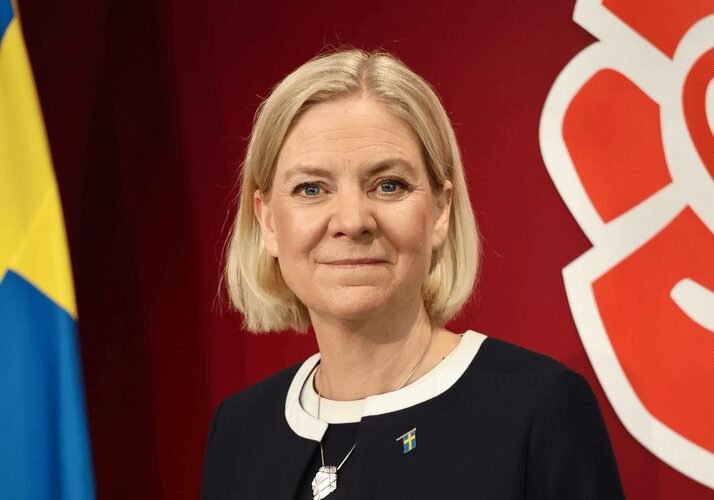
Attempts to form a new government in Sweden hit the buffers on Monday after Social Democrats leader Magdalena Andersson said she was unable to secure enough support, despite the centre-left bloc winning a narrow majority in this month’s election.
“I can conclude that there is currently no possibility for me to form a government,” Andersson said at a press conference, saying she had lost the support of Sweden’s Left Party.
The speaker of Sweden’s parliament, Andreas Norlen, told reporters he will meet each party leader one-on-one on Wednesday before announcing who will have the next go at exploring the formation of a government.
One likely option would be Prime Minister Ulf Kristersson, whose Moderates are the next biggest party after the Social Democrats.
The general election on September 13 saw the centre-left opposition taking 176 seats in parliament, just beating the centre-right’s 173.
The result was driven by a decline in support for the anti-immigration Sweden Democrats, bucking a Europe-wide trend of gains for the far right.
Despite the centre-left’s victory, the vote, widely seen as a referendum on Kristersson’s promise to bring the far-right Sweden Democrats into a ruling coalition, has left forming a stable government fraught with difficulties.
Andersson said she had given up trying to form a government after the Left Party, one of the parties she needed to form a majority, said it would support a candidate from the centre-right as speaker of parliament.
The Left Party has said previously it will only support Andersson as prime minister.
Andersson would likely get another shot at trying to form a government if any centre-right attempt fails.
The speaker can put four candidates forward to parliament for approval, but if each is rejected, Sweden will hold a new election.
Casting a further cloud over the process, police said on Friday they had started preliminary investigations into five complaints of election fraud around Stockholm.
The probes come days after prosecutors opened a separate investigation into suspected fraud in the central Swedish town of Borlange, a case that could put 11 parliamentary seats in play if the Election Review Board orders a re-run of the vote there.
In 2018, Social Democrat Stefan Lofven took 134 days to form a new government.