Low turnout and youth discontent loom over Morocco’s next government as coalition talks begin
Morocco’s Authenticity and Modernity Party (PAM) won Wednesday’s parliamentary election with 97 of 395 seats, provisional results announced early Thursday showed, while the Islamist party it pushed from power five years ago surged back to lead the opposition.
The Justice and Development Party (PJD) took 54 seats, up from 13 in 2021, under Abdelilah Benkirane, prime minister from 2011 to 2017, who returned to lead it. Turnout fell to 38% from 50%.
King Mohammed VI controls foreign and defense policy, while the government and parliament are responsible for domestic issues including jobs, education, health care and prices.
With PAM finishing first, the king will choose the prime minister from its ranks. The party must now assemble a governing coalition.
PAM traces its origins to 2008, when Fouad Ali El Himma, a schoolmate and adviser to the king, helped create it. Many Moroccans view it as the party closest to the palace.
Its two partners in the outgoing government both lost ground. The National Rally of Independents (RNI), the pro-business party led until this year by billionaire former Prime Minister Aziz Akhannouch, fell from 102 seats to 66. Istiqlal, or Independence, the party that led the struggle against French colonial rule, fell from 81 to 65.
The PJD draws its politics from conservative Islam but accepts the monarchy and competes through elections. It governed for a decade after the Arab Spring protests of 2011, collapsed to 13 seats in 2021, and campaigned this year on corruption, the cost of living, and public services.
The Popular Movement took 29 seats, the Socialist Union of Popular Forces 26, the Party of Progress and Socialism 19, and the Constitutional Union 17.
A governing majority requires 198 seats. The three outgoing coalition parties together now hold 228 and could, in theory, continue governing together. PAM, however, has said it will not govern again with the RNI, leaving it to seek a coalition with Istiqlal and smaller parties.
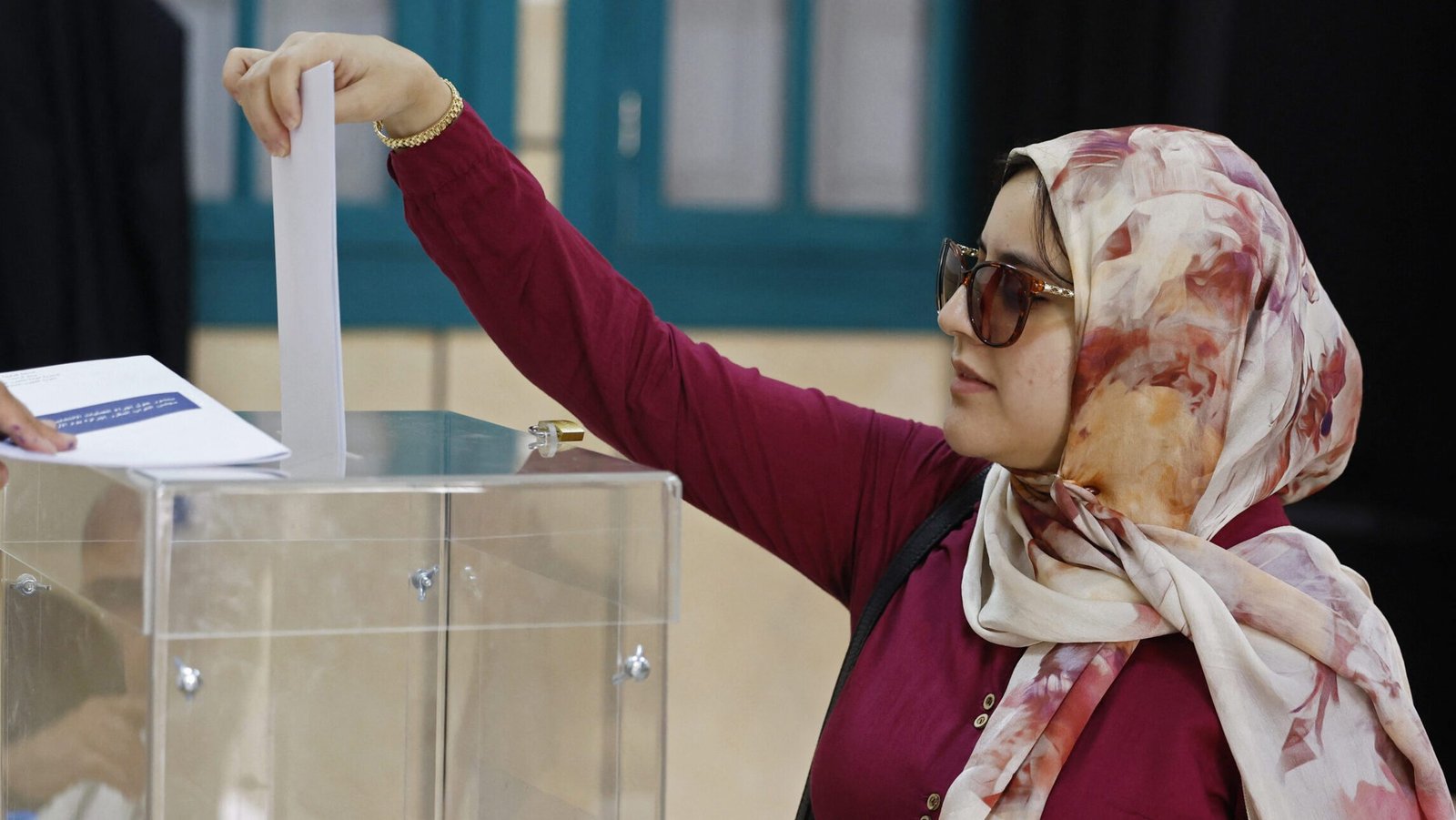
Dr. Yasmine Hasnaoui, expert fellow at the Council for Mediterranean Diplomacy and member of the National Council Popular Movement Party, voted at 10 a.m. and noticed there were few people at the polling stations.
“The polling stations were fairly empty,” Hasnaoui said. “Even some urban polling stations appeared relatively quiet, while in certain regions there was visible mobilization.”
Some voters told her they planned to cast blank ballots to protest declining purchasing power.
“Being at the polling station reflected two things at the same time,” she told The Media Line. “A public that remains civically engaged and wants to participate, and another part, particularly among young people, that is asking whether political participation will actually change their economic and social reality.”
She sees that frustration as one reason for the PJD’s return.
“The message is clear,” Hasnaoui said. “Citizens are reticent about what these political parties will bring, because we saw them in the previous government.”
Some 15.8 million Moroccans registered to vote out of 26.7 million of voting age. Registrations fell nearly 10% from 2021 even as the population grew.
Mohammed Masbah, who runs a Rabat research institute that polls Moroccans on their trust in government, told a Chatham House panel on the eve of the vote that Morocco’s youngest voters largely disappear from the electoral system before election day.
Morocco has no automatic voter registration. Masbah put the number of registered 18-to-24-year-olds at roughly 600,000 out of some 4 million.
Protest is just a channel that young people in Morocco use to express their frustration
“There is a systematic exclusion of the younger population,” Masbah said. “Protest is just a channel that young people in Morocco use to express their frustration.”
During last year’s protests, young demonstrators demanded hospitals rather than more stadiums as Morocco prepares to co-host the 2030 World Cup.
Hasnaoui said the RNI’s losses deserve as much attention as the PJD’s return after five years leading the government.
“It suggests that voters have reassessed the party’s record, particularly in the context of concerns about employment, public services and purchasing power,” she said.
The PJD, she said, ran a disciplined campaign.
“It appeared more organized, more present on the ground and more focused on reconnecting with voters,” she said.
Officials announced the national results shortly after 3 a.m. Hasnaoui said the order of the leading parties broadly matched expectations. The PJD’s 54 seats did not.
“Even before election day, everyone knew that PAM would be first, then the RNI, then Istiqlal,” Hasnaoui said. “What surprised me is the 54 seats. That is something no one expected at all.”
Early returns encouraged the PJD, and Benkirane said overnight that his party was leading in most constituencies where counting had finished. He later alleged irregularities at some polling stations. Authorities have not responded to the allegation.
Supporters celebrated at PJD headquarters in Rabat before the Interior Ministry announced the national results. Early urban returns put the party ahead in parts of Rabat and several other cities before rural returns changed the picture.
Morocco reserves 90 of parliament’s 395 seats for women elected from separate regional lists. Around 2,600 women stood as candidates this year, Hasnaoui said, roughly 30% of the field, up from about 2,000 in 2021.
The system has helped women enter politics and gain experience inside parties, she said, but deeper barriers remain.
The real challenge is to create the conditions for women to compete more broadly in electoral constituencies
“The real challenge is to create the conditions for women to compete more broadly in electoral constituencies, and to reach leadership and decision-making positions within political parties,” Hasnaoui said.
PAM national coordinator Fatima-Zahra Mansouri, the mayor of Marrakesh, would become Morocco’s first woman head of government. Budget Minister Fouzi Lekjaa, who also heads the Royal Moroccan Football Federation and joined PAM’s political bureau in July, is another name in circulation. The king will decide.
“If she were to become head of government, the significance would go beyond the fact that she is a woman,” Hasnaoui said. “We should judge her leadership by her ability to deliver policies that improve people’s lives.”
Morocco restored formal relations with Israel in December 2020 under the Abraham Accords, after the Trump administration recognized Moroccan sovereignty over Western Sahara. The PJD governed at the time and signed the agreement.
The party now campaigns against taking those ties further. The relationship has kept moving anyway.
On Sept. 16, at a meeting in New York hosted by US Ambassador to the United Nations Mike Waltz, Morocco and Israel agreed to raise their liaison offices to full embassies and exchange ambassadors before the end of the year, along with investment-protection and double-taxation agreements due by December.
Direct flights resumed before the diplomats moved. Arkia flew Tel Aviv to Marrakech on Aug. 19, ending a suspension that began after the Hamas attacks of Oct. 7, 2023, and El Al’s low-cost subsidiary Sun d’Or said last week it would restore service this fall. Hundreds of thousands of Israelis trace their families to Morocco.
Defense ties have also held. Morocco bought Israel’s Barak MX air-defense system in a deal valued at roughly $500 million, and Reuters reported in 2024 that Rabat planned to buy an Israeli reconnaissance satellite for about $1 billion.
Trump has returned to the file twice in recent weeks. In August, he reaffirmed US recognition of Moroccan sovereignty over Western Sahara in a message to King Mohammed VI, calling Morocco’s autonomy proposal the “only basis for a just and lasting solution.”
His senior adviser for Arab and African affairs, Massad Boulos, met UN political chief Rosemary DiCarlo in New York on Sept. 11 and called for progress toward a settlement under Security Council Resolution 2797. He then traveled to Algiers to meet Algerian President Abdelmadjid Tebboune.
The mandate for MINURSO, the UN mission in Western Sahara, expires Oct. 31. Morocco has claimed the former Spanish territory since 1975, and the Algerian-backed Polisario Front seeks independence there.
Foreign Minister Nasser Bourita carried the Moroccan position to the UN General Assembly this week, saying the dispute had entered a new phase after the Security Council put Morocco’s autonomy proposal at the center of renewed negotiations.
The 2020 deal tied normalization with Israel to Washington’s position on the territorial dispute Rabat treats as existential, which is why domestic opposition has not moved it.
Unemployment among Moroccans aged 15 to 24 stood at 29.2% in the first quarter, according to the High Commission for Planning, while about 2.9 million people aged 15 to 29 are neither in school nor working.
In late July, tens of thousands of mostly young Moroccans crossed or tried to cross into the Spanish enclave of Ceuta after social media posts claimed the border was open. Dozens died, most while trying to swim around the breakwater.
Morocco’s Interior Ministry blamed people who spread false information on social media. A Spanish police report seen by Agence France-Presse in September said Moroccan security forces stood back that day. Spanish Prime Minister Pedro Sanchez rejected that finding.
In his UN speech, Bourita called the Palestinian question a constant priority of Moroccan foreign policy and backed an independent Palestinian state alongside Israel. He also called for enforcement of the Gaza ceasefire and confirmed that Morocco had joined the international stabilization force in Gaza in July, pledging police officers and trainers.
A coalition of Moroccan groups opposed to relations with Israel has called three days of demonstrations beginning Friday in cities across the kingdom. Organizers want Morocco to scrap the normalization agreement and close the Israeli mission in Rabat. The PJD, returning to parliament with 54 deputies instead of 13, has backed the protests.
Hasnaoui said coalition arithmetic will prove easier than rebuilding public trust.
Turnout was only around 38%, so there is a clear challenge of rebuilding citizens’ confidence
“Turnout was only around 38%, so there is a clear challenge of rebuilding citizens’ confidence,” she said. “That trust will not be rebuilt simply through political agreements. It will be rebuilt through concrete results on the ground, particularly on employment, youth opportunities, public services and purchasing power.”
“The numbers make a coalition mathematically possible and politically understandable,” she added. “But the real coalition that Morocco needs is between the political institutions and Moroccan citizens.”