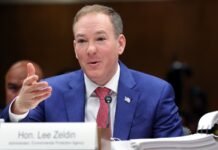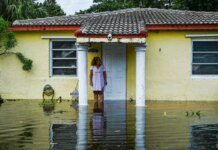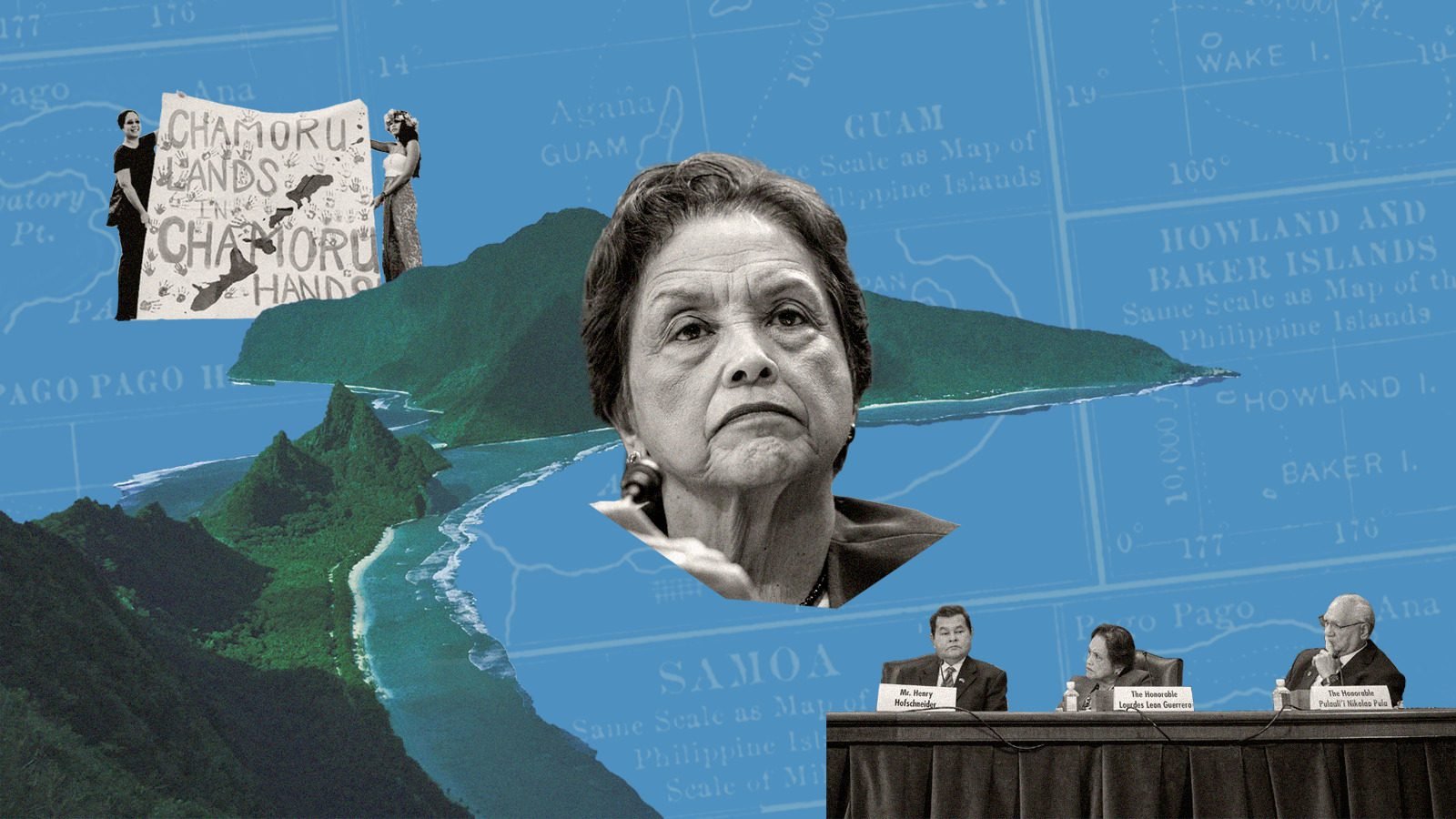
Lou Leon Guerrero, the governor of Guam, learned about the government’s plan to mine her people’s waters the same way everyone else did: by reading the news.
It was November 12, and her advisor had sent her an article link — apparently, a journalist had inquired about it. She opened the page, and was stunned by what she read. The Trump administration planned to lease millions of acres of seafloor around the island to mining companies.
“I’ll never forget the date,” Leon Guerrero said from her office overlooking Agaña Bay. “I had not heard anything about it.”
She immediately called David Apatang, the governor of the Commonwealth of the Northern Mariana Islands, a neighboring U.S. territory.
“We were both very upset that we didn’t get any kind of warning,” she said. Shortly after, she rang Bill Hague, an official in the Department of the Interior, an agency that handles federal relations with territorial leaders and tribal nations.
“I know we are a U.S. territory,” Leon Guerrero recalls saying to him. “I know that you as the federal government can just come in and say, ‘I don’t care about what you guys say. We’re going to do it anyway.’” But still, she said, “I want you to know I don’t support this.” Hague reassured her, she said, that mining would never proceed without the community’s support.
Nearly a year later, that’s exactly what’s happening.

The Trump administration is moving forward with plans to lease vast swaths of seafloor to mining companies. It is part of a broader push to secure critical minerals and counter China, which dominates the global supply. These resources — including copper, manganese, nickel, and rare earth elements — are essential to military technologies and batteries.
First up are America’s Pacific island territories. In July, the Marine Minerals Administration said that it would auction access to 31 million acres of the continental shelf around American Samoa in mid-November. A month later, the agency announced plans to do the same in December across more than 67 million acres on either side of the Marianas archipelago, which includes the Commonwealth of the Northern Mariana Islands and Guam. About half of those acres border a national marine monument established by President George W. Bush.
Local leaders and environmentalists staunchly oppose these plans. Recently, Earthjustice, an environmental law nonprofit, filed lawsuits against the Trump administration on behalf of conservation groups in American Samoa and the Mariana Islands, arguing that the government does not yet know if seabed mining would harm animals that are protected by the Endangered Species Act, like whales and sea turtles.
The Marine Minerals Administration declined to comment on the ongoing litigation. Brent Lawrence, a spokesperson who responded to Grist’s questions, said that the department would continue “to closely coordinate with territorial leadership” as well as community members in American Samoa, Guam, and the Mariana Islands.
Unlike neighboring Pacific nations, which can decide for themselves whether to allow mining, Guam, American Samoa, and the Northern Mariana Islands are subject to federal decisions often made without their approval. Under international law, the Indigenous peoples of these islands have the right to free, prior, and informed consent to projects affecting their lands and waters. The Trump administration, however, says it has the authority to proceed under U.S. law.
That decision is the latest example of how the United States has for more than a century denied the residents of these islands a meaningful voice in decisions that affect them, said Adi Martínez-Román, co-director of Right to Democracy. They cannot vote for president, have no voting representation in Congress, and their right to self-determination is generally ignored, she said.
“The territories are practically invisible to the general U.S. society and to public officials,” said Martínez-Román. “It is an insidious result of the colonial framework.”
Lourdes “Lou” Aflague Leon Guerrero, governor of Guam, attends a a full committee hearing in Washington, DC, alongside other leaders of U.S. territories on June 17, 2026. Ken Cedeno / AFP via Getty Images
On July 16, while staying with family in Manuʻa, American Samoa, J.V. Langkilde awoke at 2 a.m. It was Manuʻa Flag Day, a holiday commemorating the islands’ chiefs signing a treaty that brought Manu‘a under U.S. sovereignty more than a century ago.
The family had agreed to cater the day’s festivities, which included a cricket tournament, a parade, and a competition to determine who could make the best oka, a Samoan raw fish dish similar to ceviche. His favorite dish of the day was lobster with coconut sauce, but there was also pig, and smokey Samoan taro cooked in an umu, or earthen oven, he said.
The early start meant Langkilde immediately noticed when his phone screen lit up the darkness with a text message alerting him to the news: On a day marking the anniversary of the United States agreeing to respect Samoan property rights, the Trump administration had announced it was proceeding with a plan to allow deep-sea mining in the waters of American Samoa.
The subject came up again and again during his time at home. The first concern people in Manuʻa have is, “Shouldn’t there be a full understanding of impacts before someone gets a property interest in our ocean floor?” said Langkilde, an attorney at the environmental nonprofit Earthjustice. During the rest of his visit home, his fellow Samoans repeatedly expressed their unease.
“They think it’s a little bit backwards that some company who has no stake in the community here will have property interest on our ocean floor without a full understanding of impacts,” he said.
Deep-sea mining has not yet occurred on a commercial scale, and scientific understanding of the consequences is scant. One recent study suggests mining could create sediment plumes that harm large fish like tuna, which makes up more than 99 percent of American Samoa’s exports. Mining companies dispute these claims, but locals and environmentalists remain unconvinced.
“The throughline of concern I hear is becoming a test site with no kind of guarantees for money being reserved, not just for revenue share, but even for environmental protection,” Langkilde said. “There could be some sort of bond or fund imposed upon the company should things go wrong.”
The governor of American Samoa, Pula’ali’i Nikolao Pula, has expressed similar concerns. In June of 2025 he announced that the government was united in its opposition to mining “in line with the express will of the people and the protection of American Samoa’s natural resources.”
Five months later, the Trump administration nearly doubled the area that might be mined.
Because American Samoa is a U.S. territory, its ban on seafloor mining only extends three nautical miles from shore, a fraction of the 200-mile radius around the islands that the federal government claims jurisdiction over.
By contrast, Samoa, which lies just 40 miles to the northwest, has complete control over its waters, of which it plans to protect at least 30 percent. The nation has also joined others calling for a moratorium on deep-sea mining in international waters. It was the first of a dozen Pacific island nations that have achieved independence from colonial powers in the modern era, an autonomy that allows them to determine how their waters are managed.

Some, like the Republic of Naoero (which was until this month known as Nauru) and the Kingdom of Tonga, are eager to see the industry move forward. The two countries sponsor deep-sea mining companies, allowing them to apply for exploration contracts in international waters through an international body in exchange for financial benefits. “For Nauru, seabed minerals represent more than economic diversification. They are a pathway to resilience and a pathway to contribute to global solutions,” said David Adeang, the president of Naoero, at the United Nations General Assembly in September 2025.
Earlier this year, Tonga’s prime minister, Lord Fatafehi Fakafānua, signed an agreement with the Trump administration for mining research and exploration. Fakafānua called it an “exciting development.” Others, like the Republic of Kiribati, are considering similar moves.
But the majority of Pacific nations support an international moratorium on the industry. Palau has banned the practice in national waters, while others like Papua New Guinea and the Solomon Islands have taken similar stances amid concerns about its effects on fisheries and cultural practices.
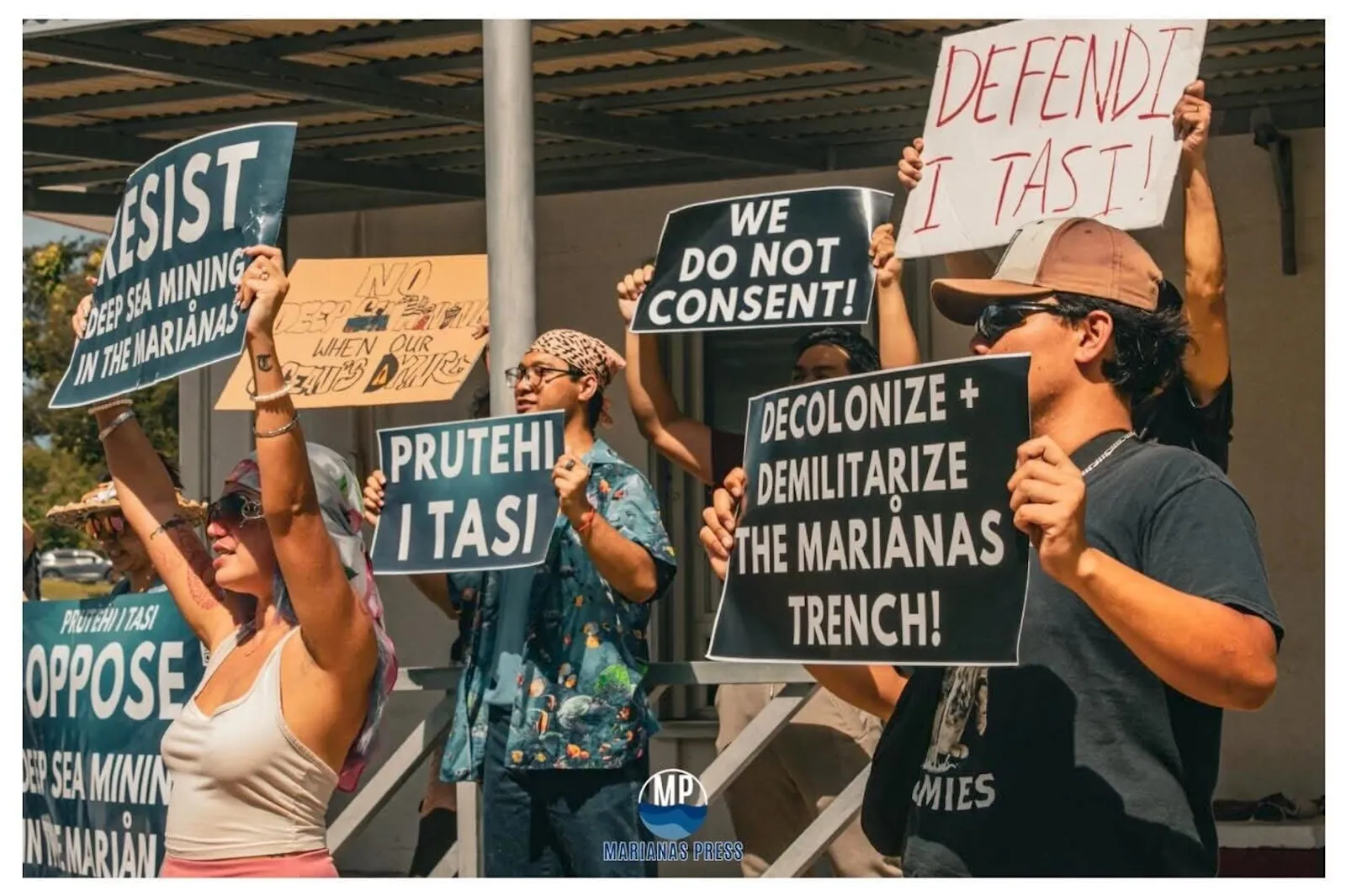 a vote in international negotiations over seabed mining. More than 45 countries have called for an international moratorium or ban.
A 1994 United Nations treaty created the International Seabed Authority to oversee mining in international waters, which lie beyond any country’s jurisdiction and cover about half the globe. That body holds biannual meetings to develop potential rules for the industry. This mining code has been under debate for more than a decade, and commercial extraction has not yet been approved.
The Trump administration isn’t waiting. The president ordered federal regulators to begin processing applications for mining in international waters under a decades-old U.S. law. That prompted outcry from other nations, which say the United States is circumventing international law. As with mining in U.S. waters, it could also leave Indigenous Pacific peoples with little say over industrial activity in the seas they have long stewarded.
More than 170 nations have ratified the treaty establishing the seabed authority, allowing them to attend meetings and cast votes. But territories without independence are excluded. The federal law extending U.S. citizenship to the people of Guam explicitly grants Congress the right to overturn any law passed by the island’s legislature.
“A decision about our islands is going to be made at a desk,” said Sabrina Suluai-Mahuka, a fellow at Right to Democracy from American Samoa. “It does not make sense that we can’t have any say in how our futures go.”
Four months after the Trump administration announced plans to lease the seabed around Guam, Lou Leon Guerrero met with officials in Washington, D.C. to share her concerns. Three days later, back on Guam, she learned that the Bureau of Ocean Energy Management had doubled the area that might be mined, including waters closer to Guam than initially proposed. Again, she called Hague at the Interior Department. The department had not told Leon Guerrero that they were days away from making the change.
“You guys don’t include us in your discussions,” she told him. “We’re the ones that’re going to be impacted.
“He said he made it very clear to everybody to make sure that the governor and the leaders are apprised about what’s happening,” she recalled Hague assuring her.
“We hear it only in the media or in the CFR announcements,” Leon Guerrero told him, referring to federal regulatory notices.
Hague did not respond to Grist’s request for comment. A department spokesperson, Alyse Sharpe, clarified that while the agency facilitates support for tribal people and nations, “Mr. Hague does not have a role in that,” and that the department regularly communicates with U.S. territory leadership and will continue to do so. In an emailed statement, she declined to comment on or verify the conversations with Leon Guerrero, “due to the often confidential and deliberative nature of these conversations.”
The statement also said, “The Department of the Interior is committed to maintaining a transparent process as the possibility of mining critical minerals from the seafloor is explored,” and noted that a signed lease does not necessarily grant permission to mine and that any lease holder would be subjected to a feasibility, safety, and environmental assessment.
A remotely operated vehicle, Deep Discoverer, images the seafloor off American Samoa during an expedition in 2017. NOAA OER
Neildino Taisacan, an Indigenous Carolinian-Chamorro environmental advocate in the Marianas, said the community submitted extensive comments opposing the proposal despite the short notice. The governors had requested a 120-day extension which would give residents until after the holidays to leave a public comment. The Trump administration instead approved a 30-day extension. In the end, when the proposed area was eventually doubled, many residents were left wondering whether their concerns had been heard, Taisacan said.
“All we can do is just scream at the top of our lungs and say, ‘No, we don’t want this,’” he said.
The administration is also pursuing seabed mining in the waters of Alaska and Virginia. But residents of those states can vote and have representatives with sway in Congress. Those rights are not extended to residents of the territories, giving lawmakers little motivation to take their concerns seriously.
That hasn’t stopped territorial leaders from trying. In June, Pula’ali’i Nikolao Pula, the governor of American Samoa, flew to Washington, D.C. to testify before the Senate. There, wearing a black suit and yellow tie, he reaffirmed his opposition to deep-sea mining.
“However, should the federal government move forward,” he said to senators, “we would like to have basically a seat at the table.” If mining is done in an environmentally friendly way, he said, “our little territory would very much appreciate revenue sharing.”
Kimberlyn King-Hinds, who is the U.S. House delegate for the Commonwealth of the Northern Mariana Islands, plans to introduce legislation that would give the commonwealth half of all seabed mining revenue. “If they’re going to shove this down our throats,” she said, “I want to be able to ensure that we have a backup plan, we have insurance and that we actually benefit from the waters that surround us.”
Still, what happens next remains to be seen, because she, as a delegate, cannot vote on bills.
One company interested in mining in the region, Impossible Metals, has suggested a benefit-sharing agreement that would give territories a small percentage of their profits, as a gesture of goodwill. But these promises are not yet legally binding.
And with decision-making power consolidated in Washington, D.C., there is little incentive for companies to approach territorial leaders like Pula. The Metals Company, for example, has instead spent about $800,000 lobbying federal officials to permit seabed mining.
If the nascent industry becomes profitable, even a small share of the windfall could provide a significant boost to Pacific island economies.
In American Samoa, a single StarKist tuna cannery employs about 2,000 people and accounts for 80 percent of the private-sector jobs. The Commonwealth of the Northern Mariana Islands has endured a prolonged tourism downturn and was battered by two super typhoons earlier this year. In Guam, fewer people have visited since the pandemic, leaving the island increasingly reliant on military investment. Without stable economies at home, many residents leave their island communities for jobs abroad.
That’s one reason some Pacific governments with more autonomy than U.S. territories are in favor of mining. The Cook Islands, for instance, supports the industry and has used government funds to explore nearby waters for mineral deposits.
Prime Minister Mark Brown has described that exploration as part of the islands’ “journey of sovereign independence.” Mining companies have been courting the islands’ communities for years, sponsoring local cultural organizations and sporting events. Brown has said the industry could boost revenue significantly.
But some mining analysts and environmentalists doubt that. A recent study found that mining near American Samoa would carry steep operating costs and might not generate enough revenue to be profitable. It also concluded that demand for some targeted minerals — including cobalt, manganese, and nickel — may not hold, while other analyses found that proposed financial arrangements would return little revenue to developing countries.
Langkilde, the Earthjustice attorney from American Samoa, said his community was shocked by how the latest lease proposal doesn’t include revenue sharing. And while the federal notice suggests that deep-sea mining companies invest in training a local workforce and upgrading public facilities like ports, neither is mandated.
Seeing it in black and white is, he said, “very discouraging to people here who might have otherwise been like, ‘Maybe the federal government will do right by us.’”
In April, Sheila Babauta hid with her parents and her 2-month-old son in a storage room for hours, listening to 150-mph winds moan and rattle the windows as Typhoon Sinlaku battered her home island of Saipan.
They had no running water or electricity for weeks afterward. While cleaning up flood damage, collecting water for baths, and caring for her newborn son, Babauta received a group chat message about the federal government’s latest push to accelerate seabed mining.
“I didn’t have capacity to even think about it,” she said. “All of the immediate needs definitely took priority over keeping track of what was happening with seabed mining.”
Babauta, a former member of the Commonwealth of the Northern Mariana Islands House of Representatives, is a longtime Indigenous Chamorro-Pohnpeian environmental advocate who has been vocal about opposing seabed mining. But even she has found it difficult to keep track of what the federal government is doing and find the time and energy to weigh in as her community recovers from two climate-fueled typhoons.
“After the typhoon, I definitely felt overwhelmed, especially with a baby, because he’s my priority, right?” Babauta said of her son, whom she envisions growing up and living on the island.
“Deep-sea mining is also important to me because I want to protect our home for future generations,” she said. “All of that is going on in my head while outside of me, in reality, you see destruction all over.”
Pacific islands are on the front lines of climate change, with rising seas and worsening storms already impacting residents. But as the Trump administration pushes seabed extraction while undermining climate action, those immediate crises leave many territorial residents with less time and energy to influence whether mining proceeds.
That’s happening despite what many Pacific Islanders describe as the incalculable cultural costs seabed mining could impose on the environment and on the ancestral beliefs, practices, and traditions of Indigenous peoples.
Companies like the Metals Company have spent hundreds of millions of dollars exploring deep ocean ecosystems. Scientists who conducted that research later published some of their findings independently in peer-reviewed journals, concluding that these habitats are fragile and slow to recover.
Any risk to fishing, an essential part of culture and identity in American Samoa, looms large.
“The people of American Samoa have a profound connection to the ocean, relying on it for sustenance, cultural practices, and economic activities, particularly through fisheries and tourism,” then-Governor Lamanu Peleti Mauga wrote in his 2024 moratorium on seabed mining.
Other Indigenous Pacific Islanders, including John Castro, worry about how mining would impact traditional seafaring.
On an afternoon in May, Castro sat beneath a damaged canoe house in Susupe, Saipan. Its thatched roof had been partially destroyed by Typhoon Sinlaku, and Castro had joined others in repairing it. He is a fisher who coordinates a program that helps pass down the knowledge required to navigate canoes across the Pacific using the stars and waves.
Traditional seafarers rely on marine life to determine where they are, he said. “If deep-sea mining happens, and that thing kind of drives whales in a different course, then we’re going to get lost, too.”
This knowledge was once widespread across the Pacific but was lost to colonization in many places, including the Marianas and Hawaiʻi. It has recently returned with the help of expert navigators from the Federated States of Micronesia. Disrupting that revival would be an enormous loss.
Still, Castro is resigned to what feels like an inevitable consequence of his communityʻs status as a U.S. territory. “We do have a say-so, but it’s not going to be entertained,” he said. “We’re small compared to Uncle Sam, who makes the rules.”
Earthjustice is an advertiser with Grist. Advertisers have no role in Grist’s editorial decisions.