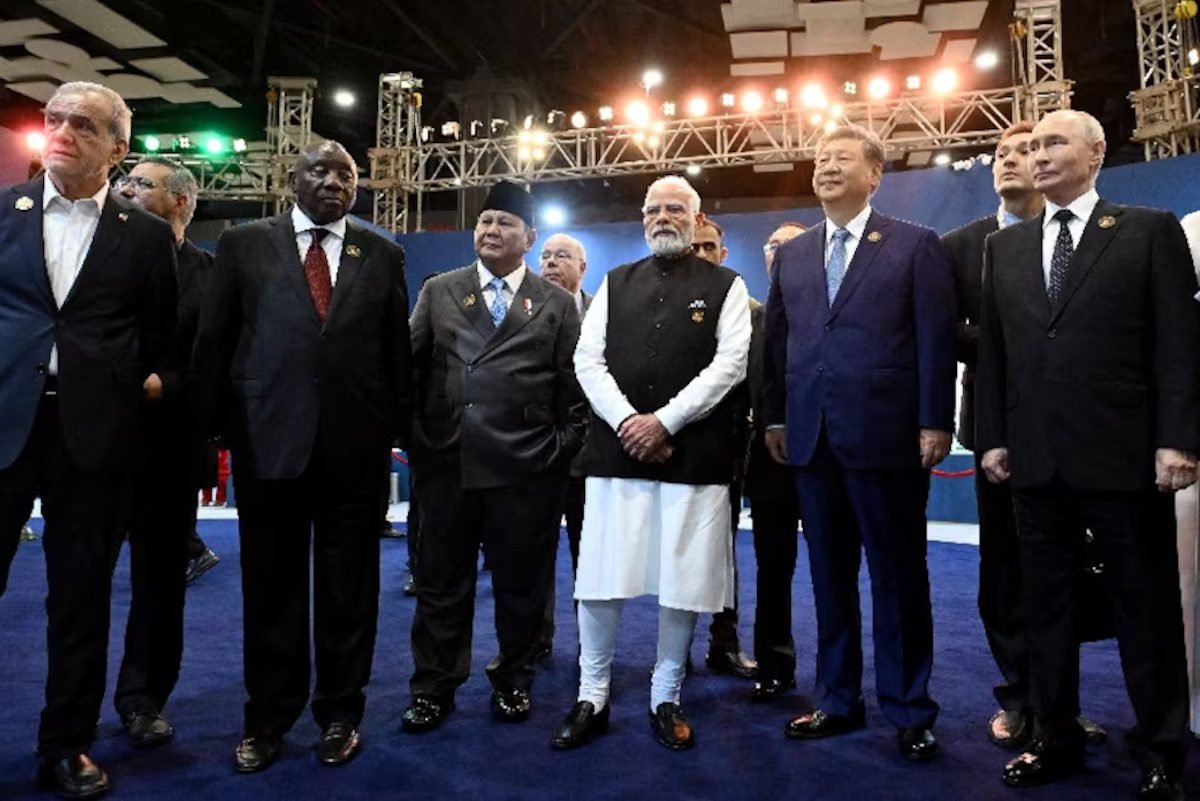
The New Delhi Declaration, adopted unanimously at the 18th BRICS Summit on September 12, will be read mostly through a geopolitical lens: Gaza, Security Council reform, sanctions, the drift toward a multipolar order. That reading isn’t wrong. It just misses the bigger story buried in the document’s sheer bulk.
Of the more than 130 paragraphs BRICS leaders signed off on, only about a third concern geopolitics and security. The rest — nearly a hundred paragraphs — sketch an increasingly dense architecture spanning health, food security, energy, industrial cooperation, science, finance, trade, climate and human development.
In other words, BRICS is no longer just a forum where major emerging economies coordinate positions on a fragmenting global order. It is becoming something closer to a parallel development institution, assembling an alternative economic architecture for the Global South, paragraph by paragraph, one working group at a time.
India’s chairmanship theme this year — “Building for Resilience, Innovation, Cooperation and Sustainability” — was operationalized through a dedicated Task Force on Growth and Development, built explicitly around those four pillars. BRICS is thus being reorganized, in real time, around a development mandate that now rivals — arguably exceeds, in sheer volume — its original geopolitical purpose.
For emerging and developing economies, including those outside the bloc entirely, that broadening matters. The New Development Bank, described in the declaration as entering its “second golden decade,” is expanding local-currency lending and courting new members.
A proposed BRICS Multilateral Guarantees mechanism aims to lower financing costs for development projects across BRICS and the wider Global South. A Global Value Chains Action Plan running to 2030 commits BRICS to addressing the specific difficulty developing economies face in moving beyond low-value assembly and into higher-value production — precisely the structural transformation problem that has stalled industrial upgrading across much of Asia and Africa.
A proposed BRICS Grain Exchange, still in early discussion, could give food-import-dependent countries a hedge against the kind of price shocks that hit hardest when energy and fertilizer markets seize up simultaneously, as they did in 2022 with the Ukraine war and have since again with the Iran conflict.
Together, it all represents finance, technical cooperation and market access outside the traditional Bretton Woods channel — genuinely useful ballast for smaller economies navigating a more fragmented, more coercive global economy.
That all said, ambition is not capacity to deliver – this is where the New Delhi declaration deserves more skepticism than the celebratory coverage will trumpet. A close look at the operative language across the development chapters and the same handful of verbs do nearly all the work: “welcome”, “note”, “encourage”, “look forward to”, “acknowledge.”
These are the words of an organization announcing activity, not committing resources. Strip away the New Development Bank, which has an actual balance sheet, and a customs cooperation agreement still awaiting member signatures, and almost everything else in the document is a voluntary framework, a compendium of best practices, a working group, a “dialogue,” or a memorandum of understanding with no binding force and no deadline.
This is an old, not new, problem for grand Global South coalitions. The declaration itself invokes the 1955 Bandung Conference as a touchstone for a fairer multilateral order. But Bandung — and the Non-Aligned Movement and G-77 coordination that followed — foundered on exactly this defect: solidarity rhetoric standing in for delivery because no one outside the coalition was tracking specific commitments against specific dates.
Fourteen science and technology working groups, seven industrial cooperation working groups, dozens of new “networks” and “centers of excellence.” That’s a lot of institutional machinery for a grouping with no monitoring framework and no mechanism to hold any member accountable for non-delivery.
This is the trap waiting for any ambitious multilateral bloc once it moves from coordinating positions to building institutions: launching a working group is cheap; funding one is not. Issuing a compendium is easy; changing an outcome is not. The proliferation of soft, voluntary instruments in the New Delhi Declaration isn’t evidence that BRICS has failed. It’s evidence that the organization still hasn’t decided what kind of institution it wants to be.
But that choice can’t be deferred indefinitely. If BRICS wants its development agenda to amount to more than an annually renewed list of good intentions, it needs three things the rhetoric doesn’t yet supply.
Those include dedicated implementation financing, not voluntary best-efforts cooperation; a handful of prioritized, sequenced initiatives carried out well, rather than dozens launched at once; and some form of monitoring — even a simple annual scorecard — against which members and outsiders alike can measure whether the promises made in New Delhi were kept by the time the chairmanship passes to China and beyond.
For countries watching from outside the bloc, the sensible posture is neither dismissal nor uncritical enthusiasm. An additional pole of development finance and technical cooperation is plainly useful in a world where the Bretton Woods institutions remain slow to reform and where unilateral tariffs and sanctions increasingly disrupt trade for economies that had no hand in the disputes that produced them. But usefulness is conditional, and it should be tested rather than taken on faith.
Three benchmarks are worth naming now, precisely because each can be checked with ordinary tools rather than rhetoric: whether export and value-added data show developing economies actually climbing global value chains by the plan’s 2030 horizon; whether guaranteed sovereign or project borrowing shows measurable spread compression against comparable unguaranteed debt; and, at the simplest end, whether the Grain Exchange ever executes a single verifiable trade.
None of these requires access to BRICS’s internal deliberations — only the discipline, largely absent from summit commentary, to name the claim now and come back to grade it later. Until then, the honest verdict is that BRICS has drafted an ambitious development agenda, but has not yet built the institutions capable of delivering it.
Golam Rasul is a professor of economics at the International University of Business Agriculture and Technology (IUBAT), Dhaka. He contributes regularly on political economy, globalization, and development transitions in Asia. His commentary has appeared in East Asia Forum, South Asia Monitor, Asia Times and leading South Asian newspapers.