It turns out Jean-Luc Picard was an even better starship helmsman than the writers knew. A physicist has gone through the details of a warp-speed trick from the first season of Star Trek: The Next Generation and found a subtlety the show missed. But instead of a plot hole, the detail he found actually makes the maneuver more impressive… as well as a great opportunity to teach about a lesser-known feature of the theory of relativity.
Níckolas de Aguiar Alves, a physicist at the Federal University of ABC in Brazil, first watched Next Generation as a master’s student. When he got to the episode “The Battle” in the show’s first season, the plot reminded him of his relativity coursework.
In “The Battle,” a Ferengi leader reminds Picard of a battle he fought years ago as captain of a ship called the Stargazer. Under fire from a mysterious attacker, Picard’s ship’s shields were down. He had to get closer without taking a hit, so he made a gamble. Picard ordered the Stargazer to charge the enemy ship at warp speed (meaning faster than light), then stop abruptly and fire. By going faster than light, Picard anticipated that the other ship would see two images of the Stargazer: where it reached warp speed and where it stopped. If they fired on the wrong image, they would miss the Stargazer, and Picard could win the battle.
Later in the episode, Riker mentions that the trick had been immortalized in Starfleet textbooks as the “Picard maneuver.”
As it turns out, it’s also not that far from what you can find in some physics textbooks. While warp speed is pure science fiction, physicists sometimes need to consider what happens when an object goes faster than light, and such an object really does leave two images.
Something about the story bothered de Aguiar Alves at the time. But he forgot about it until years later, when he was working through a more practical problem involving particles in a medium with a slower speed of light. Not trusting that he had done the math right, he started trying to work out the situation visually.
“And after I drew one or two diagrams, I started noticing, ‘Hey, I think I’ve thought about something like this before,’” said de Aguiar Alves.
Three images, not two
The idea behind the Picard maneuver comes from the way a faster-than-light spaceship would outrun its own light. If the spaceship were going at a constant, faster-than-light speed, then another ship at rest would see two images, corresponding to two different times when light from the ship could reach them.
But in the story, Picard’s ship isn’t going at a constant speed. He speeds up to warp speed, then stops close to the enemy ship. The Stargazer accelerates twice… and that changes the timing. After diagramming things out, de Aguiar Alves found that the enemy ship would see three images of the Stargazer, not two.
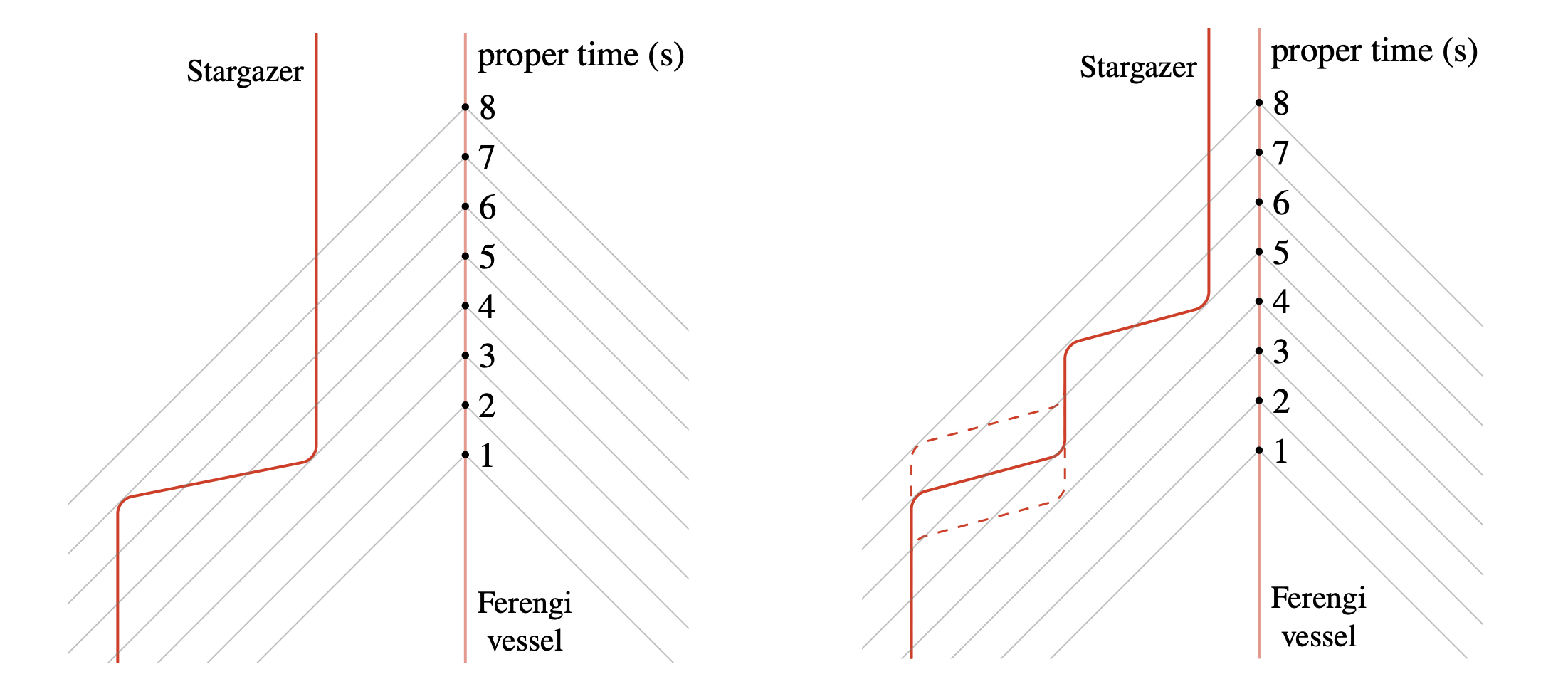
Right: Adding another burst of warp speed can boost the number of Stargazer images to five.
Right: Adding another burst of warp speed can boost the number of Stargazer images to five. Credit: Níckolas de Aguiar Alves
While the details were wrong, de Aguiar Alves was impressed that the episode reproduced the core textbook idea mostly accurately. “The main thing they got perfectly, and I think it is a great illustration.”
Physicists don’t expect faster-than-light space travel to ever be possible. But because light travels more slowly in substances like water, the math of faster-than-light travel is still useful. When a particle travels faster than light can in water, its shockwave emits a characteristic glow called Cherenkov radiation, the blue light seen in nuclear reactors.
For de Aguiar Alves, the motivation was a more elusive physical phenomenon, called the memory effect. First theorized for gravitational waves, the memory effect happens when a wave passes by a particle and leaves a lasting effect on its motion. Theoretical physicists expect it to happen when ordinary electromagnetic waves pass a particle, too, but it requires very specific circumstances and is very hard to detect. Recently, a physicist at the Niels Bohr Institute has argued that the effect should be more dramatic in a medium like water with a limited speed of light. Wanting to understand this better inspired de Aguiar Alves to try to picture how a memory-effect-influenced electron would be detected, and the diagrams he drew helped him picture the Star Trek scenario as well.
“You get a lot of intuition very quickly, and pretty much for free, by just doodling,” said de Aguiar Alves.
Matt von Hippel is a freelance science writer based in Copenhagen, with a background in particle physics. In addition to journalism, he blogs weekly at 4gravitons.com.