The extreme right-wing Alternative für Deutschland (AfD) has won a decisive victory in a regional election in the German state of Saxony-Anhalt, gaining nearly 44% of the vote. However, it fell just short of the outright majority needed to govern alone, so negotiations are underway to determine who will run the state.
One small party, the Bündnis Sahra Wagenknecht (BSW), stands as possible kingmaker. Formed in 2024 by high-profile figures who broke away from the radical left-wing Die Linke, the BSW won five seats in Saxony-Anhalt’s parliament. During the election campaigns, BSW founder and eponymy Sahra Wagenknecht signalled an openness to work with the AfD in the state.
She remarked in August that the BSW’s election goal was “to remove the incumbent Christian Democratic Union minister [Sven Schulze]” and “end this firewall idiocy”. Germany’s mainstream political parties have long refused to work or form coalitions with the radical right. This is known as the “firewall”.
On election night itself, the lead candidate for the BSW in Saxony-Anhalt, Claudia Wittig, stopped short of endorsing the AfD’s Ulrich Siegmund as minister president. But she said: “there are, of course, projects that we can very well imagine doing with the AfD”. She made these remarks in a television broadcast while stood beside the AfD’s leader, Alice Weidel.
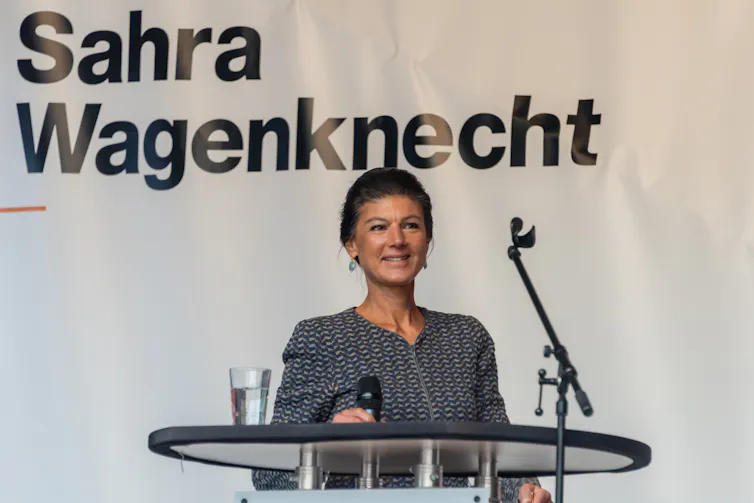
The BSW and AfD sit on different ends of the traditional left-right political spectrum. But they share more common ground than you might imagine. Both parties are anti-establishment and firmly against immigration, making the argument that immigration numbers need to be reduced.
This is despite Germany already widening deportations as part of a nationwide shift towards stricter migration controls. Germany resumed deportation flights to Afghanistan in 2024, for example, initially focusing only on people with criminal records before widening the policy.
Despite a significant overlap, their anti-immigration stances are not entirely aligned. While the AfD has proposed mass deportations and ending the right to asylum entirely, the BSW is less extreme. It does not propose ending the right to asylum or deporting people solely due to their ethnic background.
Instead, it argues that restricting immigration numbers is important in order to keep the welfare state alive. This is a core principle in the party’s ideology, which experts call “left-conservative”.
Another area of common ground is Russia. Both parties demand a stop to Germany’s weapon deliveries to Ukraine. They argue that military support is prolonging the war there, draining domestic economic resources and escalating the risk that Germany is dragged into direct conflict with Russia.
The AfD and BSW are also closely aligned on proposals to end Russian sanctions, which have been in place since the full-scale invasion of Ukraine in 2022. They want to resume energy imports from Russia and begin receiving Russian gas again via the Nord Stream pipelines. These proposals are also related to both parties’ scepticism of renewable energy.
Not a straightfoward relationship
There are similarities between the two parties at the state level, too. But these are less clear cut. The AfD has announced that, if it does lead the next government in Saxony-Anhalt, it intends to terminate the public broadcasting arrangements. It claims public broadcasters are government mouthpieces biased towards mainstream parties.
The BSW similarly argues that public broadcasting is part of a “cancel culture” and should inform, rather than try to push an agenda. However, the BSW advocates for reform rather than the outright abolition of public broadcasting.
Other AfD proposals include changes to the school curriculum to end “inclusion” in mainstream education, where children with special needs currently learn alongside other students. Its manifesto in Saxony-Anhalt also included plans to place refugees in separate classes at school rather than teaching students together.
The BSW, on the other hand, advocates greater inclusion of children with disabilities in mainstream classrooms and calls for funding specialised classroom support. And while the AfD advocates for culture war projects like banning LGBTQ+ flags, the BSW does not explicitly support a ban or mention LGBTQ+ issues in their Saxony-Anhalt manifesto.
The BSW’s national party platform has, however, adopted positions that critics characterise as transphobic.

Saxony-Anhalt may well become the first German state to be led by a radical right government since the second world war. But the context is important. Saxony-Anhalt is a small state made up of 1.7 million voters, just 2.5% of the German electorate. As such, its political landscape should not be taken as representative of the country as a whole.
The conditions for an absolute AfD majority in Saxony-Anhalt were also favourable. The east German state has a higher unemployment rate than the national average and there is widespread dissatisfaction there with the German chancellor, Friedrich Merz. Many voters in the state blame the federal government for feeling left behind and unrepresented.
Yet the AfD did not succeed in securing their electoral goal, an outright majority, leaving it reliant on other parties to form a government. All eyes should thus be on the BSW, its most likely partner – not only in Saxony-Anhalt but also in Mecklenburg-Western Pomerania and Berlin, where voters head to the polls later in September.