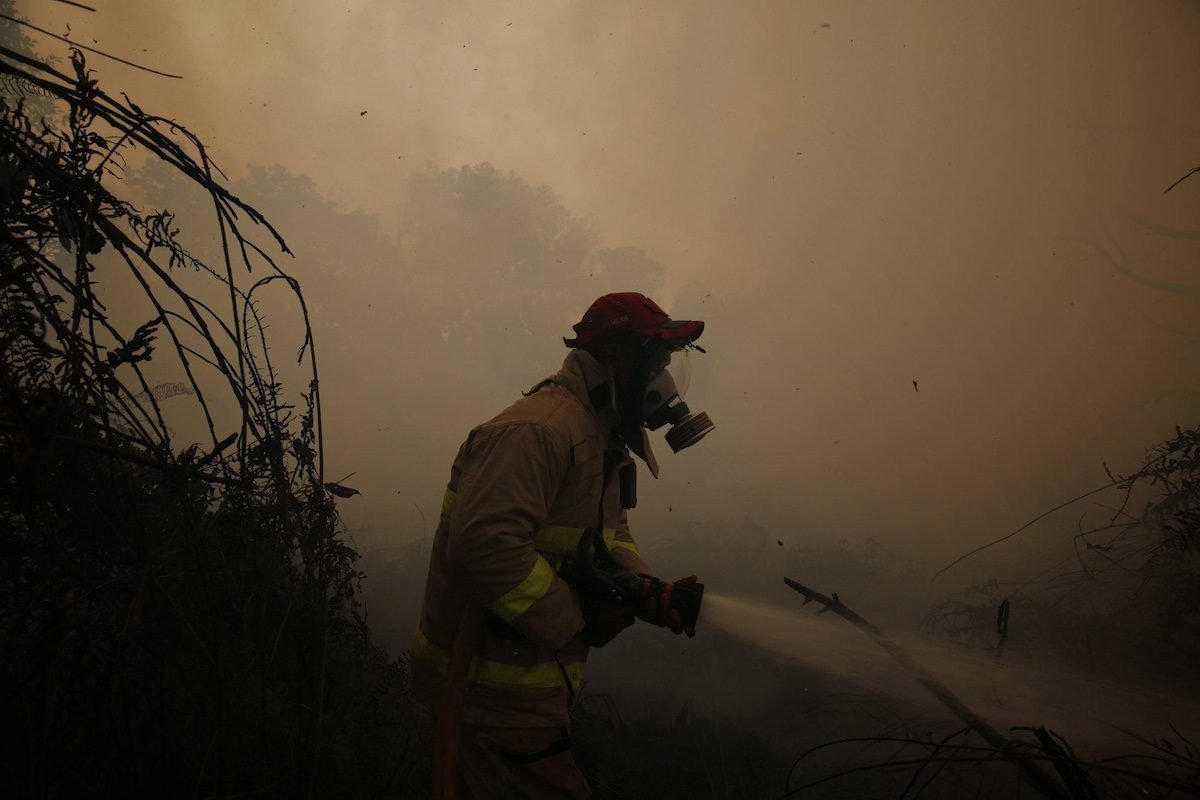
Indonesia is once again dominating headlines across Southeast Asia as dense plumes of toxic haze drift into neighboring skies. Latest satellite monitoring data from the Ministry of Forestry’s SiPongi system confirms that over 202,000 hectares of forest and land have been reduced to ashes across 36 provinces.
From degraded peatlands in Sumatra and Kalimantan to virgin landscapes in South Papua, vast expanses of green have suddenly turned into barren fields of soot and charcoal. Spatial zoning data reveals that 57% of the burned areas lie within state-designated forest zones, while the remaining 43% devoured non-forest public lands (APL).
The toll on public health is equally alarming. Health Ministry records highlight a harrowing surge in Acute Respiratory Infections (ISPA), topping 15.7 million cases since the start of the year, with weekly spikes hitting 400,000 new cases at the height of the blazes.
In Banjarbaru, South Kalimantan, hazardous particulate concentrations skyrocketed to 389.4 micrograms per cubic meter, far exceeding the national danger threshold of 250.5 micrograms. Yet, amid this unfolding crisis, government officials routinely hide behind a familiar script: blaming the El Niño weather anomaly as an unpreventable natural disaster.
This climate determinism is a dangerous fallacy that conveniently masks systemic governance failures. While sea surface temperature anomalies in the Niño3.4 region did hit +2.19°C, extreme drought acts merely as a catalyst.
Tinder-dry tropical vegetation does not spontaneously ignite without a spark. Tragically, nearly 99% of those sparks come from human hands. The root cause of Indonesia’s recurring fire crisis is simple: a cold economic calculation for cheap land clearing, where burning is deliberately chosen because it slashes costs compared to non-fire mechanical clearing techniques.
Behind the choking smog enveloping the skies lies a structural crisis driven by regulatory fragmentation, corporate impunity, and a centralized fiscal system that paralyzes regional emergency response.
When transboundary haze breaches international borders, forcing the closure of over 100 schools in Malaysia’s Sarawak state and threatening regional diplomatic friction — claims that this is a routine seasonal event fall apart.
Even more alarmingly, Kalimantan’s toxic plumes reaching Metro Manila this week have forced health authorities in the Philippines to urge millions of residents to wear N95 face masks as air quality plunged to hazardous levels.
This recurring catastrophe is not an act of God. It is the direct consequence of deliberate institutional policy choices and systemic tolerance for recurring economic crimes.
Incentive to burn
An analysis of land preparation practices shows that economic incentives remain the primary driver of environmental destruction. Clearing one hectare of tropical peatland using heavy machinery and excavators costs operators between 10 million rupiah (US$566) and 15 million rupiah.
By contrast, deploying the slash-and-burn method costs a mere 500,000 rupiah to 1 million rupiah per hectare. This massive 95% cost differential creates a staggering financial incentive for agribusinesses and land speculators to burn, while offloading the devastating ecological costs onto the public.
Independent spatial analyses show that roughly 74% of hotspots across Kalimantan fall precisely within concession areas owned by palm oil companies and industrial timber plantations (HTI). Yet, law enforcement on the ground remains strikingly asymmetric.
Police forces act swiftly to arrest smallholders and logging laborers, detaining at least 72 individual suspects across various regional jurisdictions, while corporate prosecutions move at a glacial pace. Dozens of companies with recurring fires inside their concessions routinely face minor administrative slaps on the wrist rather than aggressive criminal prosecution.
Institutional fragmentation within the central government exacerbates this enforcement deficit. The split between the Ministry of Forestry and the Ministry of Environment has fostered bureaucratic bottlenecks and jurisdictional overlaps.
The Ministry of Forestry controls spatial concession maps and the Manggala Agni firefighting corps, yet it routinely draws sharp criticism for refusing to disclose corporate work plans (RKU) transparently.
Without open spatial data under the One Map Policy framework, civil society oversight remains crippled. Environmental offenders treat low fines as a routine cost of doing business, while state coffers absorb the massive price tag of emergency firefighting.
Fiscal centralism
While ministries in Jakarta issue top-down directives, regional governments on the frontlines are left fiscally paralyzed. Central government cuts to Regional Transfer Funds (TKD) over the past two years have inflicted severe financial distress on nearly 490 local administrations.
These budget reductions have gutted local capacity to fund environmental protection and disaster mitigation operations, leaving regional agencies powerless when prolonged dry seasons hit.
This fiscal disparity translates directly into operational failures on the ground. In West Kalimantan, where burned land exceeded 38,000 hectares, the government deployed just 265 Manggala Agni firefighters. This resulted in an absurd workload, requiring a single firefighter to extinguish over 144 hectares of smoldering land.
Furthermore, community volunteer groups like Fire-Aware Communities (MPA) face chronic delays in stipend payments and lack basic equipment such as portable water pumps and protective gear, crippling early-detection capabilities at the field level.
Unyielding local government financial regulations worsen the emergency. Regional leaders are often hesitant to disburse Emergency Budget (BTT) funds because of complex disaster-declaration procedures and fear of post-disaster financial audits. In Central Kalimantan, for instance, 70 billion rupiah in emergency funds sat idle due to bureaucratic red tape as fires began to spread.
Deprived of agile local funding, regional authorities become entirely dependent on central government aerial water bombing—an exorbitantly expensive method that remains notoriously ineffective against subterranean peat fires creeping beneath the surface.
Structural reform
The real cost of Indonesia’s forest fires extends far beyond the commercial value of charred timber.
Using environmental economic valuation models, direct losses from destroyed ecosystem services and lost revenue potential are estimated at 269 million rupiah per burned hectare. Multiplied across the 202,000 hectares burned, direct national economic losses have already topped 54 trillion rupiah.
Historical World Bank evaluations of the 2015 and 2019 fire crises documented total economic damages of $16.1 billion and $5.2 billion respectively, wiping out up to 0.5% of national GDP growth while inflicting long-term damage on human capital.
Indonesia’s tropical peat ecosystems hold a massive carbon reserve of roughly 57 gigatons, accounting for 30% of the world’s global peatland carbon. When peatlands are drained for commercial canals, these vital carbon sinks turn into giant carbon emitters.
Smoldering peat releases massive volumes of carbon dioxide and methane into the atmosphere. Re-wetting degraded peatlands and permanently blocking drainage canals is scientifically proven to reduce greenhouse gas emissions by 50% to 65% while preventing recurring underground fires.
To break this vicious cycle of ecological destruction, the Indonesian government must enact bold structural reforms. The central government must publicly disclose all corporate concession maps and strictly enforce the principle of strict liability for corporate entities.
Companies found with repeated fire hotspots inside their concessions must face immediate license suspensions, revocation, mandates for ecological restoration, and asset seizures utilizing anti-money laundering laws.
Concurrently, the fiscal framework must be overhauled through Ecological Fiscal Transfers (EFT), providing higher budgetary allocations to regions that successfully protect peat ecosystems and prevent fires.
On the global stage, Indonesia must shed its defensive posture and assume leadership in regional climate diplomacy. Fully operationalizing the ASEAN Agreement on Transboundary Haze Pollution (AATHP) and establishing a joint monitoring platform will rebuild regional trust and unlock global climate finance.
By cracking down on corporate environmental crimes, rectifying regional fiscal imbalances, and restoring the natural hydrology of peatlands, Indonesia can permanently extinguish the blazes threatening its people’s future and global climate stability.
Ronny P Sasmita is senior analyst at the Indonesia Strategic and Economic Action Institution, a Jakarta-based think tank. He holds a PhD from the University of Tokyo.