China’s WZ-X points to a future in which stealth, endurance, surveillance and strike converge in a new class of unmanned aircraft built for sustained operations across the vast distances of the Pacific.
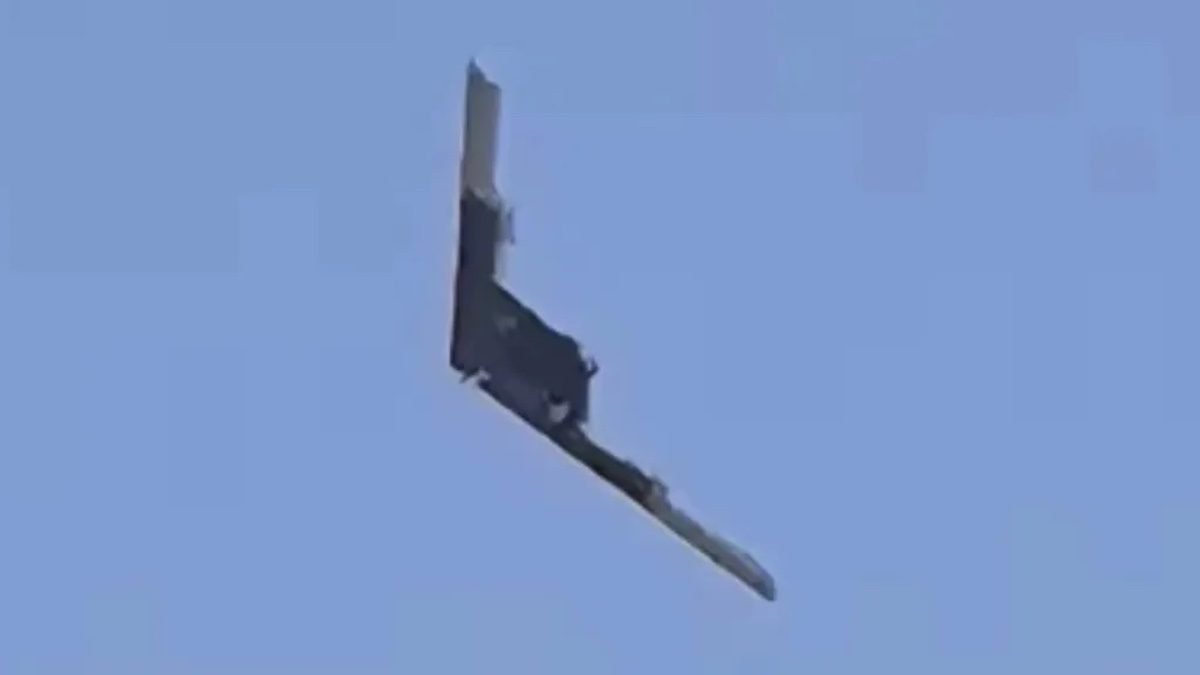
This month, The War Zone (TWZ) reported that newly surfaced aerial imagery has confirmed the unusual wing design of China’s secretive WZ-X stealth drone, revealing a stepped-down geometry engineered for high-altitude endurance.
The revelation builds on commercial satellite imagery from May 2025, which first captured the massive, twin-engine flying wing parked outside newly constructed high-security hangar bays at the People’s Liberation Army’s (PLA) remote test base in Malan, Xinjiang.
With an estimated 51.82-meter wingspan rivaling the US B-2 bomber and a 14.02-meter length, the unmanned aircraft transitions abruptly from a wide-chord inner body to slender outboard wings, creating a shallow, semi-serrated trailing edge. It is estimated to have a range of 19,000 kilometers and an operational altitude between 17,000 and 20,000 meters.
Its aerodynamic layout maximizes aspect ratio and curbs cruise-induced drag to sustain long-range intelligence, targeting, and communications missions across contested Pacific airspace, despite potential radar-signature trade-offs caused by the distinct planform discontinuities.
While China has officially disclosed no performance specifications or fielding timelines, the prototype’s progression from static display outside specialized hangars to active flight testing underscores China’s accelerated push to deploy very large, low-observable unmanned platforms alongside next-generation crewed combat systems.
The WZ-X may therefore represent China’s effort to extend unmanned operations deeper into contested Pacific airspace by combining long endurance with the survivability needed for intelligence, surveillance, and reconnaissance (ISR), target cueing, communications support and potentially strike missions.
The drone’s stealth design may be an effort to improve survivability, as legacy designs may not last against contemporary air defenses. The Washington Post reported in August 2026 that the US military has lost 45 MQ-9 drones – about 25% of an 185-unit pre-war fleet – in the ongoing Iran War.
According to unnamed US officials cited by the Washington Post, not all downed MQ-9 drones were shot down; some crashed due to a loss of communication between the drone and its operator.
The MQ-9 was designed in an era of uncontested US air superiority. It was designed for maximum loitering time in relatively permissive airspace. While effective against technologically unsophisticated adversaries with no capability to counter it, its low speed, lack of maneuverability, non-stealthy design, and significant thermal signature may have made it vulnerable to relatively advanced adversaries such as Iran and its Houthi proxies.
While early in the conflict, initial US and Israeli strikes using sophisticated aircraft such as the F-35 decimated Iran’s long-range air defense systems, including the S-300, follow-on operations such as close-in surveillance, battle damage assessment, combat search and rescue, and special operations may require aircraft that operate at much lower speeds and altitudes, such as MQ-9s and helicopters.
Those missions make them vulnerable to small, numerous, concealable, and easily dispersed systems such as man-portable air defense systems (MANPADS) or air-to-air infrared-guided missiles repurposed as surface-to-air missiles.
China operates several drone designs similar to the MQ-9, most notably the Wing Loong 2, which could be similarly vulnerable. Highlighting the possible vulnerability of the type, the South China Morning Post (SCMP) reported in April 2026 that Iran had shot down a Wing Loong 2 drone over the city of Shiraz.
According to SCMP, Iran then demanded an explanation from Saudi Arabia and the UAE, as those two countries are the only known operators of the type in the region.
The loss illustrates the vulnerability of legacy UAV designs in increasingly contested environments and helps explain the PLA’s interest in lower-observable alternatives such as the WZ-X and carrier-capable GJ-21.
Although the WZ-X’s specific role remains unclear, Catherine Welch and her co-authors note in a July 2026 CNA report that Chinese military-affiliated researchers increasingly view uncrewed platforms as important nodes in distributed, resilient kill processes linking sensors, communications networks, command systems, and weapons.
According to Welch, Chinese studies indicate that uncrewed systems provide cost-effective platforms for expanding wide-area sensing and early warning without risking crewed aircraft.
She also notes that Chinese researchers assess that attritable drones can penetrate contested airspace to deliver real-time targeting coordinates for standoff weapons launched from non-stealth platforms, while serving as distributed communications relays and edge-computing nodes that connect disparate units and reduce data latency across multi-domain environments.
Jonathan Caverley notes in a June 2025 Texas National Security Review (TNSR) article that China could use large uncrewed surveillance aircraft as alternative find-and-fix nodes against US carrier strike groups if its space-based ISR were degraded. He argues that such airborne sensors could help preserve China’s ability to cue long-range missile forces even when satellite coverage is disrupted.
Although China’s H-20 stealth bomber program has been publicly known for a decade, Harry Kazianis notes in a June 2026 article for 19FortyFive that it faces technical and industrial hurdles in propulsion, low-observable materials, large flying-wing aerodynamics, and systems integration.
If China’s H-20 program remains delayed, the WZ-X could offer the PLA a parallel path to developing some of the technologies and operational concepts associated with long-range penetrating airpower.
In a US-China conflict over Taiwan, China could see value in a stealth bomber able to penetrate US and allied air defenses protecting forward bases and staging points, such as those located in South Korea, Japan, the Philippines, Guam, and other Pacific islands.
The dispersal of US forces across numerous Pacific bases could strengthen the case for reusable, penetrating aircraft capable of revisiting targets and delivering comparatively inexpensive munitions, rather than relying exclusively on finite inventories of long-range ballistic and cruise missiles. Such aircraft could also offer greater payload flexibility and retargeting options than preplanned missile strikes.
China’s interest in unmanned stealth bombers could stem from the static US forward bases and staging areas in the Pacific. Their fixed locations would at least simplify the targeting problem for an autonomous or heavily automated strike aircraft compared with attacks against mobile or time-sensitive targets.
By contrast, US forces hunting mobile Chinese missile launchers would face a far more dynamic targeting problem, requiring rapid identification, retargeting, and engagement decisions that remain considerably harder to delegate fully to autonomous aircraft.
If the WZ-X proves operationally viable, it could mark the point at which China begins shifting part of its strategic airpower from scarce crewed bombers and expendable missiles toward reusable, uncrewed platforms capable of sustaining reconnaissance and strike pressure across the Pacific.