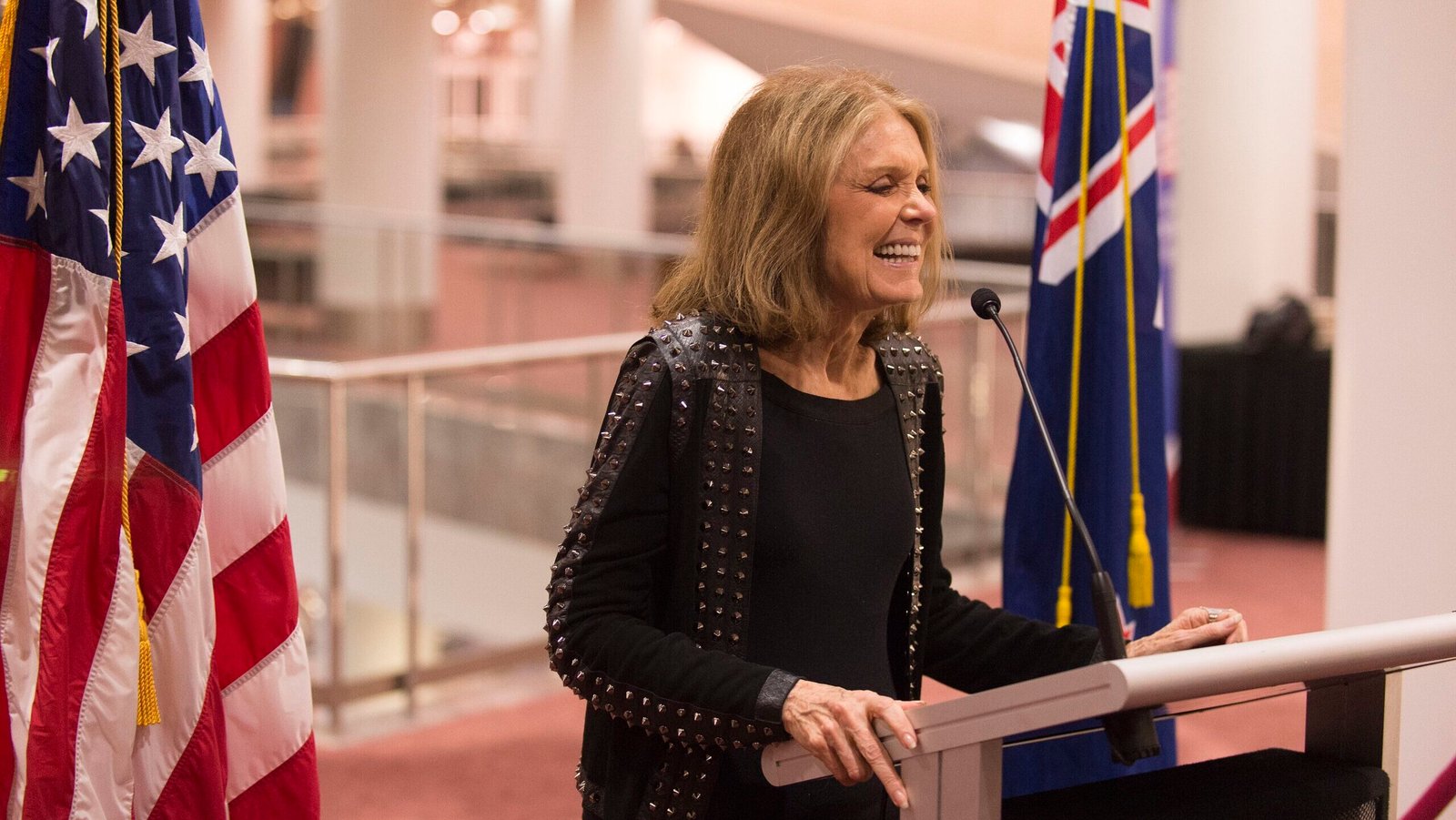
Gloria Steinem, the journalist, author and organizer who became the most recognizable public face of America’s modern women’s movement, died Wednesday at her New York City home. She was 92.
Her foundation said Steinem died peacefully surrounded by loved ones; no cause of death was announced.
Over more than six decades, Steinem helped change the terms of public debate about women’s lives. She pressed for reproductive freedom, equal pay, workplace equality, political representation and protection from sexual violence, arguing that none were private matters or secondary concerns. Her presence at rallies, conventions, campuses and community meetings made her a household name—and, for supporters and critics alike, an enduring symbol of second-wave feminism.
Steinem first rose to prominence as a journalist. In 1963, she went undercover as a Playboy Bunny and documented the degrading working conditions at Hugh Hefner’s clubs in an exposé later published as “A Bunny’s Tale.” The reporting established her as a writer willing to enter worlds that had dismissed women’s experiences as unworthy of serious journalism.
Her move into organized feminism followed a 1969 abortion-rights speak-out, where women publicly described obtaining illegal abortions. Steinem, who had undergone an illegal abortion herself as a young woman, later called the event the beginning of her activism. She became a founder of the National Women’s Political Caucus in 1971 and co-founded Ms. magazine the following year, creating a national platform for reporting on sexism, reproductive rights, domestic abuse and women’s economic independence.
She also helped found the Ms. Foundation for Women and the Women’s Media Center, supported women candidates for office, and campaigned against racism, violence and discrimination. Her 2015 memoir, My Life on the Road, traced the travel and grassroots organizing that she believed were central to durable political change. President Barack Obama awarded her the Presidential Medal of Freedom in 2013.
Steinem was born in Toledo, Ohio, in 1934, to Leo Steinem, who was Jewish, and Ruth Nuneviller, who was Protestant. Raised largely without religious observance, she nonetheless spoke plainly about antisemitism: “Never in my life have I identified myself as a Christian, but wherever there is antisemitism, I identify as a Jew.”
Her connection to Israel and the Middle East reflected her wider human-rights politics rather than a single, fixed foreign-policy profile. In 1975, she joined dozens of prominent women, including Betty Friedan and Bella Abzug, in condemning the UN General Assembly resolution equating Zionism with racism. The letter rejected what its signatories called the denial of Jewish national self-determination and Israeli statehood.
Steinem also supported efforts involving both Israeli and Palestinian women. In 2001, she accompanied Israeli activist Terry Greenblatt and Palestinian activist Maha Abu-Dayyeh Shamas as they urged the UN Security Council to support peacekeeping and include women and civil society in peace negotiations.
She could be sharply critical of Israeli policy. In 2004, she signed a petition calling for Jewish settlements in the West Bank to be relocated to Israel proper through a negotiated approach. In 2019, she said she would not visit Israel while Benjamin Netanyahu was prime minister after Israel barred entry to US Reps. Rashida Tlaib and Ilhan Omar.
Steinem remained active into her 90s, writing, mentoring younger organizers and speaking for women’s equality. Her final memoir, An Unexpected Life, is scheduled for publication later this month.