Back in 2015, when I was living in Brooklyn, my apartment flooded. My landlord, who owned a bunch of apartments, offered to put me up in temporary accommodations. He and his girlfriend were going to be out of town for several months, so he let me stay in her room.
His girlfriend was an aspiring actress from Minnesota named Poppy Liu. I got to interact with her a number of times, and I can say that she’s one of the more interesting and original people I’ve ever met.
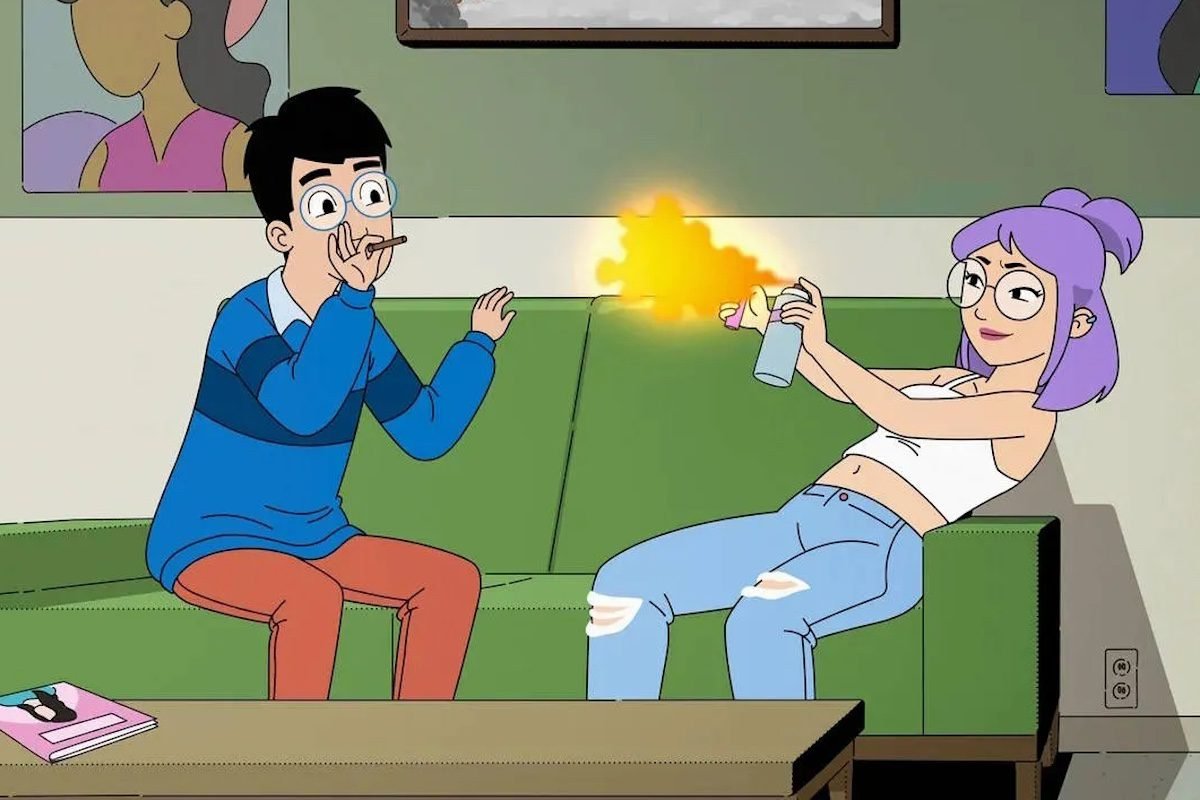
Poppy finally made it big. One of her latest roles is as the voice actress for one of the protagonists on the new animated Netflix series DANG!, a story about three Asian Americans living in NYC:
DANG!, a new adult animated series, premieres September 8. Starring Andrew Law, Poppy Liu, and Stephanie Hsu.
Siblings Andrew and Eunice are living out their fun and messy dreams in New York City. Until their worst nightmare comes true: their high-achieving sister Ruthie wants… pic.twitter.com/kAbysm9DpY
— Netflix (@netflix) August 11, 2026
The show isn’t out yet, but from what I can tell, DANG! is trying to tell a story that will resonate with second-generation Asian Americans[1] — one of the characters is a striver who goes off the beaten path, the others were escaping their striver upbringing by leading nontraditional lifestyles from the get-go. That’s probably a pretty typical real-world experience for the American-born children of high-skilled immigrants.
I don’t know if the show will be good or not, but as soon as the trailer hit, people on Twitter started ridiculing it — and using it as an opportunity to make fun of “Asian American media” or “Asian American art” in general. Some of the comments were dour and downbeat:
Asian American writing is a very interesting phenomenon when you take a break from laughing at it.
Somehow they went through an arduous life suffering as much as a medieval prisoner, when they were raised by doctors/engineers. They lament about their school lunch smelling weird… https://t.co/Ds3hZaRMAk
— President-Elect Toguro (@PresidentToguro) August 13, 2026
…While other commentary was pretty hilarious:
DONG!, a new adult animated series, premieres September 8. Starring a Chinese guy.
David Dong, typical UMC Chinese-American, has struggled with stereotypes and hardships all his life. From being told by online rightwing Pepe the frog avatars that he’s a “bug man who can only…
— Daniel Yang (@punished_daniel) August 12, 2026
It turns out that Asian Americans bashing “Asian American art” is a pretty well-established tradition. Here’s another example unrelated to the Netflix show:
I remember reading most Asian American “art” takes the form of a college application essay. The safe edginess, the yearning for acceptance, the resignation to conformity. Asian Americans write application essay after application essay and wonder why it all rings hollow. https://t.co/P5Aw5BkbyP
— tomie (@tomieinlove) August 27, 2026
(See also here.)
It’s always fun to rag on tired tropes. But I feel like I should stand up for Asian American art here, because there really is a lot of excellent stuff out there that doesn’t fit into the standard format that people are complaining about.
“Asian American art” is defined too narrowly
The biggest problem with “Asian American art”, as far as I can tell, is that it’s defined so narrowly that there really isn’t much room for it to be creative. Consider these two possible definitions of “Asian American art”:
- Art made by Asian Americans
- Art made about Asian Americans or Asian American culture
As far as I can tell, movies, TV shows, books, etc. only get labeled “Asian American” if they satisfy both of these criteria at once. But that’s a pretty narrow slice of art!
First, it excludes art made about Asian Americans by non-Asians. There isn’t really a lot of this around, because America’s modern approach to identity politics says that you should only write about a group of people if you’re from that group — if a white author writes a novel with an Asian American protagonist, it’s generally frowned upon.
There are some notable exceptions that get grandfathered in — Harold & Kumar Go to White Castle was written and directed by three white guys — but the culture of the 2010s really put a damper on that sort of crossover.
That means a lot of interesting and insightful stories about Asian Americans probably never get told. For example, I thought Ernest Hemingway’s portrayal of a frustrated Jewish striver in The Sun Also Rises was incredibly deep and thoughtful, and managed to say lots of things about how second-generation Jewish Americans were integrating into American society at the time.
That portrayal probably wouldn’t get written today — a lot of people now accuse it of being antisemitic,[2] because the character, while complex and sympathetic, is deeply flawed, and Hemingway himself wasn’t Jewish.
It also means that works clearly inspired by Asian America don’t generally get recognized as such. The clearest example of this is Avatar: the Last Airbender, which was arguably the best new fantasy IP to come out of the US since the turn of the century.[3] ATLA, as it’s sometimes known, drew on a bunch of Asian cultures — mostly Chinese, but also Japanese, Tibetan, Korean, and others — to create a sort of pan-Asian mishmash, informed by American sensibilities and written in a distinctly American style.
That’s not too different from what Asian American culture is, and many Asian Americans were involved with both the production of the show and its adaptation into graphic novels and other media. But because the show’s creators themselves were white, it typically isn’t counted as Asian American art.
Even more importantly, the narrow definition of “Asian American art” also tends to exclude art made by Asian Americans, if it doesn’t deal directly with Asian American culture as its subject matter or motif. That ends up limiting the idea of “Asian American art” to things like Fresh off the Boat, The Joy Luck Club, Crazy Rich Asians, Everything Everywhere All at Once, American Born Chinese, Past Lives, the first season of BEEF, and so on.
I’m not saying those shows and movies are bad. For example, I love Everything Everywhere All at Once, which is among the most original and fun things I’ve seen in the past decade, and a true throwback to the zany 80s movies I loved as a kid. The first season of BEEF is one of the best things I’ve ever seen on TV. But Asian American culture is just a pretty small pool of source material to draw on.
It’s not that big, for one thing — if you exclude South Asians like Indians and Pakistanis, Asian Americans are only around 5.5% of the US population. And Asian American narratives usually don’t tend to carry any special resonance with people in Asia:

And like all immigrant subcultures in America, Asian American culture is probably destined to be a sort of transitory, ephemeral thing. The classic second generation experience — “My parents really drove me hard and kids made fun of my weird lunch, until I went to college and met other people with the same background” — almost never lasts beyond the second generation.
Assimilation happens. It’s already happening. Around two-thirds of Asian Americans report having close friends of another race, and over 40% of US-born Asian Americans marry people of other races (usually white or Hispanic).
Despite concerns that nonwhite immigrants wouldn’t follow the same patterns as the East and South European immigrants of a century ago, Asian Americans are assimilating even faster than the white immigrants of yesteryear in every measurable way — outmarrying, climbing up the economic ladder, adopting American naming conventions, speaking English, moving out of coastal enclaves, and so on.
That means that both the source material and the natural audience for what we now consider “Asian American” narratives are destined to shrink. I’m fourth generation; when I read stories or watch movies about the New York Jewish culture of the early and mid 20th century, it already feels like a foreign country to me. I would be willing to bet that most fourth-generation Asian Americans will watch Fresh Off the Boat and feel the same way.
So we’ve defined “Asian American art” in a way that inherently limits it to something small and transient — basically, a micro-genre. It’s thus inevitable that lots of people see it as repetitive. If we want to appreciate the true breadth and depth of Asian American art, we need to take a broader view of what that means.
I think we should start looking at any art created by Asian Americans as “Asian American art” — even if it’s about white people, or about robots, or about fantasy worlds where our modern races and cultures don’t even exist.
So here are a few examples of Asian American art I’ve enjoyed in recent years. This is far from an exhaustive catalog, or even a “top” list — it’s just a random selection of things I personally like. I’ve restricted it to works with major contributions by Asian Americans, so no Scott Pilgrim vs. the World, Kpop Demon Hunters, Counterstrike games, Kim’s Convenience, Mariko Tamaki graphic novels, etc. — those are all by Asian Canadians.
A few examples of great Asian American art
1. The comics of Adrian Tomine
A lot of the most interesting Asian American art comes in the form of graphic novels — a category that’s usually overlooked in these discussions. Adrian Tomine is probably tied with Neil Gaiman as my favorite graphic novelist of all time.
He’s also one of the greatest authors of Generation X — he manages to capture the peculiar spirit of cynicism, longing, and rugged independence mixed with a strange sense of helplessness that defines that forgotten generation. His most famous work is Shortcomings, which was adapted into an excellent and overlooked movie in 2023:

(The opening scene of the movie is a send-up of Crazy Rich Asians — very much in the spirit of Asian Americans making fun of “Asian American art”.)
But my favorite are actually Tomine’s shorter comics, assembled in collections like Summer Blonde, Killing and Dying, and Sleepwalk. Tomine is one of the most sensitive observers of the human condition that I’ve ever read, and he deserves far more recognition than he’s received.
2. Monstress, by Marjorie Liu and Sana Takeda
This is possibly the best fantasy graphic novel I’ve ever read, both in terms of the storytelling and the art quality. Takeda, the illustrator, is Japanese, but Liu, the author, is American. Monstress is steampunk mixed with Lovecraftian horror, and the twist — sorry for the minor spoiler — is that one of the horrors is one of the protagonists. It has amazing fight scenes, an epic page-turning plot, and deep, complex characters. Like most long-running graphic novel series, it starts to meander later on,[4] but it’s absolutely worth picking up.

3. The first season of BEEF
OK, on to television. TV tends to get short shrift in the cultural zeitgeist relative to movies, but I’d argue that television is where the truly creative screen stories now get told. BEEF is an anthology show created by Lee Sung Jin, with the running theme being suburbanites who get into feuds. I was lukewarm on the second season, but the first season is one of my favorite things ever.

This season actually is about Asian American culture, but it’s about interesting corners of it that don’t usually get air time, including working-class Korean Americans and Japanese American artists. The portrayals are devastatingly funny and deeply poignant at the same time, and the story arc is executed to perfection. Make sure to watch until the very last half-second of the last episode.
4. Atlanta (and Childish Gambino videos)
Atlanta is a quintessential work of Black art about Black America, created by (and starring) by Donald Glover, and written by an all-Black writers’ room. But one of the key creators of the show is Asian American: Hiro Murai, who Glover said “had the eye for this show”. Murai directed many of the episodes (including the pilot), and was also an executive producer.
In fact, Murai and Glover have been creative partners for many years, and it’s difficult to separate their brilliance. Murai has also directed many of Glover’s music videos (in Glover’s alter ego as Childish Gambino), including the iconic “This Is America.”
Atlanta is, simply put, one of the most brilliant TV shows I’ve ever seen. If you haven’t seen it, you need to. And Murai’s participation in a quintessentially Black production shows how Asian artists can contribute to art well outside the typical “Asian American” paradigm.

5. Japanese Breakfast (and Crying in H Mart)
I really like the band Japanese Breakfast. They’re broadly a rock band, but really they defy genre — you could call them indie or synth-pop. Michelle Zauner, who is half Korean, is the lead singer and main songwriter. I recently saw them live, and they give a very good show.

Zauner also wrote a pretty well-known book called Crying in H-Mart, about the death of her mother from cancer. It’s a very good memoir, and it did indeed make me cry (though not in H Mart).
6. Wisp
I really loved shoegaze music when I was young, and I’m delighted that the Zoomers have brought the genre back. One of the best-known examples of the shoegaze revival — and my personal favorite — is Wisp. It’s basically just one woman, Natalie Lu.

7. Ninefox Gambit, by Yoon Ha Lee
Finally, on to my favorite genre of art: science fiction books! I grew up reading a lot of these, and one of my favorite subgenres was “weird” sci-fi books from the 1960s and 70s — Samuel R. Delany, Roger Zelazny, and stuff like that. I also love Rudy Rucker’s weird cyberpunk. Well, I can confidently say that Ninefox Gambit and its sequels and associated short stories are every bit as weird and far-out and creative as any of the stuff on my old shelf.
It’s about a universe where the laws of physics depend on which calendar people use — and so of course the galaxy is made up of warring empires, each trying to make everyone use their own calendar. If you want your mind blown, this series is a good one.

8. The stories of Ted Chiang
Ted Chiang is, I would argue, the greatest English-language science-fiction short story author of the 21st century so far. His stories — collected in books like Stories of Your Life and Others and Exhalation — are high-concept stuff, exploring premises like “What if people had implants that gave them perfect memory?”, and “What if people could turn off their ability to identify beautiful faces?”.
But they almost always manage to work deep and meaningful character arcs in as well, which is something that relatively few sci-fi short story authors are good at. His story “Story of Your Life” was adapted into the film Arrival.
9. Jade City, by Fonda Lee
I wanted to put a fantasy novel in here. I’m pretty picky about fantasy, but I really enjoyed Fonda Lee’s Jade City, which is about super-powered mafia wars in an alternate universe, in a city that’s somewhat reminiscent of Hong Kong — basically, think of The Godfather with superpowers. Lee is a very good writer, and I couldn’t put the books down.
10. How to Live Safely in a Science Fictional Universe, by Charles Yu
This book is pretty light on the actual sci-fi; it’s mostly about a guy resolving his psychological issues via time travel. But in fact, I like books about guys resolving their psychological issues via time travel — at least when they’re well-written, which this book definitely is.
11. Nothing, Except Everything, by Wesley Wang
This short film was made by a 19-year-old college kid, and it really blew me away. It’s a surrealistic portrait of a high schooler who comes to understand the idea of mortality:[5]

There’s apparently a bunch of controversy over whether it’s a good film, but the haters are wrong — it’s very good. Darren Aronofsky agrees, which is why when he saw the short film, he immediately called Wang up and gave him a deal to direct a feature film.
12. Plants vs. Zombies
OK, fine, video games aren’t exactly “art.” But who doesn’t love Plants vs. Zombies? I can’t even count the hours I sunk into that game.
Anyway, there’s a small selection of Asian American art that doesn’t fit the standard definition (except possibly BEEF, which stretches the typical format and takes it in innovative directions).
Of course this is just the tip of the iceberg — it’s a smattering of stuff I just happened to consume over the past few years. There are a lot of very brilliant Asian American creators out there, making art that looks nothing like DANG!.
And to the snarky people on X, I’d think twice about bashing the traditional “Asian American art” stuff as well. Yes, many of its tropes have become cliche by now. But its often modest success opened the door for a lot of Asian American creators to break into the worlds of art and entertainment.
Increasingly, they have the creative freedom to write stories and make art about anything they want, and we’re just starting to see a few glimmers of what that could encompass.
Notes
1 It’s also clearly trying to be pan-Asian; the main characters are ethnically Chinese but have a typically Vietnamese last name, and one of the characters has the typically Korean name of Eunice.
2 Amusingly, the author of that New Yorker article alleging that Hemingway’s character was antisemitic is named Akhil Sharma — presumably, not Jewish — while I, who think the character is sympathetic and worthwhile, am Jewish.
3 The Song of Ice and Fire books, which inspired the Game of Thrones series, first came out in the 1990s.
4 This happens because writing graphic novels takes a ton of time and pays very little money, so once a graphic novelist gets a hit, they are financially forced to keep it running for as long as possible. The same problem occurs in the manga industry in Japan. The way to solve this is for TV producers to start adapting graphic novels for TV series early in their runs.
5 This probably resonated with me in part because my mom died when I was 19.
This article was first published on Noah Smith’s Noahpinion Substack and is republished with kind permission. Become a Noahopinion subscriber here.