Welcome to Edition 9.08 of the Rocket Report! Some major news this week from the state of Louisiana, previously associated with space due to NASA’s aging Michoud Assembly Facility near New Orleans. Now the state has a chance to become the epicenter of SpaceX’s Starship program as the company plans to invest up to $100 billion to construct factories and multiple launch pads for the super heavy lift rocket. It would utterly transform coastal Louisiana.
As always, we welcome reader submissions, and if you don’t want to miss an issue, please subscribe using the box below (the form will not appear on AMP-enabled versions of the site). Each report will include information on small-, medium-, and heavy-lift rockets as well as a quick look ahead at the next three launches on the calendar.

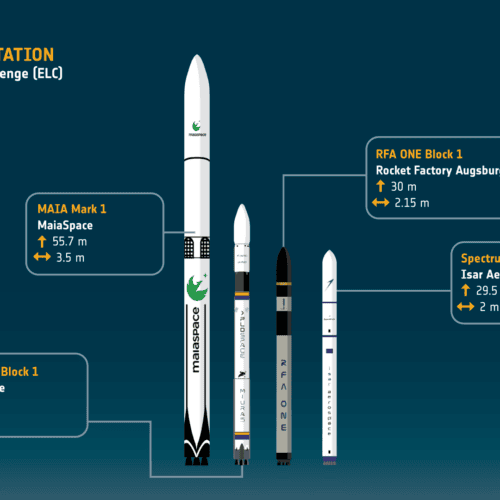
ESA announces big launch challenge contracts. The European Space Agency said Thursday it signed contracts with a handful of European launch startups to help them continue development of their vehicles. “The European Launcher Challenge is ESA’s initiative to expand European launch service supply and ensure more robustness in Europe’s access to space,” the space agency said of the award, which supports the development and operation of small launch vehicles in Europe. For some of these firms, the funding will provide a key lifeline.
And the winners are … Rocket Factory Augsburg, based in Germany and developing the RFA One rocket, received 186.9 million euros and is mainly funded by Germany, with a contribution by the United Kingdom. PLD Space, based in Spain and developing the Miura 5 rocket, received 158.9 million euros and is mainly funded by Spain with a contribution by Germany. Isar Aerospace, based in Germany and developing the Spectrum launcher, received 197.8 million euros and is mainly funded by Germany, with contributions by Austria and Norway. Another contract award process with MaiaSpace is nearing completion, the agency said.
Skyroot is great, but India needs more. Jatan Mehta writes some of the most insightful articles about India’s space program, and we wanted to highlight his six-part series on what he calls “India’s launch vehicle crisis.” Part six of this series was published on Sunday, and it explains why, despite the recent success of Skyroot and its Vikram-1 rocket, India’s growing gap in orbital launch capacity will remain unresolved. “Even if we hope and assume that the thousand-plus people of Skyroot bag a commendable place in the small-lift launch market, that does not in itself solve India’s space access crisis,” Mehta writes.
India’s government needs to be proactive … He notes that the country faces major constraints in spaceports, suppliers, and especially medium- and heavy-lift rockets. “Skyroot’s success with the first flight of Vikram-1 is only the least worst case scenario for India’s launch vehicle crisis,” Mehta says. “It’s not at the peak alongside people’s emotions but at the bare minimum level to cater to but a fraction of India’s needs in space.”
Japanese startup wins launch contract. A Japanese radar-imaging startup has signed an agreement to launch its first demonstration satellite on Space One’s Kairos rocket, Space News reports. Space One and Sarmony announced on August 25 that they signed a memorandum of understanding regarding the launch of Sarmony’s first SAR DiskSat spacecraft on a Kairos rocket in 2028.
A bold choice … Kairos has launched three times to date, in each case failing to reach orbit. On the most recent launch in March, the vehicle broke apart a little more than a minute after liftoff. A Space One representative said the company is completing the investigation into the failure and plans to release more details soon. The company has not announced a schedule for the next Kairos launch.

Falcon 9 Starlink launches from Florida end. It’s the end of an era in Florida, Ars reports. A Falcon 9 launch early Tuesday was the last planned Starlink mission from Cape Canaveral until SpaceX begins flying Starship missions from Florida, according to Kiko Dontchev, the company’s vice president of launch. “From here on, Starlink missions out of Florida will fly on Starship,” Dontchev said. “The West Coast team will continue regularly launching Starlink from Vandenberg.”
A real workhorse … SpaceX launched around 260 Starlink missions on Falcon 9 from Florida, but all future Falcon 9 and Falcon Heavy launches from Florida will carry external customer payloads. The next one is scheduled for August 30, when a Falcon Heavy rocket will lift off from Launch Complex 39A at Kennedy Space Center with NASA’s Nancy Grace Roman Space Telescope. Officials eventually plan to phase out the Falcon 9 in favor of Starship, at least for commercial missions, raising concerns among SpaceX customers about the availability of reliable launch services after 2028.
Pallas-1 rocket nears debut. Chinese commercial firm Galactic Energy is ready for a first orbital launch attempt with its Pallas-1 liquid propellant launch vehicle, Space News reports. Newly published airspace warnings now indicate a launch window of between 9:52 pm ET on August 31 and 12:09 am ET on September 1 (01:52–04:09 UTC, September 1). While the rocket is designed for reusability, no recovery attempt of the first stage is expected for the first flight. No payloads have so far been announced ahead of launch.
Solidly a medium-lift vehicle … Pallas-1 is Galactic Energy’s two-stage liquid launch vehicle, with an optional Eros upper stage for extended missions. It has a 3.35 meter-diameter body, a 4.2 meter-diameter fairing, a liftoff mass of 283 tons, and liftoff thrust of 350 tons, according to Galactic Energy’s webpages. While payload capacity stats have fluctuated during development, the firm states a maximum payload capacity of 7,000 kilograms to low-Earth orbit.
New federal policy calls for additional spaceports. A new national space transportation policy signed by President Donald Trump calls for the development of more spaceports to support more than 1,000 launches and reentries per year by 2030, Ars reports. The most notable updates to the national space transportation policy focus on increasing the country’s ability to enable those lofty forecasts. The Trump administration calls on the Pentagon and NASA to “prioritize and coordinate on infrastructure investments” to boost launch and reentry capacity and flexibility at federal launch and reentry ranges.
Finding additional launch facilities … The policy document supports more efficient range scheduling criteria at federally owned spaceports, balancing the needs of commercial users and US government missions. It also directs the military and NASA to “regularly publish range schedules to ensure transparent allocation of resources and optimize launch capacity.” Today, the schedules for most rocket launches are not public until a few days or weeks in advance. The government will also identify potential locations for additional launch facilities in the United States, improve integration of space launch and reentry operations into airspace and air traffic control modernization efforts, and designate “priority airspace for critical space launch corridors.”
Ariane 6 set for first geostationary launch. On Thursday, Arianespace is scheduled to launch the MTG-I2 meteorological satellite with the Ariane 62 configuration from Europe’s Spaceport in French Guiana. According to Arianespace, the MTG-I2 mission will mark the fourth Ariane 6 launch of the year and the rocket’s first to a geostationary orbit.
Flying high, for now … In addition to these milestones, this will be the ninth overall launch by the Ariane 6 program, which was developed by the European Space Agency and is now operated by Arianespace. From a technical standpoint, Europe’s workhorse rocket continues to perform well, but there are questions about its long-term viability.

SpaceX plans massive Starship launch site in Louisiana. Louisiana Gov. Jeff Landry said Tuesday that SpaceX will commit $100 billion to develop Starship factories and launch pads in the state’s coastal areas. In doing so, the company seeks to replicate the Starbase facility it has built over the last decade in southern Texas on a larger scale, Ars reports. Gwynne Shotwell, the president and chief operating officer of SpaceX, said the “Starbase Louisiana” facility would become a self-sustaining spaceport with propellant production, power generation, deep-water shipping capabilities, vehicle processing facilities, and an airport on site.
It will be much larger in scale … The Starbase Texas site encompasses only about 350 acres, and SpaceX also must maintain public access to Boca Chica Beach as much as possible along a single roadway. By contrast, SpaceX is expected to have unfettered access to about 125,000 acres in southern Louisiana, in an area generally referred to as Pecan Island. SpaceX plans to begin construction of the first launch facilities in 2027 and is targeting an initial launch from Louisiana by 2029. Eventually, the company may build as many as a dozen Starship launch towers at the location.
China delays key lunar launch. China’s “Manned Space” program issued a terse announcement on Sunday regarding its much-anticipated Chang’e 7 lunar exploration mission, Ars reports. The agency stated: “In keeping with the principle of proceeding prudently and reliably, and ensuring absolute success, after a comprehensive assessment it has been determined that the Chang’e 7 mission does not meet the conditions for launch and therefore cannot be carried out during the planned launch window this year.”
A key step in the race back to the Moon … Consisting of a lunar orbiter, lander, rover, and a mini-hopper probe, the mission was due to launch as early as Sunday on a Long March 5 rocket. It is intended to land at the south pole of the Moon. Although official Chinese sources have provided no confirmed information, there has been social media chatter indicating that another suitable launch window may not open until next February or March. Why so long? It’s likely a combination of factors, including sunlight conditions in polar landing zones and the mission plan, which requires a 90-day lunar orbit reconnaissance before landing.
Nearly time for Roman to fly. NASA’s Nancy Grace Roman Space Telescope arrived Tuesday at the SpaceX hangar at Launch Complex 39A at Kennedy Space Center in Florida, just days before its scheduled liftoff on a Falcon Heavy rocket, the US space agency said. NASA, Roman, and SpaceX teams will host a Launch Readiness Review on Friday to conduct the final “go/no go” poll ahead of the planned 7:26 am ET launch on August 30, from Launch Complex 39A at Kennedy.
A far-seeing instrument … Launching nine months ahead of schedule, Roman is expected to transform the way we see the Universe and settle essential questions about some of the biggest mysteries out there. Roman has a wide field of view that will rapidly capture huge swaths of sky full of stars and galaxies once it reaches the second Sun-Earth Lagrange point 2, or L2.
Next three launches
August 27: Ariane 6 | MTG-I2 | Guiana Space Centre, French Guiana | 20:10 UTC
August 30: Falcon Heavy | Roman Space Telescope | Kennedy Space Center, Florida | 11:25 UTC
August 31: Electron | Own Around the World | Māhia Peninsula, New Zealand | 12:05 UTC