The United States has announced its latest plan to put maximum economic pressure on Iran. Launching “Operation Economic Outcast” on August 24, the US treasury secretary, Scott Bessent, said the plan would involve the “toughest sanctions in history” against Iran.
The US objective is ambitious. To economically isolate Tehran, punish countries that continue trading with it and achieve through financial pressure what nearly six months of military confrontation have failed to deliver. Bessent said this would mean cutting any countries continuing to trade with Iran out of the dollar system.
“Any nation that serves as a financial artery of a withering regime should expect to share in its isolation,” he said. “To become a sanctuary for terror is to become, in the eyes of the United States, a global pariah.”
When asked whether the same measures would apply to China, which accounts for the majority of Iran’s oil exports, Bessent said that no country “is above the reach of US sanctions”. China, meanwhile, said it was firmly opposed to “illicit unilateral sanctions”. It has warned it will retaliate if any Chinese companies are hit by the expanded US sanctions regime.
Cutting China out of the US dollar system would be likely to cause catastrophic disruption to global markets. It would immediately curtail trade between the US and China, causing severe shortages of retail goods and medical supplies in the US and leading to sharp rises in unemployment in China as a result of factory closures. There would also be a risk that China could liquidate its US debt holdings, prompting a spike in interest rates.
But quite apart from how risky this move would be in terms of global economic disruption, Iran has spent more than four decades learning how to survive US sanctions in various forms. Iran’s economy minister, Seyed Ali Madanizadeh, acknowledged this when he responded to the US announcement by saying that Tehran has been “waiting for these plans for a long time, and the government is and was ready and has a two-year plan to manage these events”.
Iran’s economy has suffered greatly since the US reimposed wide-ranging sanctions in 2018 after pulling the US out of the Joint Comprehensive Plan of Action nuclear deal signed during the administration of his predecessor, Barack Obama. Obama had used sanctions and the promise of sanctions relief in the negotiations, which culminated in the 2015 nuclear agreement. So there’s no doubt of the power of sanctions as a tool of diplomacy under certain circumstances.
But Iran has also become experienced at circumventing economic restrictions. Oil can move through opaque trading arrangements. Payments can travel through intermediaries and exchange houses. Front companies substitute for conventional businesses. Tankers change names, flags and ownership structures.
The results are striking. Despite extensive American sanctions in 2025, China purchased approximately 1.38 million barrels of Iranian oil per day in 2025 through a trading system designed to resist US financial pressure. This represents more than 13% of the total of oil it imported by sea.
Every additional sanction imposed on Iran creates another incentive to develop mechanisms capable of circumventing the next one. Iran has not defeated sanctions. It has learned to live within them.
Military power also limited
Military force presents a similar problem. US and Israeli attacks have inflicted enormous damage on Iranian infrastructure and military capabilities. Yet nearly six months into the conflict, the lack of success of its military campaign appears to be forcing Washington to return to – and double down on – economic coercion to achieve its political objectives.
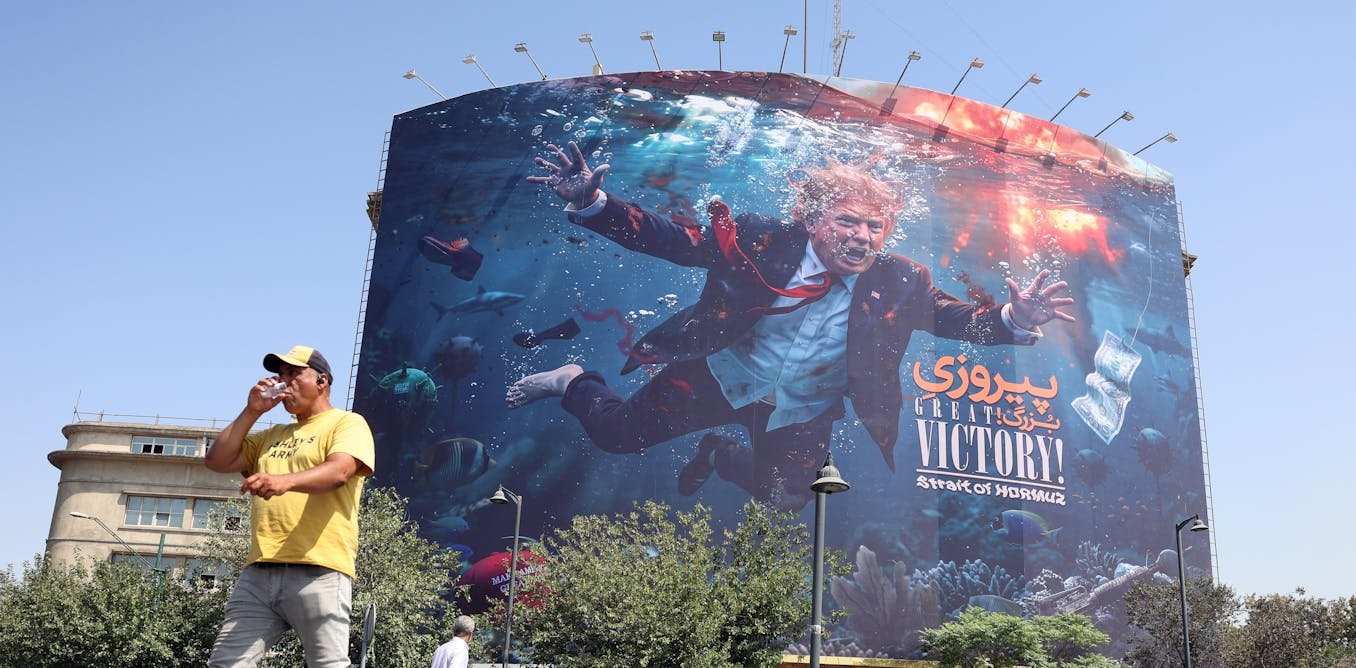
Military pressure may actually reinforce Tehran’s longstanding strategic calculation. Iran cannot match the US conventionally, so it has relied on its ability to weaponise geography via its control of the Strait of Hormuz. And it’s this leverage, basically, that has caused the military stalemate.
Before the present conflict, approximately 20.9 million barrels of oil passed through the strait each day – equivalent to around 20% of global petroleum consumption and one-quarter of internationally traded maritime oil. Existing Saudi and Emirati pipelines bypass only a fraction of that volume.
Traffic through Hormuz is now around 90% below pre-conflict levels. And the implications extend beyond Iran. In August, Iran granted special permission for Iraqi oil tankers to pass through the strait following diplomatic efforts by Baghdad. Iraq – one of the world’s great oil producers – effectively required Tehran’s consent to move some of its own oil through the Gulf.
This dramatically complicates secondary sanctions. Washington can threaten countries with exclusion from American markets if they continue trading with Iran. Tehran can now demonstrate that countries supporting American economic warfare may face consequences affecting the energy routes upon which their economies depend.
Making Iran poorer not the same as making it weaker
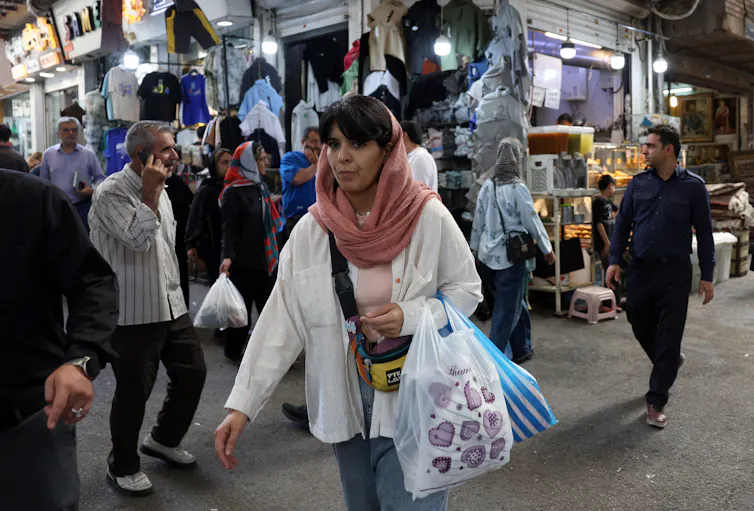
None of this means sanctions are harmless. They can devastate living standards, accelerate inflation and place enormous pressure on ordinary Iranians. And there can be little doubt that Iran’s economy is suffering at present. Inflation is currently running at 66%, according to official data from the Statistical Centre of Iran reported by Iranian Labour News Agency. The rial now stands at a historic low of more than 2 million to the US dollar on the open market.
But impoverishing a country and changing the strategic behaviour of its government are different objectives. Iran’s history suggests that pressure repeatedly produces adaptation: alternative markets, financial networks, missiles, drones and relationships with regional actors.
The lesson of the Obama period is therefore easily misunderstood. Sanctions were most successful not when they became an end in themselves, but when pressure ultimately produced diplomacy and the 2015 nuclear agreement.
Sanctions can provide leverage for negotiation. But when sanctions become the strategy itself, Washington risks repeating a familiar mistake. It may make Iran considerably poorer. It should not assume that makes Iran weaker.