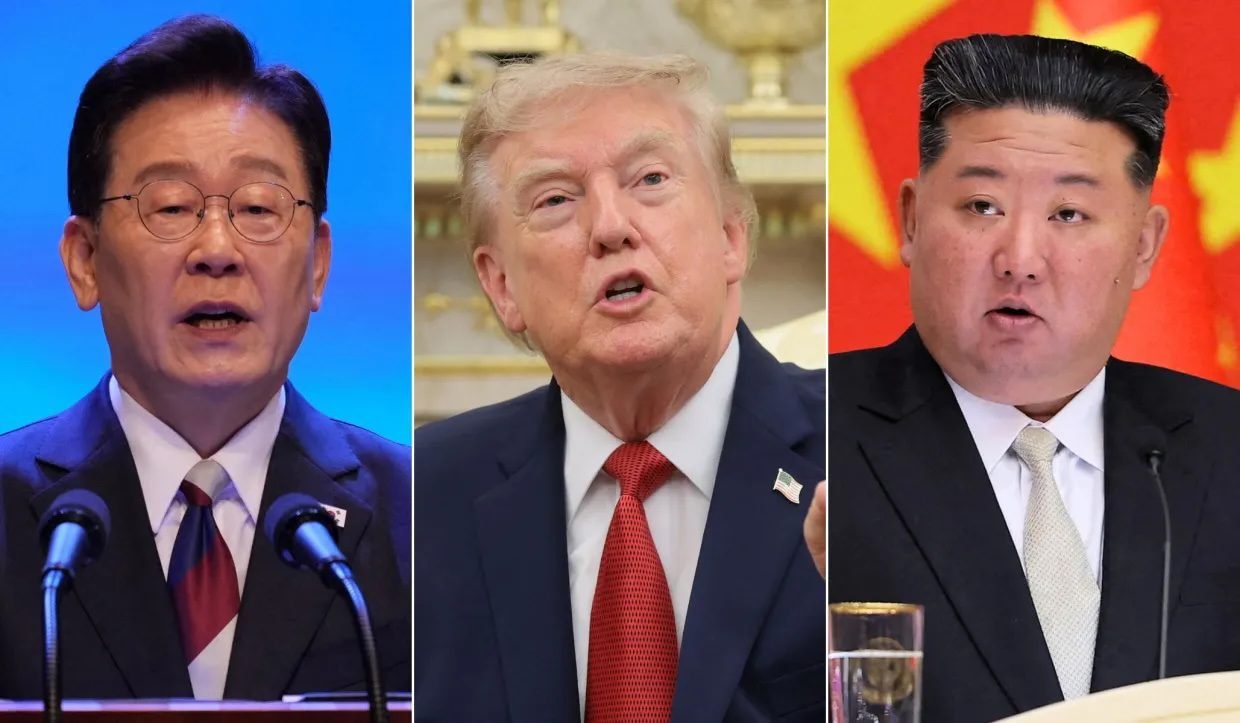
NEW YORK — Of all the indignities South Korean President Lee Jae Myung expected to face in 2026, being run over by Donald Trump probably wasn’t one of them.
The tire marks are fresh, too, as the US president throws Lee’s economy and geopolitical priorities under the bus in real time. It hardly takes a financial Nostradamus to see that higher tariffs may soon be headed Seoul’s way.
Since taking office in June 2025, managing Seoul’s fraught relationship with Trump World has been a top challenge for the Lee administration — including slow-walking Trump’s demand for a $350 billion “signing bonus” in exchange for less punishing tariff rates.
In August 2025, Lee won rave reviews all around for a cordial, even jovial summit with Trump — the kind of reception Ukraine’s Volodymyr Zelensky can only dream of. In a post-meeting analysis headlined “South Korea’s Very Good Day in the Oval Office,” Politico gushed about Lee’s “unscathed, even charming” rapport with the notoriously transactional US leader.
A year later, things look very different. Trump is scrapping military exercises with South Korea, apparently after a phone call with North Korean dictator Kim Jong Un. He’s made clear that Lee’s administration disappointed him by declining to support the US war effort against Iran .
Trump claims he’d asked Lee,”‘Would you like to give us a little hand? We don’t need help with Iran, but if you’d like, give us a hand with Iran.’ He said, ‘No thanks,’ and I said, ‘Wait a minute. We have 39,000 soldiers over there, guarding you from Kim Jong Un, your next-door neighbor, and you’re not going to help us on a very easy military operation in Iran. That’s strange.’”
The US president went on to say that he “didn’t like the fact that we’re doing these massive military exercises really against North Korea,” which “I thought that was very insulting to somebody that, frankly, has been, during my term at least, very well-behaved.”
Also last week, Trump’s Defense Department pulled its only remaining Pacific-based aircraft carrier to the Middle East — welcome news for Xi Jinping in Beijing, but an anxiety-inducing pivot for Taiwan despite Trump World’s insistence that it still has its Asian allies’ backs.
“Unfortunately, the Trump administration’s recent actions suggest the opposite: that the White House is shifting its priorities away from Asia, by necessity and choice,” says Joshua Kurlantzick, an analyst at the Council on Foreign Relations.
As a result, Kurlantzick adds, “Asian allies and partners are becoming increasingly concerned that they can no longer depend on US security guarantees, potentially leading them to move closer to China – or simply facilitating an intra-Asia arms race as they scramble to provide for their own defenses.”
Nowhere are officials watching more warily than in Tokyo, which is bracing for Trump’s demand of a $550 billion signing bonus of its own. No Asian country moved faster to court Trump after his initial victory in 2016. Days after the win, then-Prime Minister Shinzo Abe became the first world leader to rush to Trump Tower to meet the reality-TV-star-turned-politician.
Over time, buyer’s remorse set in. Abe’s deference didn’t spare Japan from the Trump 1.0 tariffs on steel and aluminum. Three days into his first term, Trump withdrew from the Trans-Pacific Partnership — undoing, in an instant, Tokyo’s decades-long strategy of dismantling trade barriers to help contain China. Trump also railed early and often against the weak yen on social media.
Trump’s overtures to Kim, made with little regard for Tokyo’s security concerns, cost Abe’s foreign ministry plenty of sleep. And word that Trump had pressured Abe into nominating him for a Nobel Peace Prize embarrassed Japan’s diplomatic corps.
Since taking the premiership last October, Sanae Takaichi has worked hard to stay in Trump’s good graces — with mixed results, as Trump slaps fresh tariffs on Tokyo anyway. Now add Trump’s newfound warmth toward Kim’s regime to the mix, and things could get rockier still, especially as Trump grows impatient with Tokyo and Seoul for not moving faster to pay the hundreds of billions of dollars he’s demanding.
The $350 billion Trump wants from Seoul equals roughly 18% of Korea’s GDP — a sum large enough to push the economy back to the brink of collapse.
“Without a currency swap, if we were to withdraw $350 billion in the manner that the US is demanding and to invest this all in cash in the US, South Korea would face a situation as it had in the 1997 financial crisis,” Lee said in September 2025.
At the time, Korea’s National Security Adviser Wi Sung-lac left no doubt that Seoul had ruled out handing over 70% of this year’s national budget and 80% of its foreign exchange reserves in one lump payment. “Our position is not a negotiating tactic,” he said. “It’s objectively and realistically not a level we are able to handle. We are not able to pay $350 billion in cash.”
Georgetown University’s Victor Cha argues that the confusion surrounding US policy in North Asia is proof that “the international system is in a state of disorder.” Among the reasons: the wars in Europe and the Middle East, the US-China power competition, the growing assertiveness of autocratic states and the weaponization of economic interdependence and trade.
“For US allies and partners in Asia and Europe, the additional variable creating disorder is the increasing unpredictability of the United States,” Cha explains. “They are witnessing a paradigm shift in US policies. ‘America First’ policies no longer value alliances as intrinsic goods and power assets for the US. Rather, alliances are viewed as expensive obligations and power liabilities that exploit US generosity. The US presses instead for transactional deals without much thought given to the deeper investments in these relationships.”
The erosion of these norms has left officials in Seoul and Tokyo reeling. Part of their strategy now is simply to stall — dragging out negotiations after the Supreme Court ruled the White House’s tariffs violate the Constitution. Officials in both capitals understand that clawing the money back from Trump World afterward would be a fool’s errand.
Trump’s move “resonates not just in Korea but across the entire Indo-Pacific because everyone’s wondering whether or not their relationship with the United States is as unstable as the Koreans,’” Ian Brzezinski, who served as deputy assistant secretary of Defense for European and NATO Policy under President George W. Bush, tells Politico.
The White House’s decision to throw Korea under the bus comes at a brutal moment for the economy — even as the AI trade sends Seoul’s stock market skyward. And perhaps too much, too fast.
In the first 20 days of August, Korea’s exports surged 61.5% year-on-year, confirming that AI demand is powering the economy and bolstering the case for further interest rate hikes. Semiconductor exports soared 198.8% year-on-year, while shipments of computer-related products jumped 242.1%.
With AI still booming, investors barely seemed to notice that automobile exports fell roughly 45%, or that a jump in US Treasury yields could destabilize Asian markets. Adding to the drama: a US Treasury move to support long-duration bonds through buybacks.
“While buybacks alone are unlikely to alter longer-term fundamentals, they do signal willingness by policymakers to lean against further yield increases,” says Lloyd Chan, a strategist at MUFG Bank. “This suggests the relative-rate story that has supported the dollar is fading.”
As yields on the debt underpinning Korean assets climb, Asia’s fourth-biggest economy is in harm’s way. Geopolitical shocks increases risks for Korea’s trade-reliant economy, reduces the odds MCSI will upgrade the Kospi index to developed market status and throws Lee’s legislative prospects into disarray. Amid so much uncertainty, having to watch out for Trump’s wheels is the last thing Seoul needs.