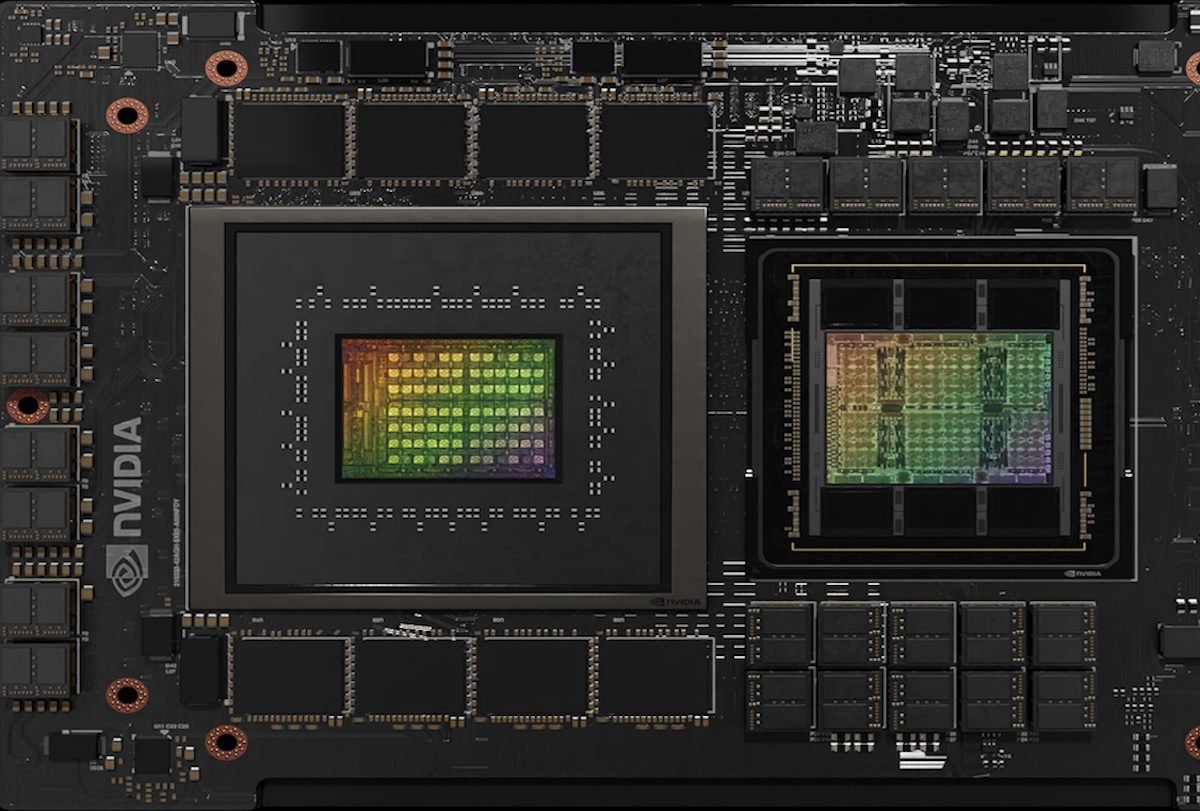
Nvidia’s newly unveiled plan to mobilize more than US$500 billion in third-party financing for artificial intelligence (AI) data centers is expected to deepen its global dominance and reduce the competitiveness of Chinese chips in global markets.
The company said on Monday it had signed memoranda of understanding with six of the world’s largest financial institutions, including BlackRock, Blackstone and Goldman Sachs, to create dedicated compute financing platforms that will help customers buy its chips and build so-called AI factories.
The financing platforms are designed to turn Nvidia’s compute and full-stack AI infrastructure into an investable asset class, giving global capital providers exposure to long-duration and usage-linked revenue tied to its chips.
Some Chinese pundits said the move is expected to deal a broad setback to China’s AI development. They pointed to three main risks:
- deeper reliance on Nvidia’s compute unified device architecture (CUDA) software ecosystem,
- rising prices for imported high-end chips and
- fewer opportunities for Chinese AI chips overseas.
“Investors worry this is essentially a closed-loop game of moving money from one hand to the other,” says Lai Jiaqi, a writer at Guancha.cn. “Nvidia provides the financing, customers use it to buy Nvidia chips and that spending feeds back into Nvidia’s revenue growth, relying on external leverage to artificially create chip demand rather than reflect real demand in the industry.”
“As Wall Street offers customers loans to buy Nvidia’s chips, financial risks increase significantly,” she says. “If returns from AI applications fall short of expectations, it could trigger something like the subprime mortgage crisis of 2008.”
Lai warns that Nvidia and its financial partners could face regulatory scrutiny if the boom turns into a bust. During the 2008 financial crisis, executives at major American financial institutions were called before Congress to answer for the systemic risks created by the subprime mortgage collapse, credit default swaps (CDS) and other complex financial products.
“Financial leverage will reinforce the lock-in of the CUDA ecosystem, and global AI research and model training will become even more dependent on Nvidia hardware,” writes an Anhui-based columnist using the pen name “Irresistible Freedom.” “That will narrow the technology paths available and reduce diversity across the global AI industry.”
“Cheap financing will also fuel blind expansion of computing capacity,” he writes. “Supply of high-end computing power will exceed demand within two to three years. Graphics processing units (GPUs) that depreciate 30% to 40% a year are financed with debt that runs five to 10 years, so falling demand or rents could shrink collateral values and trigger a wave of defaults.”
He adds that chips made by Chinese firms, such as Cambricon Technologies, Hygon Information Technology and Biren Technology, will lose cost advantage overseas as foreign data centers can borrow cheaply to buy Nvidia GPUs.
The intensifying competition between China and the US in computing power has begun to squeeze profit margins at some Chinese technology giants.
Tencent Holdings, the operator of the WeChat messaging app, saw its revenue up 11% to 204.8 billion yuan in the three months ended June 30 from a year earlier, but net profit rose just 0.7% to 56 billion yuan, missing forecasts, as capital expenditure on AI nearly tripled to 52.8 billion yuan.
Hardware curbs widen
Some Chinese commentators say Nvidia’s plan may create new opportunities for Chinese data center equipment suppliers, as large-scale expansion of overseas AI factories directly boosts domestic hardware exports, with server, liquid cooling and high-speed connector suppliers standing to benefit.
Whether that optimism is justified remains uncertain, since Washington is working to bar American data centers from using Chinese-made components.
The Federal Communications Commission (FCC) is drafting a rule that would ban imports of Chinese-made optical transceivers, hardware used in data centers to convert electrical signals into light for high-speed transmission. Sources told Reuters the agency wants the rule published in time to take effect before the end of the year.
The Trump administration fears the components could be used to steal data, install malware or disrupt operations at data centers seen as critical to the AI boom.
Amid rising US-China tensions, many American AI data centers already under construction have avoided Chinese components to preempt any tightening of the rules.
Meanwhile, China is also building its own mechanism for data centers to securitize their AI computing power and raise fresh cash for expansion.
In March 2026, Zhang Yunquan, a member of the National Committee of the Chinese People’s Political Consultative Conference (CPPCC) and a researcher at the Chinese Academy of Sciences, suggested China establish an AI computing power bourse, saying trading mechanisms for computing power lag far behind the infrastructure itself.
“High-end GPU resources are concentrated in large tech companies, and market information is severely asymmetric,” Zhang said. “Trading of computing power is still dominated by bilateral deals with no unified price index or risk management tools.”
He said China should explore futures and options on computing power and, in the longer term, securitize computing power assets as tradable products to broaden financing channels. He predicts China could launch such products within two to three years.
In March 2026, Shanghai began accepting applications for national computing power interconnection nodes, building a unified system of identification, standards and rules to underpin a future computing power exchange.
In June, Shanghai issued guidelines to prepare for computing power futures as part of its push to become a global asset management hub. That same month, 21Vianet Group, a Nasdaq-listed Chinese data center operator, completed two computing power-linked REITs (real estate investment trusts) worth more than 6.3 billion yuan (US$930 million), a further step toward scaling up securitization.
Taiwanese economist and commentator Lang Xianping says the AI race between China and the United States will inevitably create asset bubbles. But he says people should not be overly worried about a bubble bursting, as eventually all the infrastructure built will be turned into real productivity tools.
Read: AI race loss fears behind Trump’s planned September hosting of Xi
Follow Jeff Pao on X at @jeffpao3